Navigating the world of cryptocurrency can feel like learning an entirely new language — one where a single mistake can cost you everything. If you’re setting up your first digital vault (whether a software wallet like Electrum, a mobile app like Trust Wallet, or a hardware device like Ledger or Trezor), you’ve probably come across confusing terms: public key vs wallet address, recovery phrase vs private key wallet, BIP39 seed words, and more.
Mastering these concepts is the absolute foundation of secure wallet key management. Once you understand how they work together, you’ll never again worry about “losing access” to your Bitcoin or falling for common scams. Let’s break everything down clearly, step by step.
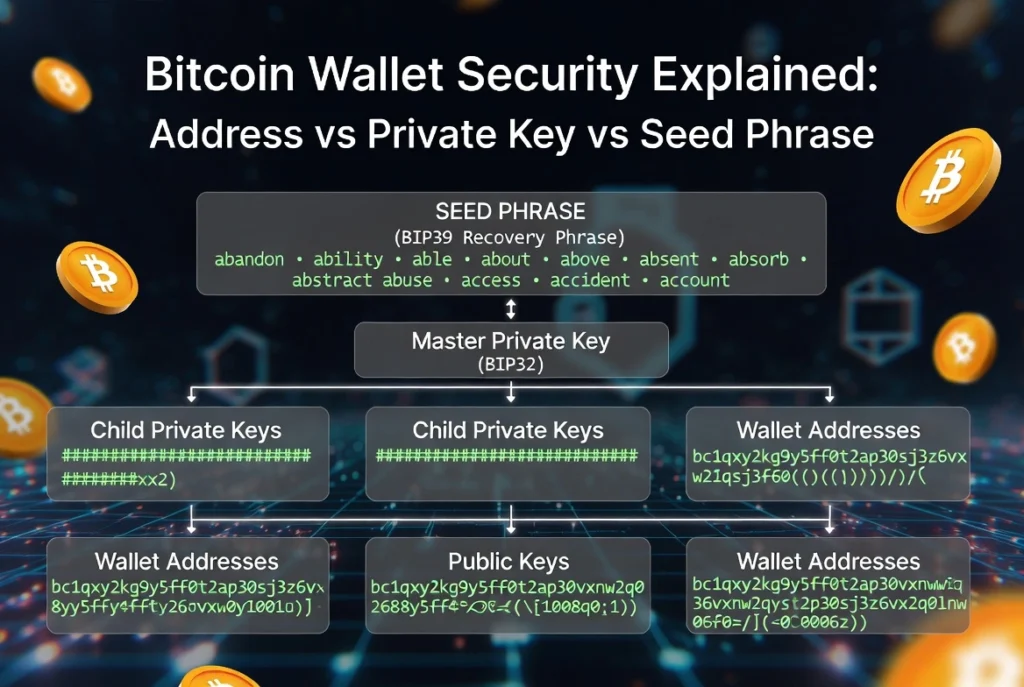
Table of Contents
What Is a Bitcoin Wallet Address?
Think of your wallet address exactly like your bank account number or an email address you give to friends. It’s the public destination where people send you Bitcoin.A typical Bitcoin address looks like this:
bc1qxy2kdy8f3zq… (a Bech32 address)
or the older format: 1A1zP1eP5QGefi2DMPTfTL5SLmv7DivfNaTechnically, a wallet address is a hashed and encoded version of your public key. The hashing process (using SHA-256 and RIPEMD-160) turns the long public key into a much shorter, user-friendly string. This is why addresses are safe to share publicly — they only allow people to send you money, never to spend it.
You can generate as many addresses as you want from the same wallet (especially with modern HD wallets), which helps protect your privacy.
What Is a Public Key?
Most beginners skip over this one, but it’s important. Your public key is derived mathematically from your private key using elliptic curve cryptography (secp256k1). It’s longer than an address and looks like a long string starting with “02” or “03”.
The public key proves to the Bitcoin network that you are the rightful owner when you spend funds, without ever revealing your private key. Your wallet automatically converts the public key into the shorter address format for everyday use.
What Is a Private Key Wallet?
If the wallet address is your bank account number, the private key is your PIN + signature + password all rolled into one — and it must remain 100% secret. A private key is a 256-bit number, usually displayed as a long hexadecimal string (64 characters) or in Wallet Import Format (WIF) starting with “5”, “K”, or “L”. Example (never use this one):
5Kb8kLf9zgWQnogidDA76MzPL6TsZZY36hWXMssSzNydYXYB9KFWhen you send Bitcoin, your wallet uses this private key to create a digital signature.
The network verifies the signature against your public key/address. If someone obtains your private key, they can instantly drain your entire balance — no password required. This is why the debate between custodial vs non-custodial wallets matters so much:
- Non-custodial (you control the keys): Exodus, Electrum, BlueWallet, hardware wallets.
- Custodial (exchange holds the keys): Binance, Coinbase, Kraken — convenient but “not your keys, not your coins.”
What Is a Seed Phrase (Recovery Phrase / BIP39 Seed Words)?
This is the most misunderstood part of Bitcoin security.
A seed phrase (also called recovery phrase or mnemonic) is a human-readable “master key” consisting of 12, 18, or 24 common English words. It is generated using the BIP39 standard (Bitcoin Improvement Proposal 39).
Examples of words you might see:
abandon ability able about above absent absorb abstract absurd abuse access accidentThese 12–24 words contain 128 to 256 bits of entropy — enough to generate billions of possible private keys and addresses.
Your entire wallet (all addresses, all private keys) can be recreated from this single phrase.That’s why losing your seed phrase = losing your Bitcoin forever. And why writing it down correctly is critical.
Key Differences: Seed Phrase vs Private Key vs Wallet Address
| Component | Controls | Format | Can Be Shared? | Risk if Exposed |
|---|---|---|---|---|
| Wallet Address | Receiving funds only | Alphanumeric string (26–62 chars) | Yes, publicly | None (only receive) |
| Public Key | Verifying ownership | Long hex string | Yes | Low |
| Private Key | One specific address | 64-char hex or WIF | Never | Total loss of that address |
| Seed Phrase | Entire wallet (all keys) | 12–24 dictionary words | Never | Total loss of everything |
Summary:
- Private key = controls one address.
- Seed phrase = controls all addresses and private keys in your wallet.
- You almost never touch individual private keys manually. The seed phrase is what you back up.
How They Work Together (Simple Flow)
- Your seed phrase generates your master private key (BIP32/44).
- Master private key derives child private keys → public keys → wallet addresses.
- When you receive Bitcoin → funds go to one of your addresses.
- When you send → wallet signs the transaction with the corresponding private key.
This hierarchical structure (HD wallets) lets you create unlimited addresses from one seed phrase.
Wallet Backup Best Practices (2026 Edition)
Follow these rules religiously:
- Never store it digitally — No screenshots, no cloud notes, no email, no password managers (unless using advanced offline air-gapped methods).
- Physical backups only — Write it on acid-free paper, or better, engrave on stainless steel or titanium plates (fireproof up to 2,500°F).
- Use metal backups — Products like Billfodl, Cryptosteel, or PlateMate are popular for a reason.
- Create multiple copies in separate secure locations — One at home (fireproof safe), one with a trusted family member (in a sealed envelope), or split using Shamir’s Secret Sharing.
- Test your backup immediately — After writing it down, wipe your wallet app and restore using only the seed phrase on a different device. Do this before sending significant amounts.
- Never enter your seed phrase on any website — Real support will never ask for it.
- Consider a passphrase (BIP39 optional extra word) — Adds an extra 25th word (can be anything) for plausible deniability and extra security.
Common Pitfalls New Users Make
- Taking a photo of the seed phrase “just in case.”
- Saving it in Google Drive or iCloud.
- Trusting a “wallet recovery service” that asks for the phrase.
- Using the same seed phrase across multiple wallets without understanding derivation paths.
- Ignoring the difference between 12-word and 24-word seeds (24-word is stronger).
Final Thoughts: Your Keys, Your Bitcoin
Understanding the difference between your Bitcoin wallet address, private key, and seed phrase transforms you from a nervous beginner into a confident, self-sovereign user. Remember the golden rule of cryptocurrency:
“Not your keys, not your coins.”If you control your seed phrase, you control your money — no bank, no government, no exchange can freeze or seize it. Take the time to back it up properly today. Your future self (and your portfolio) will thank you.
Bookmark this guide, share it with friends who are new to Bitcoin, and always verify everything yourself. Welcome to true financial sovereignty.
Need help choosing a wallet?
I use Ellipal https://www.ellipal.com/?rfsn=8407498.1aab7c6
Hardware (most secure): Ledger, Trezor, Ellipal
Mobile (convenient + secure): BlueWallet, Muun, Sparrow (desktop) Stay safe out there — and always keep your seed phrase offline.
1 thought on “Bitcoin Wallet Address vs Private Key Wallet vs Seed Phrase: Ultimate Guide”
Comments are closed.