What is Bitcoin mining?
Bitcoin is a digital currency that uses a process called mining to secure its network and validate transactions. Bitcoin mining is a network-wide competition to generate a cryptographic solution that matches specific criteria. When a correct solution is reached, a reward in the form of bitcoin and fees for the work done is given to the miner(s) who reached the solution first.
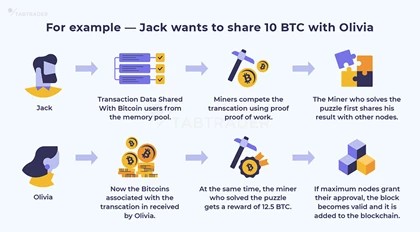
Bitcoin mining explained in simple terms: it’s the process that keeps the Bitcoin network running, secure, and decentralized.
At a basic level, Bitcoin mining is how transactions are verified and added to the blockchain, which is a public ledger of all Bitcoin activity. Every time someone sends Bitcoin, that transaction needs to be checked and confirmed—and that’s where miners come in.
Miners are computers (often very powerful ones) that compete to solve complex mathematical problems. When one of them solves the puzzle, they get to add a new “block” of transactions to the blockchain.
As a reward, they receive:
- Newly created Bitcoin (called the block reward)
- Transaction fees from the transactions in that block
This is how new bitcoins enter circulation—no central bank, no authority, just code.
Bitcoin mining basics also include something called proof of work, which is the system that ensures miners actually do real computational work before adding blocks. It’s what makes Bitcoin secure and resistant to fraud.
So when people ask, “what is Bitcoin mining?”—it’s really a mix of:
- Transaction validation
- Network security
- And new Bitcoin creation
Table of Contents
🧠 Why Bitcoin mining exists
To understand Bitcoin mining basics, you need to understand why it exists in the first place.
Traditional financial systems rely on banks or payment processors to verify transactions. Bitcoin doesn’t. Instead, it uses a decentralized network where anyone can participate.
Bitcoin mining is the mechanism that replaces trust with math.
Here’s what mining actually does for the network:
- Prevents double-spending (you can’t spend the same Bitcoin twice)
- Secures the blockchain against tampering
- Maintains consensus across thousands of nodes
- Removes the need for central authorities
Miners compete to add blocks, but once a block is added, it becomes extremely difficult to change. That’s because altering one block would require redoing all the work for every block after it.
This is why Bitcoin is considered immutable.
Without mining, Bitcoin wouldn’t just slow down—it would completely stop functioning as a secure system.
📦 Bitcoin mining Explained basics: blocks, transactions, and the mempool
Where transactions live before mining (mempool)
Before transactions are confirmed, they sit in something called the mempool (short for memory pool).
Think of it as a waiting room:
- Users send transactions
- They wait in the mempool
- Miners pick them up
Transactions with higher fees usually get picked first.
How miners build a block
Miners select transactions from the mempool and group them into a block.
Each block has:
- A list of transactions
- A timestamp
- A reference to the previous block
- A special number called a nonce
What’s inside a Bitcoin block?
A Bitcoin block includes key components:
- Block header
- Merkle root (a summary of all transactions)
- Difficulty target
- Nonce
- Transaction data
All of this is bundled together and then hashed during the mining process.
This is the foundation of how Bitcoin mining works—and it’s one of the most important Bitcoin mining basics to understand.
Proof of work and the Mining puzzle
What is proof of work?
Proof of work is the core of Bitcoin mining explained.
It means:
- Miners must perform computational work
- The solution is hard to find but easy to verify
🔐 The SHA-256 hashing process
Bitcoin uses a cryptographic function called SHA-256.
Miners take the block data and:
- Add a nonce
- Hash the block
- Check if the result meets a target
If not, they change the nonce and try again.
This process repeats millions (or billions) of times per second.
Why mining is like a lottery
Mining isn’t predictable—it’s probabilistic.
- The more computing power (hashrate) you have
- The more chances you get to solve the puzzle
Hashrate is simply how many guesses per second your machine can make.
This is why large mining operations dominate—they have more “tickets” in the lottery.
When you understand Bitcoin mining basics, you’ll fully understand how Bitcoin mining works.
⏱️ Mining difficulty and block time
📉 What is mining difficulty?
Mining difficulty controls how hard it is to find a valid block.
Bitcoin adjusts this automatically every 2,016 blocks (~2 weeks).
⏳ Why block time stays around 10 minutes
Bitcoin aims for:
- 1 block every 10 minutes
If too many miners join:
- Difficulty increases
If miners leave:
- Difficulty decreases
This self-adjusting system keeps Bitcoin stable and predictable—one of the smartest parts of Bitcoin mining basics.
💰 Block rewards, halving, and why miners get paid
🏆 What is the block reward?
When a miner successfully adds a block, they receive:
- Newly created BTC
- Transaction fees
This reward is the main incentive for mining.
✂️ What is Bitcoin halving?
Every 210,000 blocks (~4 years), the block reward is cut in half.
This is called halving.
Example:
- 2020: 6.25 BTC
- 2024: 3.125 BTC
📈 Why halving matters
Halving reduces the supply of new Bitcoin entering the market.
This:
- Increases scarcity
- Changes mining economics
- Makes transaction fees more important over time
Eventually, miners will rely mostly on fees instead of new BTC.
💻 Bitcoin mining hardware and software basics
🛠️ Bitcoin mining hardware
Early Bitcoin mining used CPUs and GPUs, but today:
👉 ASIC miners dominate
ASIC = Application-Specific Integrated Circuit
They are:
- Faster
- More efficient
- Designed specifically for SHA-256
🧑🤝🧑 Mining pools vs solo mining
Most miners join mining pools, where they combine power and share rewards.
- Solo mining → rare but higher reward You can read this Jingleminer review on solo lottery miners.
- Pool mining → consistent but smaller payouts
🧰 Mining software basics
Mining software connects your hardware to the network or pool.
It:
- Sends work to your machine
- Receives results
- Tracks performance
📊 Bitcoin mining Explained summary:
| Concept | What it is | Why it matters |
|---|---|---|
| Bitcoin mining | Validating transactions and creating blocks | Secures the network |
| Proof of work | Computational puzzle using SHA-256 | Prevents fraud and attacks |
| Block reward | New BTC given to miners | Incentivizes participation |
| Halving | Reward reduction every 4 years | Controls supply |
| Mining difficulty | Puzzle complexity | Keeps block time stable |
Mining and Bitcoin Supply
Mining is not just about securing the network—it is also how new Bitcoin is created.
Every time a new block is mined, the miner receives a block reward, which includes newly issued Bitcoin. This is the mechanism that introduces new coins into circulation.
Over time, this reward decreases through halving events, reducing the rate at which new Bitcoin is created.
This is what creates Bitcoin’s predictable and limited supply.
👉 Learn more:
Bitcoin Supply & Halving → /bitcoin/bitcoin-supply
Further Reading: Go Deeper Into Bitcoin Mining
If you want to go beyond the basics, these guides break down mining in more detail:
Mining Economics
Understand profitability, costs, and how miners operate in competitive environments.
👉 Bitcoin Mining Economics → /bitcoin-mining-economics
How Miners Earn Rewards
Learn exactly how miners make money from block rewards and transaction fees.
👉 How Bitcoin Miners Earn Rewards → /bitcoin/how-bitcoin-miners-earn-rewards
Where Mining Fits in the Bitcoin System
Mining connects several core parts of Bitcoin:
- Security: protects against double-spending
- Consensus: ensures all nodes agree on the same blockchain
- Supply: introduces new Bitcoin into circulation
- Transactions: confirms and records transfers
Understanding mining helps you see how the entire system works together.
FAQs: Bitcoin Mining Explained
What is Bitcoin mining and how does it work?
Bitcoin mining is the process of validating transactions and adding them to the blockchain using proof of work.
What is proof of work in Bitcoin mining?
It’s a system where miners solve cryptographic puzzles to secure the network and verify transactions.
What is the block reward in Bitcoin?
It’s the Bitcoin miners receive for successfully mining a block, including new BTC and transaction fees.
What is Bitcoin halving?
A scheduled event that cuts the block reward in half every 210,000 blocks.
How does mining difficulty work?
Bitcoin adjusts difficulty every two weeks to maintain a 10-minute block time.
What hardware is needed for Bitcoin mining?
Modern mining requires ASIC miners, which are specialized machines designed for SHA-256 hashing.
Is Bitcoin mining still profitable for beginners?
It can be, but it depends heavily on electricity costs, hardware efficiency, and Bitcoin price.
Conclusion
Bitcoin mining explained simply: it’s the backbone of the Bitcoin network. It validates transactions, secures the system, and introduces new bitcoins into circulation—all without a central authority.
Understanding Bitcoin mining basics—from proof of work to block rewards—gives you a solid foundation for navigating the crypto space. Whether you’re just curious or thinking about getting involved, knowing how Bitcoin mining works helps you see why it’s such a powerful and revolutionary system.