A spot Bitcoin ETF gives investors exposure to Bitcoin through a traditional exchange-traded fund instead of buying and storing BTC directly. Since U.S. spot Bitcoin ETFs launched in January 2024, they have become one of the easiest ways for investors to access Bitcoin through brokerage accounts, retirement accounts, and standard stock-market platforms. The SEC approved the first U.S. spot Bitcoin exchange-traded products in January 2024, opening the door for major issuers such as BlackRock, Fidelity, ARK, Bitwise, VanEck, and Grayscale.
For 2026, the big question is no longer just “what is a spot Bitcoin ETF?” The better question is: which spot Bitcoin ETF is best for your strategy? The answer depends on fees, liquidity, custody, tax setup, account type, and whether you want a buy-and-hold Bitcoin ETF or a more active trading vehicle like BlackRock’s IBIT.
What Is a Spot Bitcoin ETF?
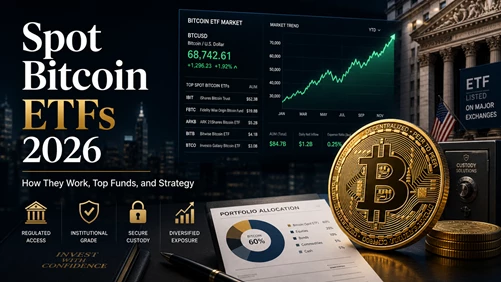
A spot Bitcoin ETF is an exchange-traded fund that aims to track the price of Bitcoin by holding actual Bitcoin. That is different from older Bitcoin futures ETFs, which track futures contracts rather than directly holding BTC. The key idea is simple: a spot Bitcoin ETF is designed to reflect the value of Bitcoin held by the trust, minus expenses and liabilities. BlackRock describes IBIT this way, and Grayscale uses similar language for GBTC and BTC.
A spot Bitcoin ETF trades like a stock during market hours. You can buy shares through many normal brokerage accounts, track the ETF price in real time, and compare the fund’s performance against Bitcoin. This makes spot Bitcoin ETFs 2026 much easier for traditional investors than setting up a crypto exchange account, learning wallet security, and managing private keys.
The main difference between a spot Bitcoin ETF and a futures-based Bitcoin ETF is what the fund owns. A spot Bitcoin ETF owns Bitcoin. A futures ETF owns Bitcoin futures contracts, which can create tracking differences because of contract rollover costs and futures-market structure. For investors who want simpler Bitcoin price exposure, spot Bitcoin ETFs are usually more direct.
However, a spot Bitcoin ETF is not the same as owning Bitcoin directly. You own ETF shares, not private keys. That difference matters.
Spot Bitcoin ETF vs Buying Bitcoin Directly
The debate around Bitcoin ETF vs buying Bitcoin directly comes down to convenience versus control.
A spot Bitcoin ETF is convenient. You can buy it inside a brokerage account, potentially inside an IRA or retirement-style account, and you do not need to manage seed phrases, hardware wallets, or exchange withdrawals. Fidelity, for example, markets its crypto funds as a way to add crypto exposure in brokerage, trust, and IRA accounts.
Buying Bitcoin directly gives you more control. If you hold BTC in self-custody, you can move it 24/7, use it on-chain, and truly control the asset with your own private keys. You are not dependent on an ETF issuer, custodian, broker, or stock-market trading hours.
Here is the simple comparison:
| Feature | Spot Bitcoin ETF | Buying Bitcoin directly |
|---|---|---|
| Ownership | ETF shares | Actual BTC |
| Private keys | No | Yes, if self-custodied |
| Trading hours | Stock-market hours | 24/7 |
| IRA access | Easier | More limited |
| Annual fee | Usually yes | No ETF fee |
| Self-custody | No | Yes |
| Simplicity | High | Medium to advanced |
For beginners, a spot Bitcoin ETF may feel easier. For Bitcoin-native users, direct BTC and self-custody may be more aligned with Bitcoin’s original purpose.
The real decision is not only “spot Bitcoin ETF vs buying Bitcoin directly.” It is also about where the exposure fits. A Bitcoin ETF in IRA accounts can make sense for retirement-style exposure. Direct BTC can make sense for long-term sovereign custody. Some investors use both.
Top Spot Bitcoin ETFs in 2026
The U.S. spot Bitcoin ETF list includes several major funds, but the biggest names are BlackRock IBIT, Fidelity FBTC, Grayscale GBTC, Grayscale Bitcoin Mini Trust BTC, ARK 21Shares ARKB, Bitwise BITB, and VanEck HODL.
Fees and assets can change, so always check the issuer page before investing. As of recent issuer and market data, IBIT has a 0.25% expense ratio, FBTC is commonly listed at 0.25%, GBTC remains much higher at 1.50%, and Grayscale Bitcoin Mini Trust BTC is listed at 0.15%.
| ETF | Ticker | Expense ratio | Custody / structure | Best use case |
|---|---|---|---|---|
| iShares Bitcoin Trust ETF | IBIT | 0.25% | Spot Bitcoin exposure | Liquidity, active trading, options |
| Fidelity Wise Origin Bitcoin Fund | FBTC | 0.25% | Fidelity crypto exposure | IRA-style accounts, Fidelity users |
| Grayscale Bitcoin Trust ETF | GBTC | 1.50% | Legacy spot Bitcoin trust ETF | Existing holders with tax considerations |
| Grayscale Bitcoin Mini Trust ETF | BTC | 0.15% | Lower-cost Grayscale spot ETF | Buy-and-hold fee focus |
| ARK 21Shares Bitcoin ETF | ARKB | Around 0.21% | Spot Bitcoin ETF | Balanced cost and scale |
| Bitwise Bitcoin ETF | BITB | Around 0.20% | Spot Bitcoin ETF | Lower-cost broad ETF choice |
| VanEck Bitcoin Trust | HODL | Around 0.20% | Spot Bitcoin ETF | Lower-fee buy-and-hold option |
For many investors, the best spot Bitcoin ETF depends on the strategy. IBIT is often favored for liquidity and active trading because of its scale. FBTC can be attractive for investors already using Fidelity. Grayscale Bitcoin Mini Trust BTC has one of the lowest listed expense ratios, which matters for long-term holding. GBTC is the expensive outlier, and many investors only keep it because of legacy tax-basis reasons.
A useful way to think about the best spot Bitcoin ETF in 2026 is this:
For active trading, IBIT is usually the first fund to compare because liquidity and options matter. For buy-and-hold, lower fees matter more. For IRA accounts, platform access matters. For existing GBTC holders, tax consequences may matter more than the headline expense ratio.
Spot Bitcoin ETF Fees and BTC-Per-Share Decay
Spot Bitcoin ETF fees are one of the most important long-term details. A spot Bitcoin ETF charges an expense ratio. That fee is usually paid from the fund’s assets, which means the fund slowly loses a tiny amount of Bitcoin exposure over time compared with simply holding BTC directly.
This is sometimes called BTC-per-share decay. The ETF may still track Bitcoin closely, but each share can represent slightly less BTC over time because the fund has expenses.
The difference between a 0.15% fee and a 0.25% fee may not sound huge. But over many years, it compounds. The difference between a 0.15% fee and a 1.50% fee is much larger. A 1.50% expense ratio can create meaningful long-term fee drag for a buy-and-hold Bitcoin ETF.
Example:
| Expense ratio | Approx. 10-year fee drag before compounding effects |
|---|---|
| 0.15% | About 1.5% |
| 0.25% | About 2.5% |
| 1.50% | About 15% |
This is not an exact BTC-per-share decay calculation because ETF mechanics, Bitcoin price changes, and fund operations can vary. But it shows why spot Bitcoin ETF fees matter.
For a short-term trader, liquidity and spreads may matter more than a 0.05% fee difference. For a long-term holder, the lowest-fee spot Bitcoin ETF may be more attractive because BTC-per-share decay becomes more important over time.
Spot Bitcoin ETF Custody, Options, and Strategy ETFs
A spot Bitcoin ETF does not remove custody risk. It changes who handles custody. Instead of you holding private keys, the fund uses a professional custodian. This is easier for investors, but it creates a different trust model.
Bitcoin ETF custody is a major topic because many U.S. spot Bitcoin ETFs use Coinbase Custody or other institutional custodians. Fidelity’s FBTC is notable because Fidelity Digital Assets is involved with its Bitcoin custody structure.
This creates a trade-off. Professional custody can reduce user error, lost seed phrases, and exchange withdrawal mistakes. But it also means investors are relying on the ETF issuer, custodian, broker, and legal structure.
Spot Bitcoin ETF options are another important area. IBIT has become a major vehicle for active traders because large ETF size often supports tighter spreads and deeper options markets. For active trading with IBIT, liquidity can be more important than simply choosing the lowest expense ratio.
There are also Bitcoin strategy ETFs, futures ETFs, leveraged ETFs, inverse ETFs, and covered-call Bitcoin income ETFs. These are not the same as a simple spot Bitcoin ETF.
A clean breakdown:
| Product type | What it does | Risk level |
|---|---|---|
| Spot Bitcoin ETF | Holds Bitcoin directly | High, but simple structure |
| Futures Bitcoin ETF | Uses Bitcoin futures | High, tracking can differ |
| Leveraged Bitcoin ETF | Amplifies daily moves | Very high |
| Inverse Bitcoin ETF | Bets against Bitcoin | Very high |
| Covered-call Bitcoin ETF | Uses options for income | Complex, may cap upside |
For most beginners, a simple spot Bitcoin ETF is easier to understand than futures, leveraged, inverse, or income-based Bitcoin ETFs.
Bitcoin ETF in IRA Accounts and Tax-Loss Harvesting
A major reason people use a spot Bitcoin ETF is retirement-account access. A Bitcoin ETF in IRA accounts may be easier than holding direct BTC in a retirement structure. Fidelity states that its crypto funds can be used for crypto exposure in brokerage, trust, and IRA accounts, although availability depends on the platform and account type.
This is one of the biggest advantages of spot Bitcoin ETFs 2026. Investors can get Bitcoin exposure without using a crypto exchange or managing wallets. For a Roth IRA or traditional IRA, that can be useful if the broker allows the ETF.
Tax implications are more complicated. A spot Bitcoin ETF may be taxed like a security in a brokerage account, while direct Bitcoin is treated as property in many tax systems. In the U.S., crypto tax rules and ETF tax treatment can be complex, so investors should check with a tax professional.
Bitcoin ETF tax-loss harvesting is another area where people need to be careful. Some investors may think they can sell one Bitcoin ETF at a loss and immediately buy another spot Bitcoin ETF, or sell direct BTC and buy an ETF. But wash-sale rules and “substantially identical” treatment can be legally uncertain and may change. Do not assume a Bitcoin ETF wash-sale strategy is safe without tax advice.
In simple terms: a Bitcoin ETF in IRA accounts can be convenient, but Bitcoin ETF tax implications should not be ignored.
Which Spot Bitcoin ETF Is Best for You?
The best spot Bitcoin ETF depends on what you are trying to do.
If you are a long-term buy-and-hold investor, focus on fees. A lower expense ratio can reduce BTC-per-share decay over time. In that case, funds like Grayscale Bitcoin Mini Trust BTC, Bitwise BITB, ARKB, or VanEck HODL may be worth comparing.
If you are an active trader, focus on liquidity, spreads, and options. IBIT is usually the first spot Bitcoin ETF to compare because BlackRock’s fund has become one of the largest and most actively watched Bitcoin ETFs. BlackRock lists IBIT’s expense ratio at 0.25%.
If you want a Bitcoin ETF in IRA accounts, focus on platform access. FBTC may be convenient for Fidelity users, while IBIT, ARKB, BITB, or other funds may be available through other brokers.
If you already hold GBTC, do not only look at fees. GBTC’s 1.50% expense ratio is high compared with newer spot Bitcoin ETFs, but selling may create tax consequences depending on your situation.
Here is a simple decision framework:
| Investor type | What to prioritize | Possible ETF focus |
|---|---|---|
| Buy-and-hold | Lowest fees | BTC, BITB, HODL, ARKB |
| Active trader | Liquidity and options | IBIT |
| Fidelity user | Platform convenience | FBTC |
| IRA investor | Account access and fees | FBTC, IBIT, ARKB, BITB |
| Legacy GBTC holder | Tax basis and fee trade-off | Compare GBTC vs switching |
Faq
What is a spot Bitcoin ETF?
A spot Bitcoin ETF holds actual Bitcoin (BTC) on‑chain rather than Bitcoin futures or derivatives, so its price is tied directly to the spot price of BTC. It trades like a stock on regulated exchanges, giving investors exposure to Bitcoin without needing a crypto exchange or private keys. This structure is what distinguishes spot Bitcoin ETFs from older futures‑based Bitcoin ETFs.
How do spot Bitcoin ETFs work in 2026?
In 2026, most spot Bitcoin ETFs in the US (such as IBIT, FBTC, and BTC) buy and hold BTC through custodians like Coinbase or Fidelity Digital Assets, then issue shares that track the value of that BTC minus fees. The ETF’s assets‑under‑management grow or shrink based on inflows and outflows, while the BTC‑per‑share slowly decays over time due to expense‑ratio fees paid in Bitcoin.
What are the main spot Bitcoin ETFs in 2026?
The key spot Bitcoin ETFs in 2026 include iShares Bitcoin Trust (IBIT), Fidelity Wise Origin Bitcoin Fund (FBTC), Grayscale Bitcoin Trust (GBTC), Grayscale Mini Bitcoin Trust (BTC), VanEck Bitcoin Trust (HODL), and ARK 21Shares Bitcoin ETF (ARKB). These funds differ mainly in fees, size (AUM), custody providers, and whether they are suitable for IRAs or active trading.
What is BTC‑per‑share decay in spot Bitcoin ETFs?
BTC‑per‑share decay is the gradual reduction in the amount of Bitcoin each ETF share represents, caused by the fund paying its expense ratio in Bitcoin. For example, a 0.25% fee means the ETF slowly sells small amounts of BTC from its holdings each year, which slowly reduces the BTC value per share over time. This is why long‑term holders should compare expense ratios carefully across spot Bitcoin ETFs.
How do spot Bitcoin ETF fees compare to buying Bitcoin directly?
Spot Bitcoin ETFs charge an annual expense ratio (typically 0.15%–0.25%, but up to 1.5% for legacy funds like GBTC), which long‑term investors pay as BTC‑per‑share drag. In contrast, buying Bitcoin directly on an exchange usually only involves one‑time trading fees and no annual management charge, but you must manage security, custody, and self‑custody.
Can I hold spot Bitcoin ETFs in an IRA or 401(k)?
Yes, several spot Bitcoin ETFs can be held in IRAs and some 401(k)s, especially funds like FBTC and ARKB that are widely available on brokerage platforms that support retirement accounts. However, rules vary by provider, so it’s important to confirm with your broker whether a specific spot Bitcoin ETF is IRA‑eligible and to understand any tax implications.
Are spot Bitcoin ETFs safer than holding Bitcoin on an exchange?
Spot Bitcoin ETFs shift custody risk to regulated asset managers and professional custodians (e.g., Coinbase, Fidelity), which many investors see as safer than holding coins on a retail exchange. However, you still face counterparty risk (ETF manager, custodian, and regulatory risk) and you lose direct control over private keys. Spot Bitcoin ETFs are not “self‑custody” like a hardware wallet.
Which spot Bitcoin ETF is best for long‑term buy‑and‑hold?
For long‑term buy‑and‑hold, many investors prefer the lowest‑fee spot Bitcoin ETFs, such as Grayscale Mini Bitcoin Trust (BTC) or VanEck Bitcoin Trust (HODL), because they have among the lowest expense ratios. However, you should also consider liquidity, listing platform, and tax‑basis if you already own higher‑fee funds like GBTC.
Final Thoughts on Spot Bitcoin ETFs 2026
A spot Bitcoin ETF is one of the easiest ways to get Bitcoin exposure through traditional markets. It removes the need to manage private keys, makes Bitcoin easier to hold inside brokerage accounts, and can fit into IRA-style investing strategies.
But a spot Bitcoin ETF is not perfect. You do not own the actual Bitcoin directly. You pay an expense ratio. You rely on the ETF issuer and custodian. You trade during market hours, not 24/7. And over time, BTC-per-share decay from fees can matter.
For 2026, the best spot Bitcoin ETF is not the same for everyone. IBIT may be best for active trading and options. Lower-fee funds may be better for buy-and-hold investors. FBTC may be convenient for Fidelity users. GBTC may only make sense for certain legacy holders with tax-basis considerations.
The main takeaway is simple: compare spot Bitcoin ETF fees, custody, liquidity, account access, and long-term strategy before choosing. A spot Bitcoin ETF can be a powerful tool, but it should fit your plan — not replace your research.