
Bitcoin price prediction 2026–2030 is one of the biggest topics in crypto because this period covers the most important part of the current Bitcoin market cycle. After the 2024 Bitcoin halving, the market entered a new supply environment where miners receive only 3.125 BTC per block, while spot Bitcoin ETFs have created a more institutional market structure than previous cycles. The SEC approved spot Bitcoin exchange-traded products in January 2024, which changed how traditional investors can access Bitcoin exposure.
At the time of writing, Bitcoin is trading around $77,975, with recent intraday movement between roughly $76,193 and $78,796. This Bitcoin price prediction 2026–2030 is not about guessing one magic number. Instead, it looks at Bitcoin cycles, halving effects, ETF inflows, macro liquidity, and BTC price prediction models to build realistic bull, base, and bear scenarios.
Table of Contents
How Bitcoin Cycles Shape 2026–2030
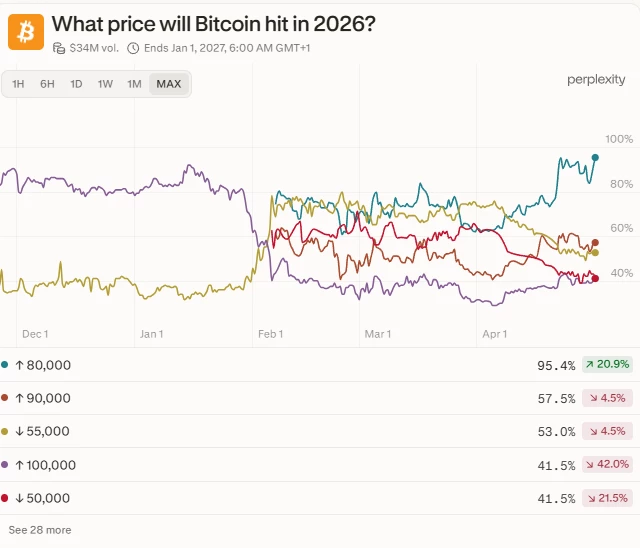
A strong Bitcoin price prediction 2026–2030 starts with the halving cycle. Bitcoin has historically moved in four-year cycles because new supply is reduced roughly every four years. The major halving dates so far were November 28, 2012, July 9, 2016, May 11, 2020, and April 19–20, 2024, depending on source timing.
| Halving cycle | Approx. halving date | Block reward after halving | Market impact |
|---|---|---|---|
| 2012 cycle | Nov. 28, 2012 | 25 BTC | First major post-halving bull run |
| 2016 cycle | July 9, 2016 | 12.5 BTC | Led into the 2017 cycle top |
| 2020 cycle | May 11, 2020 | 6.25 BTC | Led into the 2021 bull market |
| 2024 cycle | Apr. 19/20, 2024 | 3.125 BTC | Sets up the 2026–2030 forecast window |
The typical pattern is simple: halving, supply shock, accumulation, bull market expansion, cycle top, then correction. This does not happen perfectly every time, but it gives a useful framework for Bitcoin price prediction 2026–2030 cycles.
The 2024 halving is especially important because it combines reduced new supply with spot Bitcoin ETF demand. That means the post-halving bull run 2026–2027 could behave differently from earlier cycles. Bitcoin now has more institutional access, deeper liquidity, and a clearer “digital gold” narrative than it had in 2016 or 2020.
For this reason, the Bitcoin cycle 2026–2030 may not be a simple copy of the past. The cycle could become longer, more stable, or more institutionally driven. But if history rhymes, 2026 and 2027 may still represent the strongest upside window before a possible cooling period in 2028.
Key Drivers from 2026 to 2030
The first major driver in any Bitcoin price prediction 2026–2030 is ETF demand. Spot Bitcoin ETFs allow investors to gain Bitcoin exposure through traditional brokerage accounts without directly holding BTC. This makes Bitcoin easier for institutions, wealth managers, and retirement-style portfolios to access.
If ETF inflows remain strong, the spot Bitcoin ETF impact on price could be significant. Bitcoin has a fixed supply schedule, and after the 2024 halving, fewer new coins enter circulation. If ETF demand grows while long-term holders keep coins off exchanges, the supply-demand imbalance could support higher prices.
The second driver is macro liquidity. Bitcoin often performs best when financial conditions are easier, interest rates are falling, and investors are willing to take more risk. If central banks shift toward rate cuts during the 2026–2030 period, the Bitcoin macro cycle 2026–2030 could benefit from stronger liquidity.
The third driver is Bitcoin’s “digital gold” narrative. Many investors compare Bitcoin vs gold because both are seen as scarce assets. Gold has thousands of years of history, while Bitcoin has digital portability, fixed issuance, and global settlement. By 2030, a common Bitcoin valuation question will be whether BTC can capture a larger share of gold’s monetary premium.
The fourth driver is regulation. Clear rules could support adoption, while harsh regulation or ETF outflows could create downside pressure. That is why a serious BTC price forecast 2026–2030 must include both upside and downside scenarios.
Bitcoin price prediction 2026–2030: Cycle-Based Ranges
Bitcoin Price Prediction 2026 – Post-Halving Momentum
A realistic Bitcoin price prediction 2026-2030 starts with the idea that 2026 may still be inside the post-halving expansion phase. The 2024 halving reduced miner issuance, and if ETF demand continues, Bitcoin could trade in a higher range than previous cycle averages.
A base-case Bitcoin price prediction 2026 range could be $80,000 to $135,000. This assumes steady ETF inflows, improving macro conditions, and no major regulatory shock. In this scenario, Bitcoin continues grinding higher but does not enter a full euphoric blow-off top.
A bullish Bitcoin price prediction 2026 could push toward $150,000, especially if institutional demand accelerates and retail interest returns. The phrase “Bitcoin price 150,000” is important because it represents a psychological level. Once Bitcoin enters six-figure territory, market attention can increase quickly.
A bear-case Bitcoin price prediction 2026 would be closer to $60,000 to $90,000. That could happen if ETF inflows slow, risk assets sell off, or macro liquidity remains tight. Even in a bullish long-term thesis, Bitcoin can still have deep corrections.
Bitcoin Price Prediction 2027 – Potential Cycle Top
The Bitcoin price prediction 2027 is where the cycle-top debate becomes more serious. If the 2024 halving cycle follows a historical rhythm, then 2026–2027 could be the window where Bitcoin attempts a major cycle high.
A base-case Bitcoin price prediction 2027 range is $120,000 to $160,000. This would represent strong upside from current levels without assuming a full mania phase. It would also fit the idea that Bitcoin matures over time and produces lower percentage gains than earlier cycles.
A bullish Bitcoin price prediction 2027 could reach $150,000 to $250,000. This scenario requires stronger ETF demand, lower rates, growing corporate treasury adoption, and renewed retail FOMO. In this case, “Bitcoin price 150,000” becomes less of a final target and more of a breakout level.
A bear-case Bitcoin price prediction 2027 would sit around $70,000 to $110,000. That may sound disappointing, but it would still represent a market where Bitcoin holds a higher long-term base than before.
Bitcoin Price Prediction 2026-2030 – Consolidation and Long-Term Value
The Bitcoin price prediction 2028–2030 is harder because it may include both a post-cycle correction and the next halving setup. The next Bitcoin halving is expected around 2028, when the block reward should fall from 3.125 BTC to 1.5625 BTC.
For 2028–2029, a reasonable cycle-based range is $95,000 to $170,000. This assumes Bitcoin cools down after a possible 2026–2027 peak but avoids a full collapse due to stronger institutional demand.
The Bitcoin price prediction 2030 base case is $130,000 to $200,000. This range assumes Bitcoin continues to mature as a macro asset, ETFs remain active, and the market begins pricing in the next supply shock after the 2028 halving.
A bullish Bitcoin price prediction 2030 could reach $250,000 to $500,000+ if Bitcoin captures a larger share of gold’s store-of-value market, ETF inflows expand globally, and long-term holders continue reducing liquid supply. A conservative Bitcoin price prediction 2030 could remain closer to $90,000 to $155,000 if Bitcoin grows more slowly and behaves like a maturing asset instead of an explosive early-stage technology.
Bitcoin Price Models: S2F, Power Law and More
Stock-to-Flow Model 2026–2030
BTC price prediction models are useful, but they should never be treated as guaranteed. The Stock-to-Flow model, often called S2F, compares existing Bitcoin supply to new annual issuance. The idea is simple: as new supply falls after each halving, scarcity increases.
A Stock-to-Flow Bitcoin price prediction 2026–2030 often points to aggressive upside because the model heavily values scarcity. Under a bullish S2F-style view, Bitcoin could reach $150,000 to $200,000 during this cycle and potentially much higher by 2030.
The weakness of S2F is that it can overestimate price if demand does not keep up. Scarcity matters, but scarcity alone is not enough. Bitcoin also needs liquidity, investor demand, confidence, and real market participation.
Power Law and Cycle-Corridor Models
Power Law Bitcoin price 2026–2030 models look at Bitcoin’s long-term price growth on a logarithmic scale. Instead of predicting one exact target, power-law models usually create a broad valuation corridor.
A BTC power-law model may suggest that Bitcoin could trade somewhere between $100,000 and $300,000 during the 2026–2027 phase, with a much wider band by 2030. Some aggressive long-term models even place Bitcoin in a $200,000 to $1 million+ corridor by 2030.
The benefit of power-law thinking is that it respects Bitcoin’s long-term growth trend while allowing for volatility. The weakness is that historical patterns can break if adoption slows or regulation changes.
On-Chain and Technical Indicators
Bitcoin on-chain metrics 2026–2030 should also be part of any serious forecast. MVRV, exchange reserves, realized price, long-term holder supply, and miner behavior can all help measure whether Bitcoin is overheated or undervalued.
BTC technical indicators for 2026–2030 include the 200-day moving average, weekly support levels, resistance zones, RSI, and trend structure. If Bitcoin stays above long-term moving averages while ETF inflows remain positive, the bull case becomes stronger. If Bitcoin loses major long-term support and ETF outflows rise, the bear case becomes more likely.
Bull, Base and Bear Scenarios 2026–2030
The best way to read a Bitcoin price prediction 2026–2030 is through scenarios.
| Scenario | Price range idea | What needs to happen |
|---|---|---|
| Bull case | $200K–$500K+ | ETF FOMO, rate cuts, global adoption, Bitcoin vs gold narrative expands |
| Base case | $120K–$250K | Steady ETF inflows, normal volatility, continued long-term adoption |
| Bear case | $60K–$100K | ETF outflows, regulation, recession, weak liquidity |
The bull case assumes Bitcoin becomes a larger macro asset by 2030. The base case assumes adoption continues but without extreme mania. The bear case assumes Bitcoin survives but faces a difficult macro or regulatory environment.
This is why Bitcoin price prediction scenarios 2026–2030 are more useful than one exact target. Bitcoin can be bullish long term while still having brutal corrections along the way.
FAQs Bitcoin price prediction 2026-2030
What is the Bitcoin price prediction for 2026?
Explain typical ranges seen across analysts (e.g., ~$75K–$225K), and differentiate conservative vs. bullish views.
What is the Bitcoin price prediction for 2027?
Describe 2027 as a possible cycle peak, with estimates often in the $120K–$250K band depending on ETF and macro conditions.
What is the Bitcoin price prediction for 2030?
Present the wide spectrum: $150K–$275K base vs. $500K–$1M+ optimistic models, emphasizing uncertainty.
Will Bitcoin reach $150,000 by 2026?
Review major institutional forecasts (e.g., Standard Chartered, Bernstein) that target $150K–$300K by 2026, plus counter‑views.
Will Bitcoin reach $1 million by 2030?
Discuss models (S2F, long‑term bull‑case scenarios) that project $500K–$1M+ by 2030, and why many see that as high‑risk.
How do Bitcoin cycles affect 2026–2030 price predictions?
Explain the 4‑year halving cycle, post‑halving accumulation, and typical 18–24‑month bull phase timing into 2026–2027.
How do spot Bitcoin ETFs impact Bitcoin price between 2026 and 2030?
Link ETF inflows, AUM growth, and institutional adoption to upward pressure on BTC price during 2026–2030.
What are the main risks to Bitcoin price predictions 2026–2030?
Highlight regulation, macro tightening, security events, and model unreliability as key downside risks.
What scenarios are used for Bitcoin price forecasts from 2026 to 2030?
Sketch bull, base, and bear scenarios (e.g., 300K+ vs. 150K–250K vs. 50K–100K) and how analysts assign probabilities.
Are Bitcoin price predictions 2026–2030 trustworthy for investing?
Stress that these are speculative, not financial advice, and should inform risk‑aware decision‑making, not certainty‑based trades.
How to Use These Predictions
This Bitcoin price prediction 2026–2030 is not financial advice. It is a cycle-based and model-based framework for thinking about possible outcomes.
For most investors, the better approach is not trying to perfectly time the top. A smarter Bitcoin investment strategy 2026–2030 may include dollar-cost averaging, proper position sizing, self-custody education, and clear risk management.
Bitcoin can move fast in both directions. If the bull case plays out, BTC could push far above $150,000 and challenge much higher levels by 2030. If the bear case plays out, Bitcoin could revisit lower ranges before the next expansion phase.
The key takeaway is simple: Bitcoin price prediction 2026–2030 depends on cycles, halvings, ETF demand, macro liquidity, and investor behavior. The numbers matter, but the framework matters more. A realistic BTC price forecast 2026–2030 should prepare for upside, downside, and volatility — because that is how Bitcoin has always moved.