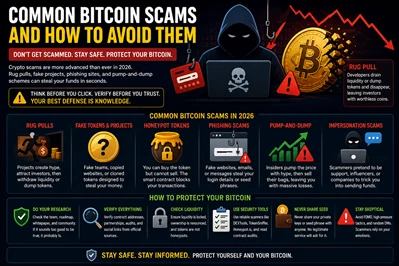
Common Bitcoin scams and how to avoid them is one of the most important topics for anyone entering crypto in 2026. Bitcoin itself is secure at the protocol level, but users can still lose money through rug pulls, phishing, fake platforms, pump-and-dump schemes, impersonation scams, wallet drainers, and fake tokens.
One of the biggest dangers is the rug pull crypto scam, especially in memecoins, DeFi tokens, and fake crypto projects pretending to be connected to Bitcoin. A Bitcoin rug pull 2026 may not always involve Bitcoin directly. Often, scammers use Bitcoin hype, Bitcoin branding, or “BTC ecosystem” narratives to sell worthless tokens before draining liquidity or disappearing.
This guide explains common Bitcoin scams and how to avoid them, with a main focus on rug pulls, fake tokens, honeypot tokens, high transaction tax scams, and on-chain warning signs.
Table of Contents
Why Rug Pulls Are Among the Most Common Bitcoin-Related Scams
A rug pull crypto scam happens when a project team creates hype, attracts buyers, and then removes liquidity, dumps tokens, or uses hidden smart contract functions to steal value from investors. These scams are common in DeFi, memecoins, NFT-linked tokens, and fake Bitcoin-themed projects.
Crypto scam activity remains a major threat. Chainalysis reported that crypto scams and fraud reached an estimated $17 billion stolen in 2025, with impersonation tactics and AI-enabled scams becoming more advanced. Binance also warns that classic crypto scams such as phishing, rug pulls, Ponzi schemes, fake giveaways, and AI deepfake scams remain active in 2026.
A memecoin rug pull usually follows this pattern:
| Step | What happens |
|---|---|
| 1 | A fake crypto project launches a token |
| 2 | Influencers, bots, or paid accounts create hype |
| 3 | Early buyers push price up |
| 4 | Developers remove liquidity or dump supply |
| 5 | The token collapses and buyers are trapped |
The reason rug pulls work is simple: scammers sell a story before investors verify the project. The best way to understand common Bitcoin scams and how to avoid them is to learn how these stories are built.
How Rug Pulls Work
A rug pull crypto scam can happen in several ways. Some are obvious after the fact, but difficult for beginners to spot in the moment.
Liquidity Rug Pull
A liquidity rug pull happens when the team removes liquidity from a decentralized exchange. Buyers may still see tokens in their wallet, but the market has no real liquidity left. That means they cannot sell without a massive loss.
This is one of the most common on-chain rug pull patterns. A project may claim liquidity is locked, but if the lock is fake, short, or controlled by insiders, investors are still exposed.
Admin-Drain or Mint Function Scam
Some fake tokens include hidden or unnecessary mint / admin functions. These allow the deployer to create more tokens, blacklist wallets, change taxes, pause transfers, or redirect fees.
A suspicious smart contract may include:
| Red flag | Why it matters |
|---|---|
| Unlimited mint function | Team can create new supply |
| Owner can pause trading | Buyers can be trapped |
| Blacklist function | Specific wallets can be blocked from selling |
| Tax can be changed | Fees can be raised after launch |
| Ownership not renounced | Admin still controls contract |
This is why a contract audit matters. But even audits are not perfect. Fake audits and low-quality audits are also used in scam marketing.
Honeypot Token
A honeypot token is a token that users can buy but cannot sell. The chart may look bullish because buys keep happening, but sellers are blocked by smart contract rules.
Sumsub describes honeypot tokens as a tactic used in DeFi rug pulls, where malicious smart contracts prevent users from selling. CertiK has also warned that honeypot tokens can imitate known projects and may be deployed at scale through automated fraudulent contracts.
High Transaction Tax Scam
A high transaction tax scam uses extreme buy or sell fees. For example, the project may advertise a 5% fee, then later change it to 30%, 50%, or even higher. In some cases, the tax goes straight to admin-controlled wallets.
If a token has a high transaction tax, unclear fee routing, or admin-controlled tax changes, treat it as a major warning sign.
How to Spot a Fake Crypto Project
The easiest way to avoid a rug pull crypto scam is to identify the fake crypto project before you buy. Most rug pulls show warning signs early.
Anonymous or Fake Team
An anonymous team crypto project is not always a scam, but it increases risk. Bitcoin itself was created by the anonymous Satoshi Nakamoto, so anonymity alone is not proof of fraud. But in small tokens and DeFi launches, anonymous teams often make it easier for scammers to disappear.
Warning signs include:
| Team red flag | What it suggests |
|---|---|
| No real LinkedIn profiles | Team may be fake |
| Stock-photo profile pictures | Identity may be fabricated |
| No previous crypto work | No reputation at risk |
| Anonymous founders controlling funds | High rug-pull risk |
| Fake advisor list | Credibility theater |
If the project asks for trust but the team has no accountability, be careful.
Unverified or Suspicious Smart Contracts
A fake token often uses a contract that has not been verified on a block explorer. If investors cannot read the contract, they cannot easily check for admin functions, mint permissions, blacklist rules, or high transaction tax settings.
Before buying, check:
| Contract check | Why it matters |
|---|---|
| Is the contract verified? | Lets users inspect code |
| Is ownership renounced? | Reduces admin-control risk |
| Is liquidity locked? | Reduces liquidity rug risk |
| Are taxes adjustable? | High transaction tax scam risk |
| Is there a mint function? | Supply can be inflated |
| Are holders concentrated? | Insiders may dump |
Tools such as token scanners can help identify honeypot behavior, sell blocks, high taxes, blacklists, unlocked liquidity, suspicious holder patterns, and mint functions.
Fake Partnerships and Hype Marketing
Fake partnerships are another major rug-pull signal. A project may claim it is “working with” a major exchange, Bitcoin company, AI brand, or payment provider without proof.
Look for wording like:
| Suspicious wording | Why it is risky |
|---|---|
| “Partnership coming soon” | No proof |
| “In talks with major exchanges” | Easy to fake |
| “Backed by whales” | Usually unverifiable |
| “Bitcoin ecosystem gem” | Often pure marketing |
| “Guaranteed 100x” | Scam-style promise |
A real partnership should be confirmed by both parties through official channels.
How to Avoid Rug Pulls in 2026
Learning how to avoid rug pulls is mostly about slowing down and verifying before buying.
Use this rug-pull prevention checklist:
| Step | What to do |
|---|---|
| Verify the official contract | Use the project’s official website and cross-check |
| Check CoinGecko/CoinMarketCap | Be careful with unlisted fake tokens |
| Inspect liquidity | Look for locked and diversified liquidity |
| Check deployer wallet | See if the creator has launched scams before |
| Review holder distribution | Avoid extreme insider concentration |
| Scan for honeypot behavior | Make sure selling is possible |
| Review contract audit | Prefer reputable audit firms |
| Avoid hype-only projects | No utility, no transparency, no trust |
A contract audit can help, but it should not be your only defense. Some rug pulls use fake audits or audit only harmless parts of the code. The safest mindset is simple: if you cannot understand where liquidity, supply, admin control, and taxes are managed, you probably should not buy.
For memecoin rug pull risk, be extra strict. Many memecoins are launched quickly with no product, no revenue, no utility, and no team accountability. That does not mean every memecoin is a scam, but it does mean the risk is higher.
Other Common Bitcoin-Related Scams
A page about common Bitcoin scams and how to avoid them should not only cover rug pulls. Scammers also use phishing, fake platforms, fake exchanges, pump-and-dump groups, and impersonation.
Crypto Phishing Scam
A crypto phishing scam tricks users into entering login details, seed phrases, or wallet approvals on a fake website. Binance’s 2026 guide warns that fake websites, social accounts, and phishing emails often copy official branding and push users to click unsafe links.
Never enter your seed phrase into any website. No real exchange, wallet company, support agent, or Bitcoin upgrade will ask for it.
Fake Crypto Website or App
A fake crypto website can look almost identical to a real exchange or wallet. Fake apps may appear through ads, social media links, or unofficial download pages.
Avoid this by typing official URLs manually, bookmarking real websites, and downloading wallets only from official sources.
Pump-and-Dump Crypto
A pump-and-dump crypto scheme happens when insiders buy early, hype the token, attract new buyers, then sell into the pump. These scams often happen in Telegram, Discord, X communities, or influencer-driven groups.
The warning signs are easy to recognize:
| Pump-and-dump signal | Meaning |
|---|---|
| “Buy now before listing” | Urgency tactic |
| “Guaranteed pump” | Manipulation |
| “Whale group entry” | Insider exit liquidity |
| “Secret alpha” | FOMO bait |
| “Only holders will win” | Emotional pressure |
Impersonation Scam
Impersonation scams involve fake support accounts, fake influencers, fake exchange staff, and fake recovery agents. AI tools have made impersonation more convincing. Binance notes that AI tools have amplified classic scams by making them more scalable and personalized.
The rule is simple: support will not message you first asking for private keys, seed phrases, or deposits.
If You Have Already Been Rug-Pulled or Scammed
If you have already lost money to an on-chain rug pull, fake token, or wallet drainer, the hard truth is that confirmed crypto transactions are usually irreversible.
Do this immediately:
| Step | Action |
|---|---|
| Stop sending funds | Do not “pay to recover” money |
| Save evidence | Keep URLs, TXIDs, wallet addresses, screenshots |
| Report the scam | Contact platform, exchange, or relevant authorities |
| Warn others | Share verified facts, not rumors |
| Move remaining funds | Use a clean wallet if keys may be exposed |
| Avoid recovery scams | Most “recovery experts” are scammers too |
Recovery scam messages often appear after victims post publicly. They claim they can retrieve stolen Bitcoin or reverse blockchain transactions for a fee. Do not send more money.
What are common Bitcoin scams in 2026?
Common Bitcoin scams in 2026 include rug pulls, phishing sites, fake exchanges and apps, pump‑and‑dump schemes, and impersonation scams that trick users into sending BTC or revealing seed phrases.
What is a rug pull crypto scam?
A rug pull crypto scam is when developers create a token or project, hype it up, then suddenly drain liquidity or dump their tokens, leaving holders with worthless assets.
How do Bitcoin rug pulls work technically?
Bitcoin‑related rug pulls often happen via hidden smart‑contract functions, undeclared admin‑mint privileges, unlocked liquidity, or high‑tax‑to‑admin‑wallets that let devs drain or manipulate funds behind the scenes.
How can I tell if a project is a rug pull?
Warning signs include anonymous teams, no audited contract, unlocked liquidity, extreme concentration of tokens in a few wallets, and suspiciously high transaction tax or hidden admin‑functions in the token.
How do I avoid rug pulls in 2026?
To avoid rug pulls, verify the contract from official sources, check liquidity‑lock status, look for reputable audits, avoid FOMO‑driven launches, and never invest in anything you can’t fully inspect on‑chain.
What are fake crypto projects and how do they scam users?
Fake crypto projects are scams that mimic real projects with polished websites and fake partnerships, collect investment, then disappear or rug‑pull, making tokens worthless or impossible to sell.
How can I avoid phishing and fake crypto websites?
Avoid phishing and fake websites by double‑checking URLs, never clicking unsolicited links, using only official exchange or wallet domains, and never entering seed phrases or keys on any site.
If I lose BTC to a rug pull or scam, can I get it back?
Once BTC is sent in a rug pull or scam, recovery is usually impossible; on‑chain transactions are irreversible, and “recovery services” promising refunds are often secondary scams.
Final Thoughts: Common Bitcoin Scams and How to Avoid Them
Understanding common Bitcoin scams and how to avoid them is now a core part of crypto education. The biggest danger is not Bitcoin itself. The danger is trusting fake projects, fake tokens, fake websites, fake support accounts, and fake promises.
A rug pull crypto scam usually depends on speed, hype, and poor verification. If you learn how to avoid rug pulls, check contracts, avoid honeypot tokens, watch for high transaction tax scams, research anonymous team crypto risks, and verify liquidity, you reduce your chances of becoming exit liquidity.
The simple rule for 2026 is this: before buying any token, ask who controls the supply, who controls the liquidity, who can change the contract, and whether you can actually sell. If those answers are unclear, walk away.