Bitcoin is one of those words almost everyone has heard by now, even if they are not into crypto.
So what is Bitcoin, really?
Some people see it as the future of money. Others think it is pure speculation. Some treat it like digital gold, while others still wonder whether it is just a trend that somehow never went away.
At its core, Bitcoin is a form of digital money that lets people send and receive value without needing a bank, payment company, or central authority in the middle. It was the first cryptocurrency, and it changed the financial world by showing that money could exist online in a decentralized form.
That might sound technical, but the basic idea is actually simple. Bitcoin is money for the internet age, built to work without relying on trust in a government, company, or middleman.
Let’s break it down in a way that actually makes sense.
Table of Contents
The basic idea behind Bitcoin
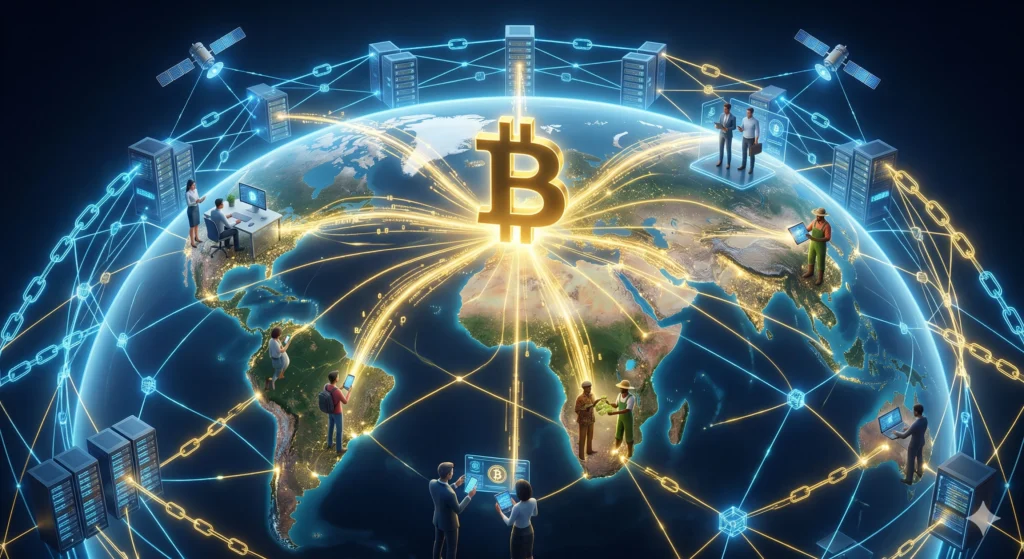
Imagine being able to send money to anyone in the world the same way you send an email. No bank approval. No long delays. No hidden middlemen deciding whether the transaction goes through.
That is one of the big ideas behind Bitcoin.
Bitcoin is a decentralized digital currency. “Digital” means it exists online rather than as physical coins or cash. “Decentralized” means it is not controlled by one company, one government, or one bank. Instead, it runs on a global network of computers.
This network keeps track of every transaction and makes sure nobody can cheat the system by spending the same Bitcoin twice.
That is what made Bitcoin such a breakthrough when it was introduced in 2009. Before Bitcoin, the idea of digital money without a central authority was incredibly hard to solve. If money is just digital information, what stops someone from copying it? Bitcoin solved that problem by creating a public, verifiable system called the blockchain.
Who created Bitcoin?
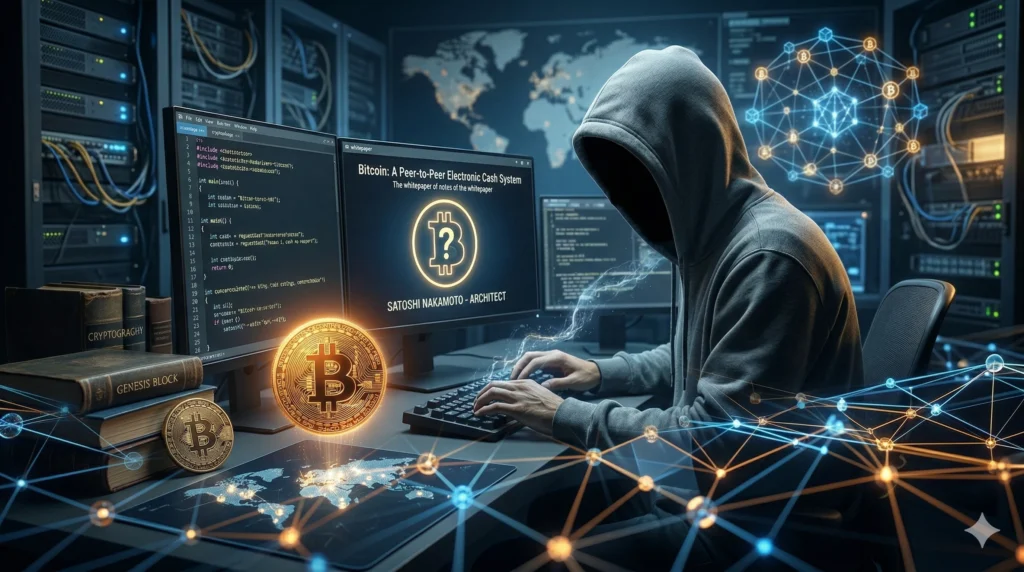
Bitcoin was created by someone using the name Satoshi Nakamoto. To this day, nobody knows for certain who Satoshi really is. It could be one person or a group of people.
In 2008, Satoshi released a whitepaper called Bitcoin: A Peer-to-Peer Electronic Cash System. It described a new kind of money that could be sent directly between users without banks or payment processors.
Then, in 2009, the Bitcoin network officially launched.
There is something almost legendary about Bitcoin’s origin story. No flashy company launch. No billionaire founder doing interviews. Just a whitepaper, open-source code, and an idea that ended up reshaping finance, investing, and online culture.
Whether you love Bitcoin or hate it, it is hard not to respect how much impact one idea has had.
How does Bitcoin work?
This is where people often get intimidated, but it helps to keep it practical.
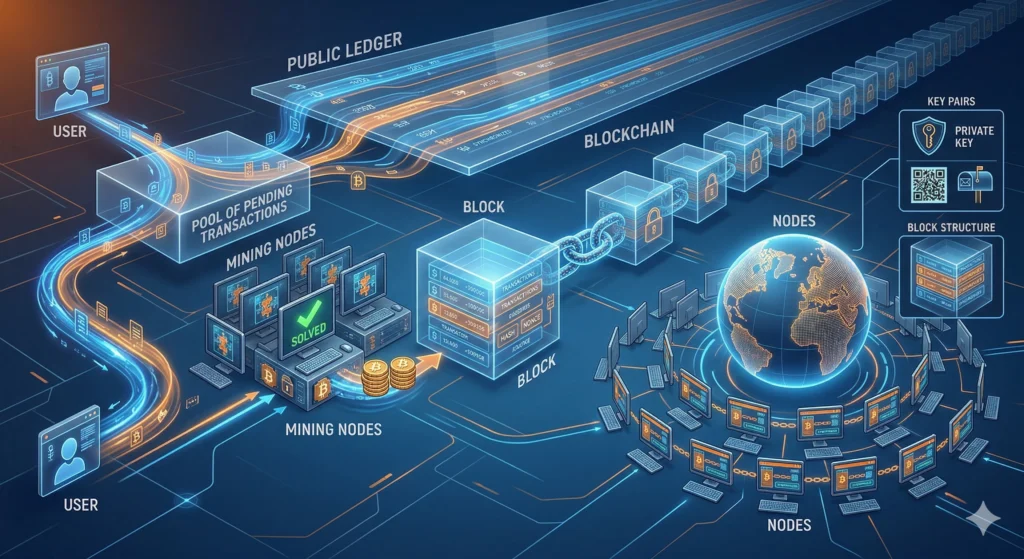
Bitcoin runs on a blockchain. A blockchain is basically a public digital ledger. It records transactions in blocks, and each block is linked to the previous one. That chain of blocks creates a history of transactions that is very difficult to change.
Every time someone sends Bitcoin, the transaction is broadcast to the network. Computers on the network verify it, make sure the sender actually has the Bitcoin they are trying to send, and then add it to the blockchain.
Because the blockchain is public, anyone can inspect it. You may not see people’s personal names attached to transactions, but the transaction history itself is visible and transparent.
That is one reason Bitcoin is often described as “trustless.” Not because there is no trust at all, but because you do not need to trust a single institution to maintain the ledger. The system itself is designed to verify and enforce the rules.
What is Bitcoin mining?
Bitcoin mining is the process that helps secure the network and create new Bitcoin.
Miners use powerful computers to solve complex mathematical problems. When they solve one, they validate a new block of transactions and add it to the blockchain. In return, they receive newly created Bitcoin as a reward, plus transaction fees.
This process is called Proof of Work.
Now, when people first hear “mining,” they sometimes imagine digging coins out of the ground. But Bitcoin mining is really more like a giant global competition of computers using energy and processing power to secure the network.
Why does this matter?
Because it makes attacking the Bitcoin network incredibly expensive. If someone wanted to cheat the system, they would need an enormous amount of computing power and energy. That is a big part of what gives Bitcoin its security.
Mining also introduces new Bitcoin into circulation. But unlike fiat money, where central banks can create more currency when they choose, Bitcoin has a fixed supply.
Why is Bitcoin limited to 21 million?
This is one of Bitcoin’s most important features.
There will only ever be 21 million Bitcoin.
That scarcity is built into the code. Nobody can wake up tomorrow and decide to create 10 million more. That makes Bitcoin fundamentally different from traditional currencies, which can be expanded by central banks over time.
For many Bitcoin supporters, this is a huge part of the appeal. They see Bitcoin as a hedge against inflation and money printing. In a world where currencies can lose purchasing power over time, Bitcoin’s fixed supply gives it a very different kind of monetary policy.
This is also why people often call Bitcoin digital gold. Like gold, it is scarce. But unlike gold, it is easy to send across borders, divide into small amounts, and store digitally.
That does not mean Bitcoin behaves exactly like gold in the market. It is still more volatile. But the comparison helps explain why so many people see it as a long-term store of value.
What makes Bitcoin valuable?
This is one of the biggest questions people ask.
After all, Bitcoin is not backed by a government. You cannot hold it in your hand. So why does it have value?
The answer is the same reason many things have value: because people agree that it does, and because it has useful properties.
Bitcoin has value to people because it is scarce, portable, durable, divisible, and resistant to censorship. You can send it globally, hold it yourself, and verify its supply. That gives it qualities many people find attractive, especially in an increasingly digital world.
Its value also comes from the network effect. The more people use, hold, discuss, develop around, and trust Bitcoin, the stronger the system becomes. Over time, Bitcoin has grown from an obscure experiment into a globally recognized asset.
That does not mean its price only goes up. It does not. Bitcoin is volatile, and that volatility scares a lot of people. But price swings do not change the core reason people care about it.
They care because Bitcoin offers a financial system with different rules.
Is Bitcoin anonymous?
Not exactly.
A lot of people still think Bitcoin is fully anonymous, but that is not really true. Bitcoin is better described as pseudonymous.
That means transactions are tied to wallet addresses, not directly to your real-world name. But because the blockchain is public, transaction activity can be traced. If a wallet address gets linked to a person or company, that history becomes much easier to analyze.
So while Bitcoin can offer privacy advantages compared to traditional payment systems, it is not invisible money. Anyone getting into Bitcoin should understand that difference.
How do people use Bitcoin?
Bitcoin is used in a few main ways.
Some people use it as an investment. They buy and hold it because they believe it will become more valuable over time.
Some use it as a store of value, similar to gold. They may not care about daily price swings as much as the long-term idea of owning a scarce digital asset.
Others use Bitcoin to transfer money. In some parts of the world, Bitcoin can be a faster or more accessible way to move value than traditional systems, especially where banking services are limited or unstable.
There are also people who simply believe in the philosophy behind it. They like the idea of money that is open, borderless, and not controlled by any single authority.
In reality, most users fall somewhere in between. They may see Bitcoin as part technology, part investment, and part financial alternative.
What are the risks of Bitcoin?
It would not be honest to talk about Bitcoin without mentioning the risks.
The biggest one is volatility. Bitcoin can move up or down sharply, sometimes in a very short period. That makes it exciting for some people and stressful for others.
There is also regulatory uncertainty. Governments and regulators around the world continue to shape how Bitcoin is taxed, traded, and integrated into financial systems.
Security is another big factor. Bitcoin itself has proven remarkably secure over time, but users can still lose money through scams, exchange failures, bad storage practices, or sending funds to the wrong address.
And then there is the emotional risk. Bitcoin has a way of pulling people into extreme thinking. When the market is going up, it is easy to feel unstoppable. When it crashes, fear takes over. That is why having a calm, long-term mindset matters so much.
Bitcoin may be revolutionary, but it is not risk-free.
Why does Bitcoin matter?
Even people who never buy Bitcoin should understand why it matters.
Bitcoin introduced the idea that money could exist outside traditional institutions. It challenged assumptions about finance, ownership, scarcity, and trust. It opened the door to the entire cryptocurrency industry and inspired thousands of other digital assets and blockchain projects.
More importantly, it forced the world to take digital scarcity seriously.
Before Bitcoin, the internet was great at copying things. Music, photos, documents, videos—everything could be duplicated endlessly. Bitcoin showed that digital value could be scarce and transferable without needing a central owner.
That is a big deal.
Whether Bitcoin becomes a permanent part of the global financial system or remains a niche but powerful asset, it has already left its mark. It changed the conversation.
Final thoughts
I hope you finally understood what bitcoin is and how it operates.
Bitcoin is the first cryptocurrency. It is decentralized digital money. It runs on a blockchain, has a fixed supply of 21 million coins, and allows people to store and transfer value without relying on a central authority.
But beyond the technical definition, Bitcoin is also something bigger.
It is a financial idea. A technological breakthrough. A challenge to the traditional system. For some people, it is an investment. For others, it is a hedge, a philosophy, or a sign of where the digital world is heading.
You do not have to agree with every bold claim made about Bitcoin to understand why it matters. And you do not have to become a hardcore believer to appreciate what makes it different.
At the very least, Bitcoin is worth understanding.
Because whether you see it as the future of money or just one of the most important innovations of the digital age, it is no longer something the world can ignore.
Written by Crypto Cobra