Most people first hear about Bitcoin as an investment. They buy it, hold it, and hope the price goes higher over time. But the real story is bigger than price charts. Bitcoin use cases beyond HODLing include payments, remittances, savings, merchant transactions, DeFi, donations, travel spending, and self-custody.
Bitcoin was not created only to sit on an exchange. It was designed as a peer-to-peer digital money system that lets people send value without relying on banks or payment companies. That makes Bitcoin use cases beyond HODLing important for anyone who wants to understand what Bitcoin can actually do in the real world.
This guide explains practical Bitcoin use cases beyond HODLing, including where Bitcoin works well, where it has limitations, and how different users can benefit from it today.
What Are Bitcoin Use Cases Beyond HODLing?
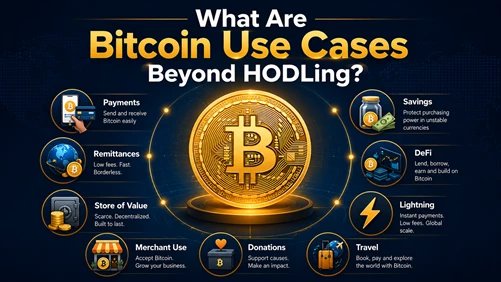
Bitcoin use cases beyond HODLing are the practical ways people can use Bitcoin instead of simply buying and holding it long term.
These use cases include:
- Bitcoin payments
- Bitcoin remittances
- Bitcoin as a store of value
- Savings in unstable currencies
- Lightning Network transactions
- Bitcoin DeFi
- Merchant payments
- Donations and fundraising
- Travel spending
- Treasury management
The main question is not just “Will Bitcoin go up?” The better question is: “What can people do with Bitcoin today?”
Bitcoin Payments
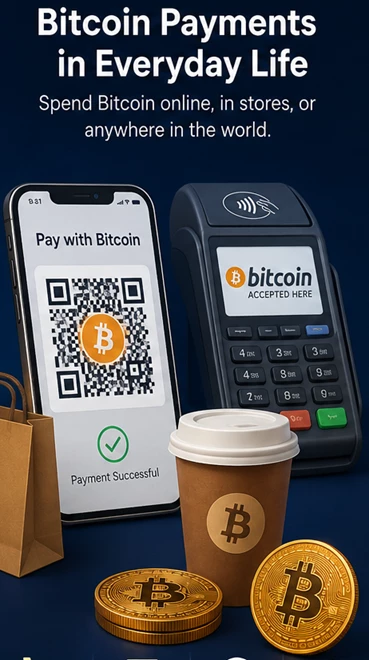
One of the clearest Bitcoin use cases beyond HODLing is payments. Bitcoin allows users to send value directly from one wallet to another without needing a bank, card network, or payment processor.
Bitcoin payments can be used for online checkout, freelance invoices, peer-to-peer transfers, merchant payments, and crypto debit cards. In some cases, users pay directly with Bitcoin. In other cases, a crypto card converts Bitcoin into local currency at the point of sale.
For smaller payments, the Lightning Network can make Bitcoin faster and cheaper. Lightning is a second-layer network built on top of Bitcoin, designed for quick payments with lower fees. This makes Bitcoin more practical for tips, small purchases, digital services, and merchant transactions.
However, Bitcoin payments are not perfect for every situation. On-chain fees can rise when the network is busy, and Bitcoin’s price can move quickly. In many countries, spending Bitcoin may also create a taxable event.
This means Bitcoin payments make the most sense when global access, speed, censorship resistance, or self-custody are more important than short-term price stability.
Bitcoin Remittances
Another major example of Bitcoin use cases beyond HODLing is remittances. A remittance is money sent across borders, often from someone working in one country to family or friends in another.
Traditional remittance services can be slow, expensive, and limited by banking hours. Bitcoin works 24/7 and can be sent globally from one wallet to another.
A simple Bitcoin remittance process looks like this:
- The sender buys Bitcoin with local currency.
- The sender transfers Bitcoin to the receiver’s wallet.
- The receiver holds the Bitcoin, spends it, or converts it into local currency.
Bitcoin remittances can be useful for people who need cross-border transfers without waiting days for bank settlement. They can also help users in countries where financial access is limited.
The main challenges are volatility, exchange access, wallet security, and local cash-out options. If the receiver needs local currency immediately, they need a trusted way to convert Bitcoin. This is why some people use stablecoins for short-term remittances, while others use Bitcoin for its decentralization and long-term value potential.
Bitcoin as a Store of Value
One of the strongest Bitcoin use cases beyond HODLing is using Bitcoin as a store of value. Bitcoin is often compared to gold because it has a limited supply and is not controlled by a central bank.
Only 21 million Bitcoin will ever exist. This fixed supply is one reason investors view Bitcoin as digital gold. Unlike fiat currency, Bitcoin cannot be printed endlessly by governments or central banks.
Gold has been used as a store of value for centuries, but Bitcoin offers digital advantages. It can be stored in a wallet, sent across borders, divided into tiny units, and verified on a public blockchain.
Bitcoin is still volatile, so it is not a risk-free savings tool. But for people looking for an asset outside the traditional banking system, Bitcoin can act as a portable digital store of value.
Savings in Unstable Currencies
Some of the most important Bitcoin use cases beyond HODLing appear in countries with unstable currencies. When inflation is high, local savings can lose purchasing power quickly.
In these situations, people may look for alternatives such as dollars, gold, stablecoins, or Bitcoin. Bitcoin is not stable in the short term, but it can be attractive because it is scarce, global, and not controlled by a local government.
For someone living with high inflation, Bitcoin may offer a way to protect part of their savings from local currency weakness. It can also be easier to move than physical cash or gold.
However, Bitcoin should be used carefully. Money needed for rent, food, bills, or emergencies should not be exposed to heavy volatility. A balanced strategy may include local currency for daily spending, stablecoins for short-term digital dollar exposure, and Bitcoin for long-term savings.
This is where Bitcoin use cases beyond HODLing become practical. Bitcoin is not only about getting rich. For some people, it is about protecting value and keeping access to money.
Bitcoin DeFi
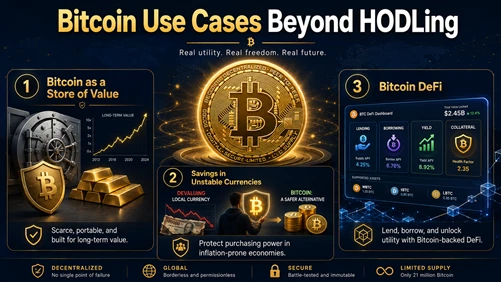
Bitcoin was not originally built for DeFi like Ethereum, but Bitcoin can still be used in decentralized finance through wrapped Bitcoin, sidechains, layer-2 systems, and lending platforms.
Bitcoin DeFi can include:
- Lending Bitcoin
- Borrowing against Bitcoin
- Using Bitcoin as collateral
- Providing liquidity
- Earning yield
- Using wrapped Bitcoin in DeFi apps
This is one of the more advanced Bitcoin use cases beyond HODLing. For example, a user may deposit wrapped Bitcoin into a DeFi protocol and borrow stablecoins against it. Another user may lend Bitcoin-backed assets to earn yield.
The risk is that Bitcoin DeFi adds extra complexity. Wrapped Bitcoin may involve custodians or bridges. DeFi platforms can have smart contract bugs. Borrowing can create liquidation risk if the Bitcoin price falls.
Bitcoin DeFi can be useful, but it is not beginner-friendly. Users should understand custody, platform risk, liquidation rules, and smart contract risk before chasing yield.
Merchant Payments and Online Business
Merchant adoption is another practical area for Bitcoin use cases beyond HODLing. Businesses, freelancers, and creators can accept Bitcoin from customers around the world.
For online businesses, Bitcoin can reduce reliance on payment processors and card networks. It can also help with international clients, digital products, and crypto-native audiences.
Merchants can choose to hold Bitcoin or convert it into local currency through a payment provider. Holding Bitcoin gives exposure to price movement, while converting immediately reduces volatility risk.
The benefits of Bitcoin merchant payments include global reach, fewer chargebacks, and direct settlement. The challenges include tax reporting, accounting, customer education, and price volatility.
For most businesses, Bitcoin works best as an additional payment option rather than the only payment method.
Donations and Fundraising
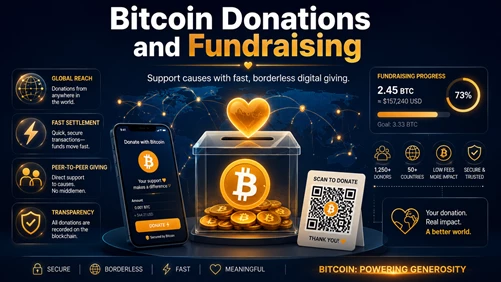
Donations are another useful example of Bitcoin use cases beyond HODLing. Bitcoin can be used by charities, creators, developers, activists, and communities that want to accept global digital payments.
A Bitcoin donation can be sent from almost anywhere in the world. The receiver does not need a traditional bank account or payment processor. Once confirmed, the transaction cannot be reversed like a card payment.
This can be useful for open-source projects, independent media, online communities, and global fundraising campaigns.
However, donation receivers still need proper wallet security and tax awareness. They also need to decide whether to hold Bitcoin or convert it into fiat currency.
Travel and Global Spending
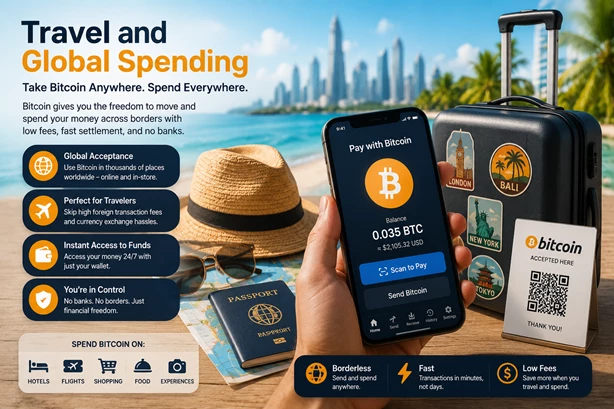
Travel is another area where Bitcoin use cases beyond HODLing can matter. Some people use Bitcoin as backup money when traveling internationally.
If a bank card is blocked or a payment app fails, Bitcoin can provide another way to access value. Some crypto cards also let users spend Bitcoin anywhere traditional cards are accepted by converting it at checkout.
Bitcoin can be helpful for travelers who want portability and global access. But it should not be the only payment option. A smart travel setup may include a bank card, local cash, and a secure Bitcoin wallet.
Treasury Management
Some companies and individuals use Bitcoin as part of treasury management. Instead of holding all reserves in cash, they may hold a small percentage in Bitcoin as a long-term store of value.
This is one of the more strategic Bitcoin use cases beyond HODLing. The idea is that cash can lose value over time due to inflation, while Bitcoin has a fixed supply.
However, treasury management with Bitcoin requires discipline. Businesses still need enough cash for payroll, taxes, bills, and operating costs. Bitcoin’s price can drop sharply, so overexposure can create financial stress.
Bitcoin may work as a reserve asset, but it should be managed carefully.
Ordinals, NFTs, and Bitcoin Digital Assets
Most Bitcoin use cases beyond HODLing focus on money, payments, and savings. But newer developments like Ordinals have introduced NFT-style digital assets on Bitcoin.
Ordinals allow data to be connected with individual satoshis, creating Bitcoin-native digital collectibles. Some people see this as innovation, while others argue it increases demand for block space and can push fees higher.
For most beginners, Ordinals are not the most important Bitcoin use case. Payments, remittances, self-custody, and store of value are more practical starting points.
Risks of Bitcoin Use Cases Beyond HODLing
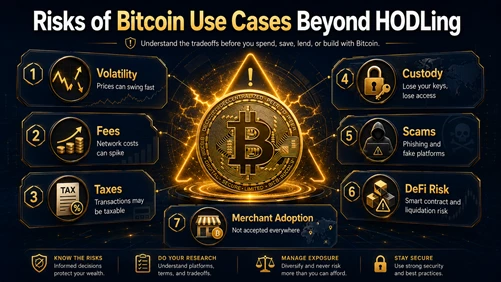
Any honest page about Bitcoin use cases beyond HODLing should explain the risks clearly.
The main risks include:
- Volatility: Bitcoin can rise or fall quickly, making it risky for short-term savings.
- Fees: On-chain transaction fees can spike when the network is congested.
- Taxes: Spending, selling, or swapping Bitcoin may trigger tax reporting.
- Custody: If you control your own wallet, you are responsible for your private keys and seed phrase.
- Scams: Fake wallets, phishing sites, fake exchanges, and impersonators are common in crypto.
- Merchant adoption: Not every business accepts Bitcoin.
- DeFi risk: Lending, borrowing, and wrapped Bitcoin can create smart contract, custody, and liquidation risk.
Bitcoin gives users more financial control, but that control comes with responsibility.
Best Bitcoin Use Cases by User Type
The best Bitcoin use cases beyond HODLing depend on the user.
For beginners, the best starting point is learning how to buy, store, and send Bitcoin safely.
For long-term savers, Bitcoin can act as a digital store of value.
For people in countries with inflation, Bitcoin may help protect purchasing power.
For freelancers and merchants, Bitcoin payments can make international transactions easier.
For people sending money abroad, Bitcoin remittances can offer faster cross-border transfers.
For advanced users, Bitcoin DeFi may unlock lending, borrowing, and yield opportunities, but only with careful risk management.
Conclusion: Bitcoin Is More Than an Investment
Bitcoin use cases beyond HODLing show that Bitcoin is more than a speculative asset. It can be used for payments, remittances, savings, merchant transactions, donations, travel, treasury management, and DeFi.
The strongest use cases come from Bitcoin’s core features: scarcity, portability, self-custody, global access, and censorship resistance.
Bitcoin is not perfect. It has volatility, fees, tax complexity, and security risks. But for users who understand the tradeoffs, Bitcoin can be more than something to hold. It can be a practical digital money network and a powerful tool for storing and moving value.
The next step is to learn how to set up a secure Bitcoin wallet, understand self-custody, and explore whether Bitcoin payments, remittances, or Lightning transactions make sense for your situation.