Introduction: Bitcoin for Beginners
If you are new to Bitcoin, the process can feel confusing at first. You may hear words like wallet, exchange, seed phrase, self-custody, KYC, transaction fees, and DCA before you even make your first purchase.
This Bitcoin for beginners guide breaks everything down into a simple roadmap. Instead of jumping straight into price predictions or advanced trading, this page shows you the practical steps: learn the basics, choose a safe exchange, buy Bitcoin, set up a wallet, send Bitcoin, store Bitcoin safely, and track Bitcoin over time.
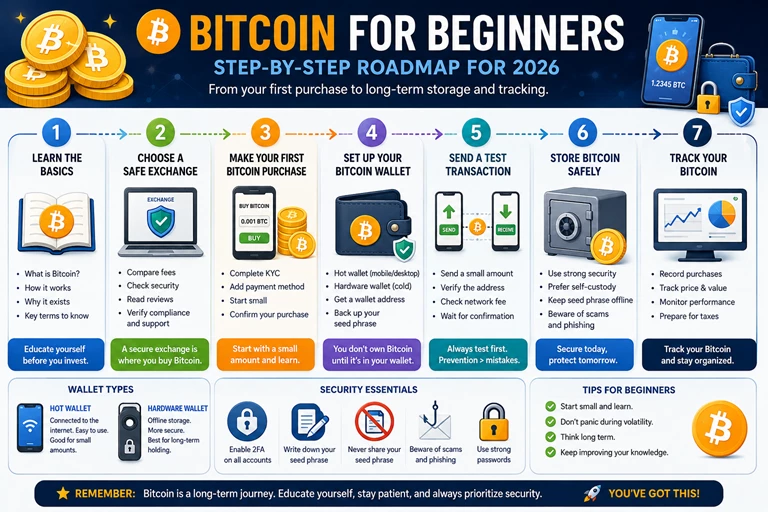
The goal is not to make Bitcoin complicated. The goal is to help beginners understand the process step by step so they can avoid common mistakes.
The simple beginner flow looks like this:
First-time buyer → Bitcoin wallet → send Bitcoin → store Bitcoin → track Bitcoin
By the end of this Bitcoin beginner guide, you should understand how to make a small first purchase, protect your Bitcoin, and manage your holdings with better security and confidence.
Table of Contents
Step 1: Learn the Basics of Bitcoin
Before you buy Bitcoin, it is important to understand what it is.
Bitcoin is a decentralized digital asset. It allows people to send value across the internet without relying on a bank, government, or payment company. Transactions are recorded on a public blockchain, and the network is secured by miners through a system called proof-of-work.
One of the main reasons Bitcoin is different from normal money is its fixed supply. Only 21 million Bitcoin will ever exist. This scarcity is one reason many people view Bitcoin as a long-term store of value.
For beginners, the most important things to understand are:
- Bitcoin is digital money, not a company.
- Bitcoin transactions are irreversible.
- Bitcoin can be held on an exchange or in your own wallet.
- Bitcoin security matters because there is no bank support if you lose access.
- You do not need to buy a full Bitcoin. You can buy a small fraction.
A strong Bitcoin for beginners strategy starts with education. Do not rush into a large purchase before you understand wallets, fees, scams, and self-custody.
Step 2: Understand Exchanges and Wallets
A common beginner mistake is thinking an exchange and a wallet are the same thing. They are not.
A Bitcoin exchange is a platform where you can buy Bitcoin, sell Bitcoin, and sometimes trade it for other crypto assets. Examples include large regulated crypto platforms that allow users to deposit fiat currency and make a first purchase.
A Bitcoin wallet is where Bitcoin is stored or controlled. More accurately, a wallet stores the private keys that give access to your Bitcoin.
There are two main ways to hold Bitcoin:
Custodial Bitcoin
Custodial Bitcoin means a platform holds the Bitcoin for you. This is what happens when you keep Bitcoin on an exchange.
The benefit is convenience. The downside is that you are trusting the exchange to protect your funds.
Self-Custody Bitcoin
Self-custody means you control your own Bitcoin wallet and private keys. This gives you more control, but also more responsibility.
With self-custody, you must protect your seed phrase. If you lose it, you may lose access to your Bitcoin permanently.
For beginners, it can be smart to start small on an exchange, learn how everything works, and then move toward self-custody once you understand wallet security.
Step 3: Choose a Safe Bitcoin Exchange
The next step in this Bitcoin beginner guide is choosing a safe exchange. Since your exchange is where you may make your first purchase, security and trust matter.
When comparing exchanges, look at:
- Security history
- Fees
- Ease of use
- Supported payment methods
- Withdrawal options
- Reputation
- Customer support
- Regulation and compliance
- Bitcoin withdrawal availability
Avoid unknown platforms promising guaranteed profits, secret trading systems, or unrealistic bonuses. Beginners should use simple, well-known, regulated platforms where they can buy Bitcoin and withdraw it to a wallet.
What KYC Means
Most regulated exchanges require KYC. KYC means “Know Your Customer.” It usually requires you to verify your identity with documents such as an ID, address information, or a selfie.
KYC may feel annoying, but it is normal on regulated exchanges. It helps platforms follow anti-money laundering rules and reduce fraud.
For a first-time buying Bitcoin experience, use a platform that makes KYC, deposits, and withdrawals clear and easy to understand.
Step 4: Make a Small First Purchase
When learning how to buy Bitcoin, beginners should start small. You do not need to invest a large amount. The goal of your first purchase is to learn the process safely.
A simple first purchase roadmap looks like this:
- Create an account on a trusted exchange.
- Complete KYC if required.
- Deposit a small amount of money.
- Buy Bitcoin.
- Check your Bitcoin balance.
- Learn how withdrawal works before buying more.
This step is not about getting rich overnight. It is about understanding how to buy Bitcoin safely.
Beginners should avoid using leverage, margin trading, futures, or risky altcoin swaps during the first purchase. Keep it simple. Buy a small amount of Bitcoin, learn the interface, and understand the fees.
Step 5: Set Up a Bitcoin Wallet
After buying Bitcoin, the next step is setting up a wallet. A Bitcoin wallet helps you control, send, and store Bitcoin.
There are two common wallet types:
Hot Wallet
A hot wallet is connected to the internet. It can be an app on your phone or computer. Hot wallets are convenient for smaller amounts and everyday use.
Pros:
- Easy to use
- Good for learning
- Fast access
- Useful for small transactions
Cons:
- More exposed to online threats
- Not ideal for large long-term storage
- Device security matters
Hardware Wallet
A hardware wallet is a physical device that stores your private keys offline. It is usually better for long-term storage and larger Bitcoin amounts.
Pros:
- Stronger security
- Better for long-term storage
- Private keys stay offline
- Good for self-custody
Cons:
- Costs money
- Requires careful setup
- Beginners must learn how to back up the seed phrase
For Bitcoin for beginners, a hot wallet can be useful for practice, while a hardware wallet is often better when the amount becomes meaningful.
Step 6: Protect Your Seed Phrase
Your seed phrase is one of the most important parts of Bitcoin security.
A seed phrase is a list of words that can restore access to your wallet. If someone gets your seed phrase, they can steal your Bitcoin. If you lose your seed phrase, you may lose access forever.
Basic seed phrase rules:
- Write it down offline.
- Do not store it in email, cloud storage, or screenshots.
- Do not send it to anyone.
- Do not type it into random websites.
- Keep it private.
- Store backups safely.
- Never share it with “support staff” or strangers online.
A real wallet provider will never ask for your seed phrase in a message. Scammers often pretend to be support agents, exchanges, or influencers to trick beginners into giving away wallet access.
Bitcoin security starts with protecting your seed phrase.
Step 7: Send Bitcoin With a Test Transaction
Once you have a wallet, the next beginner skill is learning how to send Bitcoin.
The safest way to learn is with a small test transaction. This means sending a tiny amount first before moving a larger amount.
Here is the basic process:
- Open your receiving wallet.
- Copy your Bitcoin address.
- Go to the exchange or sending wallet.
- Paste the address carefully.
- Double-check the first and last characters.
- Choose the amount.
- Review the network fee.
- Send a small test amount.
- Wait for confirmation.
- Send the larger amount only after the test arrives.
This is one of the most important parts of a Bitcoin step by step roadmap. Bitcoin transactions cannot be reversed. If you send Bitcoin to the wrong address, it may be lost permanently.
Always verify the address. Never rush.
Step 8: Understand Bitcoin Fees and Confirmations
When you send Bitcoin, you may pay a network fee. This fee goes to miners who process transactions.
Bitcoin fees can change depending on network demand. When many people are using the network, fees can rise. When the network is quiet, fees may be lower.
A confirmation means your transaction has been included in a block. For small amounts, one confirmation may be enough. For larger transactions, many services wait for more confirmations.
Beginners should understand three things:
- Higher fees can make transactions confirm faster.
- Lower fees may take longer.
- Fees are normal when sending Bitcoin on-chain.
Some wallets allow you to choose fee priority. For your first Bitcoin transaction, use the wallet’s recommended fee unless you understand how fee settings work.
Step 9: Store Bitcoin Safely
Learning how to store Bitcoin is one of the most important beginner skills.
Short-term Bitcoin storage and long-term Bitcoin storage are different.
If you are actively buying, learning, or making small transfers, keeping a small amount in a hot wallet may be fine. But if you plan to hold Bitcoin for years, long-term storage needs stronger security.
Best practices to store Bitcoin safely:
- Use a hardware wallet for larger amounts.
- Keep your seed phrase offline.
- Use strong passwords.
- Enable two-factor authentication on exchanges.
- Avoid clicking unknown links.
- Do not trust random investment messages.
- Test your backup process.
- Keep only small amounts on exchanges.
- Learn self-custody before moving large amounts.
Self-custody gives you control, but control comes with responsibility. A beginner should not rush. Learn with small amounts first.
Step 10: Track Bitcoin Purchases and Fees
After buying and storing Bitcoin, you should track Bitcoin properly. This helps you understand your average price, total holdings, fees, and potential tax records.
You can track Bitcoin with:
- A simple spreadsheet
- A portfolio tracker app
- Exchange transaction history
- Wallet records
- Tax software
A basic Bitcoin tracking spreadsheet can include:
| Date | Amount Bought | Price | Fees | Exchange | Wallet | Notes |
|---|---|---|---|---|---|---|
| 12 Jan 2026 | 0.005 BTC | Example price | Example fee | Exchange name | Wallet name | First purchase |
Tracking Bitcoin is useful because you may need records later for taxes. Depending on your country, selling, swapping, spending, or earning Bitcoin may create tax obligations.
Even if you are only making a small first purchase, good recordkeeping is a smart habit.
Optional Next Step: Dollar-Cost Averaging
DCA means dollar-cost averaging. It is a strategy where you buy a fixed amount of Bitcoin at regular intervals instead of trying to perfectly time the market.
For example, someone might buy a small amount every week or every month.
DCA can help beginners avoid emotional decisions. Instead of buying only when the price is pumping or panic-selling when the market drops, DCA creates a simple routine.
However, DCA does not remove risk. Bitcoin is volatile, and prices can fall. Beginners should only use money they can afford to leave invested long term.
A basic DCA strategy can be useful for people who believe in Bitcoin long term but do not want to trade actively.
Common Beginner Mistakes to Avoid
Many beginners lose money not because Bitcoin failed, but because they made avoidable mistakes.
Avoid these common errors:
- Buying too much before learning the basics
- Keeping large amounts on an exchange
- Sharing a seed phrase
- Sending Bitcoin to the wrong address
- Falling for fake giveaways
- Using leverage or futures too early
- Ignoring fees
- Not tracking purchases
- Panic selling during volatility
- Trusting influencers without research
A good Bitcoin for beginners roadmap is not only about how to buy Bitcoin. It is also about how to avoid losing Bitcoin.
Bitcoin Beginner Roadmap Summary
Here is the simple roadmap again:
1. Learn Bitcoin Basics
Understand what Bitcoin is, why it exists, and how it works.
2. Choose a Safe Exchange
Use a trusted platform with clear fees, strong security, and KYC compliance.
3. Make a Small First Purchase
Buy a small amount first so you can learn without taking big risk.
4. Set Up a Bitcoin Wallet
Choose a hot wallet for small amounts or a hardware wallet for long-term storage.
5. Send Bitcoin With a Test Transaction
Always send a small test amount before moving larger funds.
6. Store Bitcoin Safely
Protect your seed phrase, use strong security, and consider self-custody.
7. Track Bitcoin
Record your purchases, fees, dates, wallet movements, and tax information.
FAQ
How much Bitcoin should a beginner buy?
A beginner should start with a small amount they can afford to lose or leave untouched long term. The first purchase should be about learning the process, not chasing quick profits.
Is Bitcoin safe for beginners?
Bitcoin can be safe for beginners if they use trusted exchanges, protect their wallet, avoid scams, and learn self-custody properly. The biggest risks usually come from mistakes, phishing, bad platforms, or poor security.
Do I need a wallet before buying Bitcoin?
You do not always need a wallet before buying Bitcoin because an exchange can hold Bitcoin for you. However, learning how to use a Bitcoin wallet is important if you want self-custody and long-term control.
What is the difference between an exchange and a wallet?
An exchange is where you buy or sell Bitcoin. A wallet is where you store or control Bitcoin. Keeping Bitcoin on an exchange is custodial. Holding Bitcoin in your own wallet is self-custody.
How do I avoid losing Bitcoin?
Protect your seed phrase, use strong passwords, enable two-factor authentication, avoid suspicious links, send test transactions, and never share private wallet information with anyone.
What is the safest way to store Bitcoin?
For larger long-term holdings, a hardware wallet with a properly backed-up seed phrase is usually safer than keeping Bitcoin on an exchange. For small practice amounts, a hot wallet can be useful.
What does KYC mean when buying Bitcoin?
KYC means Know Your Customer. It is an identity verification process used by regulated exchanges. You may need to provide identification before buying or withdrawing Bitcoin.
What is DCA in Bitcoin?
DCA means dollar-cost averaging. It is when you buy Bitcoin in small regular amounts over time instead of trying to time the market perfectly.
Conclusion: Bitcoin for Beginners Made Simple
Bitcoin can seem complicated at first, but it becomes much easier when you follow a clear roadmap.
The best Bitcoin for beginners approach is simple: learn the basics, choose a safe exchange, make a small first purchase, set up a wallet, send Bitcoin with a test transaction, store Bitcoin securely, and track Bitcoin over time.
You do not need to understand everything on day one. Start small, focus on security, avoid scams, and build confidence step by step.
Bitcoin rewards patience, education, and careful self-custody. For beginners, the goal is not to rush. The goal is to understand how Bitcoin works before taking bigger steps.