Introduction: What Is Bitcoin Regulation?
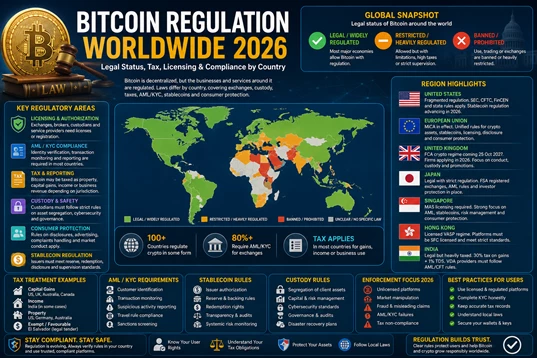
Bitcoin regulation refers to the laws, rules, and compliance requirements that governments apply to Bitcoin users, exchanges, brokers, custodians, stablecoin issuers, payment companies, and crypto service providers.
Bitcoin itself is a decentralized network, so most countries do not regulate the protocol directly. Instead, they regulate the businesses and activities around Bitcoin. That usually includes crypto exchanges, wallet providers, custody services, tax reporting, anti-money laundering rules, KYC checks, advertising, consumer protection, and market conduct.
The important point is that Bitcoin legal status differs by country. In some countries, Bitcoin is legal to buy, hold, sell, and use. In others, access is restricted, heavily supervised, or indirectly limited through banking rules and exchange licensing.
This guide gives a worldwide overview of Bitcoin regulation in 2026, including the United States, European Union, United Kingdom, Asia-Pacific, tax treatment, licensing, AML/KYC, stablecoin rules, custody rules, and enforcement trends.
This article is educational only and is not legal, tax, or financial advice.
Table of Contents
Global Snapshot: Bitcoin Regulation Worldwide
When people search for Bitcoin regulation worldwide, they usually want to know one thing first: “Is Bitcoin legal in my country?”
The answer depends on where you live. In many major markets, Bitcoin is not banned, but the companies that provide Bitcoin services must follow strict rules. This includes exchanges, brokers, custodians, stablecoin issuers, and payment platforms.
Most countries regulate Bitcoin through five main areas:
- Exchange rules — platforms may need registration, licensing, reporting, and compliance systems.
- AML/KYC — users may need identity verification before trading or withdrawing crypto.
- Tax treatment — Bitcoin gains may be taxed as capital gains, income, property, or another category.
- Custody rules — companies holding customer Bitcoin may need stronger safeguards.
- Consumer protection — regulators may control advertising, disclosures, risk warnings, and platform conduct.
A key trend in 2026 is that regulators are moving away from vague warnings and toward formal crypto frameworks. The EU has MiCA, the UK is preparing its full cryptoasset regime for October 2027, and Asian hubs like Singapore and Hong Kong are expanding licensing and supervision. MiCA creates uniform EU market rules for crypto-assets, including transparency, disclosure, authorization, and supervision requirements.
Bitcoin Legal Status by Region
| Region | Bitcoin Legal Status | Main Regulatory Focus |
|---|---|---|
| United States | Generally legal, but fragmented | SEC/CFTC oversight, stablecoins, tax, exchange rules |
| European Union | Legal under MiCA framework | Authorization, disclosure, stablecoins, consumer protection |
| United Kingdom | Legal, new regime coming | FCA regime, promotions, custody, trading, stablecoins |
| Japan | Legal, regulated exchanges | FSA registration, AML, investor protection |
| Singapore | Legal but tightly supervised | MAS licensing, stablecoins, prudential treatment |
| Hong Kong | Legal through licensed platforms | SFC virtual asset platform licensing |
| India | Not banned, but heavily taxed and supervised | Tax, AML/KYC, FIU registration |
| China | Highly restricted | Trading and exchange restrictions |
This table is simplified. Bitcoin regulation by country can change quickly, and tax treatment may differ even when Bitcoin is legal to own.
United States Bitcoin Regulation
The United States has one of the most important but fragmented approaches to Bitcoin regulation. There is no single complete federal crypto law that covers everything. Instead, different agencies may regulate different parts of the market.
The main US regulatory themes are:
- Securities law
- Commodities law
- Money transmission
- Tax reporting
- Stablecoin rules
- AML/KYC compliance
- Exchange and custody supervision
Bitcoin itself has generally been treated differently from many tokens because it is widely viewed as more decentralized than most crypto assets. However, US Bitcoin regulation still affects Bitcoin users through exchanges, brokers, ETFs, custodians, stablecoin rails, and tax reporting.
In March 2026, the SEC issued guidance clarifying how federal securities laws apply to crypto assets, including categories such as digital commodities, stablecoins, digital collectibles, digital tools, and digital securities. The guidance also addressed topics such as mining, staking, wrapping, and when a non-security crypto asset may become part of an investment contract.
Stablecoin regulation is also important for Bitcoin because many Bitcoin trades happen through stablecoin pairs. The SEC’s 2026 small-business guidance explains that a payment stablecoin used for payment or settlement may generally not be a security under the GENIUS Act, while other stablecoins may be securities depending on their features.
For everyday users, the most important US issues are tax reporting, exchange compliance, custody risk, and whether the platform they use is properly supervised.
European Union Bitcoin Regulation: MiCA
The European Union has one of the clearest crypto frameworks in the world through MiCA, the Markets in Crypto-Assets Regulation.
MiCA is important because it gives the EU a unified approach instead of forcing every member state to create completely separate rules. It covers crypto-asset service providers, crypto issuers, stablecoins, transparency, disclosure, authorization, market abuse, and consumer protection.
For Bitcoin users, MiCA matters because it affects the platforms they use. Exchanges, brokers, custody providers, and other crypto-asset service providers must meet authorization and operating requirements. MiCA is not about changing Bitcoin’s code. It is about regulating the companies that provide Bitcoin-related services inside the EU.
MiCA also places strong focus on stablecoins. This matters because stablecoins are often used as trading pairs, settlement assets, and liquidity tools in crypto markets. ESMA describes MiCA as a framework covering crypto-assets not already regulated by existing financial services law, with rules for transparency, disclosure, authorization, and supervision.
In 2026, the EU is becoming a global template for crypto compliance. Many companies serving European customers must think about authorization, disclosures, governance, custody, stablecoin treatment, and consumer protection.
United Kingdom Bitcoin Regulation
The United Kingdom is moving toward a formal cryptoasset regulatory regime, but the key start date is important.
The FCA says the new UK cryptoasset regime is expected to come into force on 25 October 2027. In 2026, firms are preparing for that regime through consultations, applications, systems upgrades, and compliance planning.
The FCA also states that the application period is open from 30 September 2026 to 28 February 2027, which gives crypto firms a preparation window before the regime begins.
The UK approach focuses on:
- Cryptoasset trading platforms
- Crypto custody
- Financial promotions
- Stablecoin rules
- Market abuse
- Prudential requirements
- Consumer protection
- Conduct standards
The FCA said in April 2026 that crypto will be regulated in the UK from October 2027 and that wider rules are being finalized.
For Bitcoin users, this means the UK is not banning Bitcoin. Instead, it is moving toward a more regulated crypto market where platforms must meet clearer standards.
Asia-Pacific Bitcoin Regulation
Asia-Pacific has some of the most diverse approaches to Bitcoin regulation by country. Some jurisdictions support regulated innovation, while others are restrictive.
Japan
Japan has long been one of the more structured crypto markets. Exchanges are legal but must follow registration, AML, custody, and consumer protection rules. In 2026, Japan continues to move toward stronger investor protection and market integrity.
Japan’s FSA published updates in 2026 related to AML/CFT guidelines, showing that compliance and financial crime prevention remain central regulatory priorities.
Reuters previously reported that Japan’s FSA planned to revise financial instruments law to give crypto assets legal status as financial products and apply insider-trading style restrictions, with legislation planned for 2026.
Singapore
Singapore regulates crypto through the Monetary Authority of Singapore, known as MAS. Its framework focuses heavily on licensing, risk management, stablecoins, AML/CFT, and consumer protection.
MAS published a 2026 consultation on the prudential treatment of cryptoassets on permissionless blockchains, showing that Singapore is thinking carefully about how financial institutions should treat crypto risk.
Singapore has also developed stablecoin rules. MAS has described a regulatory framework designed to ensure a high degree of value stability for stablecoins regulated in Singapore.
Hong Kong
Hong Kong is positioning itself as a regulated virtual asset hub. The Securities and Futures Commission publishes lists of licensed virtual asset trading platforms so the public can check the regulatory status of platforms operating in or marketing to Hong Kong investors.
Hong Kong’s SFC says licensed or registered intermediaries conducting virtual asset-related activities are subject to a wide range of regulatory requirements.
For users, the key lesson is simple: in Hong Kong, platform licensing matters.
India
India has not fully legalized crypto as official money, but crypto is not simply ignored. It is heavily shaped by tax, AML/KYC, and reporting rules.
India’s Financial Intelligence Unit issued AML/CFT guidelines for virtual digital asset service providers in January 2026, stating that these providers fall within the AML/CFT/CPF framework and must comply with due diligence and related obligations.
India is also known for strict crypto tax treatment. Crypto gains have commonly been subject to a flat 30% tax and a 1% TDS on transactions, according to Indian crypto tax guidance for 2026.
Tax and Reporting Rules
Tax is one of the most important parts of Bitcoin regulation because even where Bitcoin is legal, using it can create tax obligations.
Depending on the country, Bitcoin may be taxed as:
- Property
- Capital gains
- Income
- Business revenue
- Commodity-like asset
- Virtual digital asset
Common taxable events may include:
- Selling Bitcoin for fiat
- Swapping Bitcoin for another crypto asset
- Spending Bitcoin
- Receiving Bitcoin as income
- Mining Bitcoin
- Earning rewards or yield
- Donating Bitcoin in some jurisdictions
Tax rules vary heavily by country. One country may treat Bitcoin as property, another may tax it as income, and another may impose special digital asset rules.
For Bitcoin users, good record keeping is essential. You may need to track purchase price, sale price, dates, wallet transfers, exchange history, transaction fees, and gains or losses.
As global tax transparency increases, exchanges may be required to report more information to tax authorities. That means users should not assume crypto activity is invisible.
Licensing, AML and KYC
Licensing and AML/KYC are central to Bitcoin regulation worldwide.
AML means anti-money laundering. KYC means know your customer. These rules are designed to stop criminal finance, sanctions evasion, fraud, terrorist financing, and other illegal activity.
Crypto exchanges and custodians may need to:
- Verify customer identity
- Monitor transactions
- Report suspicious activity
- Follow sanctions rules
- Keep compliance records
- Register or obtain a license
- Apply travel-rule style data sharing
- Maintain cybersecurity and custody controls
For normal Bitcoin users, this usually means you may need to provide identity documents before using a regulated exchange. It may also mean withdrawals, deposits, or large transactions are monitored.
Some users dislike KYC because they value privacy. Regulators argue that AML/KYC is necessary for consumer protection and financial crime prevention. This tension is one of the biggest debates in crypto regulation.
Stablecoin Regulation and Why It Matters for Bitcoin
A Bitcoin regulation article should also cover stablecoins because stablecoins are deeply connected to the Bitcoin trading ecosystem.
Many Bitcoin trades happen through stablecoin pairs such as BTC/USDT or BTC/USDC. Stablecoins are also used for liquidity, settlement, DeFi, remittances, and exchange balances.
Stablecoin regulation usually focuses on:
- Issuer authorization
- Reserve assets
- Redemption rights
- Custody of reserves
- Disclosure
- Audits
- Consumer protection
- Financial stability risk
The EU’s MiCA framework includes rules for asset-referenced tokens and e-money tokens, with authorization, transparency, reserves, and supervision requirements.
Stablecoins have become one of the hottest regulatory topics in 2026. Reuters reported in May 2026 that both ECB President Christine Lagarde and Bank of England Governor Andrew Bailey raised concerns about stablecoin risks and the need for stronger or consistent bitcoin regulation.
For Bitcoin users, stablecoin rules matter because they affect exchanges, trading liquidity, fiat on/off ramps, and DeFi activity.
Custody Rules and Consumer Protection
Custody is another major part of Bitcoin regulation.
Custody means holding assets for customers. A crypto custodian may hold private keys, manage wallets, and secure customer Bitcoin. Because Bitcoin transactions are irreversible, custody failures can be serious.
Regulators care about custody because users can lose money through:
- Exchange hacks
- Poor wallet management
- Insider fraud
- Bankruptcy
- Misuse of customer funds
- Weak segregation of assets
- Poor cybersecurity
Consumer protection rules may require platforms to clearly explain risks, separate customer assets, maintain capital, follow cybersecurity standards, and provide transparent disclosures.
For self-custody users, regulation is different. If you hold your own Bitcoin in a hardware wallet, you are not relying on an exchange to custody it. But you are responsible for your own seed phrase and private keys.
This is the tradeoff: regulated custody gives convenience and potential legal protection, while self-custody gives control and responsibility.
Enforcement Trends in 2026
In 2026, crypto enforcement is focused less on Bitcoin ownership and more on platforms, fraud, market abuse, advertising, tax reporting, AML failures, and unlicensed activity.
Regulators are paying attention to:
- Unlicensed exchanges
- Misleading crypto promotions
- Fake investment schemes
- Stablecoin reserve claims
- Market manipulation
- Poor custody controls
- Weak AML/KYC processes
- Tax non-compliance
- Cross-border platform access
This is why Bitcoin users should care about whether a platform is properly licensed or registered. The legal status of Bitcoin may be one question, but the legal status of the platform you use is just as important.
Bitcoin Regulation by Country: What Users Should Check
Before using Bitcoin in any country, check these questions:
- Is Bitcoin legal to buy, hold, sell, and use?
- Are crypto exchanges licensed or registered?
- Are there AML/KYC requirements?
- How is Bitcoin taxed?
- Are stablecoins regulated?
- Can banks serve crypto companies?
- Are foreign exchanges allowed to serve local users?
- Are there restrictions on payments or advertising?
- Are custodians required to follow special rules?
- What records should users keep for tax reporting?
This type of checklist helps your page rank for both Bitcoin legal status and Bitcoin regulation by country because it answers the practical search intent directly.
FAQ
Is Bitcoin legal in my country?
Bitcoin legal status depends on your country. In many places, Bitcoin is legal to buy and hold, but exchanges, brokers, and custodians must follow licensing, AML/KYC, tax, and reporting rules.
Is Bitcoin regulated everywhere?
No. Bitcoin regulation differs worldwide. Some countries have formal crypto frameworks, some regulate through tax and AML rules, and others restrict crypto activity more heavily.
Do I need a license to use Bitcoin?
Normal users usually do not need a license just to buy, hold, or send Bitcoin. Businesses such as exchanges, brokers, custodians, payment providers, and trading platforms may need registration or licensing.
What is MiCA?
MiCA is the European Union’s Markets in Crypto-Assets Regulation. It creates uniform EU rules for crypto-assets, including authorization, disclosure, stablecoins, consumer protection, and supervision.
How do tax and AML rules affect Bitcoin users?
Tax rules may require users to report gains, income, sales, swaps, or spending. AML/KYC rules may require identity verification when using regulated exchanges or custodians.
Why do stablecoin rules matter for Bitcoin?
Stablecoins matter because they are widely used in Bitcoin trading pairs, exchange liquidity, remittances, and DeFi. When stablecoin regulation changes, it can affect how people buy, sell, and move Bitcoin.
Conclusion: Bitcoin Regulation Is Becoming More Serious Worldwide
Bitcoin regulation is no longer just a warning label. In 2026, governments are building more detailed rules around exchanges, custody, tax, AML/KYC, stablecoins, licensing, consumer protection, and enforcement.
The main trend is clear: Bitcoin itself remains decentralized, but the companies around Bitcoin are becoming more regulated.
For users, the key is to understand your local Bitcoin legal status, use compliant platforms, keep strong tax records, protect your wallet, and stay aware of changing rules. For businesses, the focus is licensing, AML/KYC, custody standards, stablecoin exposure, financial promotions, and consumer protection.
Bitcoin may be global, but regulation is local. That is why a strong understanding of Bitcoin regulation worldwide is essential for anyone using, trading, holding, or building with Bitcoin in 2026.