In the rapidly evolving digital economy, Bitcoin has emerged as the cornerstone of a new financial paradigm. Since the publication of the Bitcoin Whitepaper by the enigmatic Satoshi Nakamoto in 2008, this decentralized digital currency has transformed from a niche cryptographic experiment into a global investment asset.
Unlike legacy finance, which relies on a central authority to validate transactions, Bitcoin operates as a transparent peer-to-peer network. By utilizing blockchain technology, it offers a censorship-resistant alternative to state-backed fiat money. This article explores why Bitcoin is increasingly viewed as digital gold and how its underlying mechanics—ranging from proof of work to the Lightning Network—are positioning it as a fundamental pillar of the future global financial landscape.
What Is Bitcoin?
At its core, Bitcoin is the first successful digital currency that functions without the need for a central clearinghouse. It is a decentralized digital currency that allows users to transfer value across the globe instantly. By removing the need for intermediaries, Bitcoin enables individuals to maintain full sovereignty over their wealth.
The system is maintained by a peer-to-peer network of nodes that continuously validate the state of the decentralized ledger. Whether you are looking to hedge against inflation or participate in the next wave of global finance, understanding the distinction between Bitcoin and traditional digital assets is the first step in navigating the 21st-century digital economy.
Unlike traditional money:
- Bitcoin has a fixed supply of 21 million coins
- Transactions are transparent and verifiable
- No government or central authority controls it
Because of its scarcity and decentralized nature, Bitcoin is often referred to as “digital gold.”
Who Created Bitcoin?
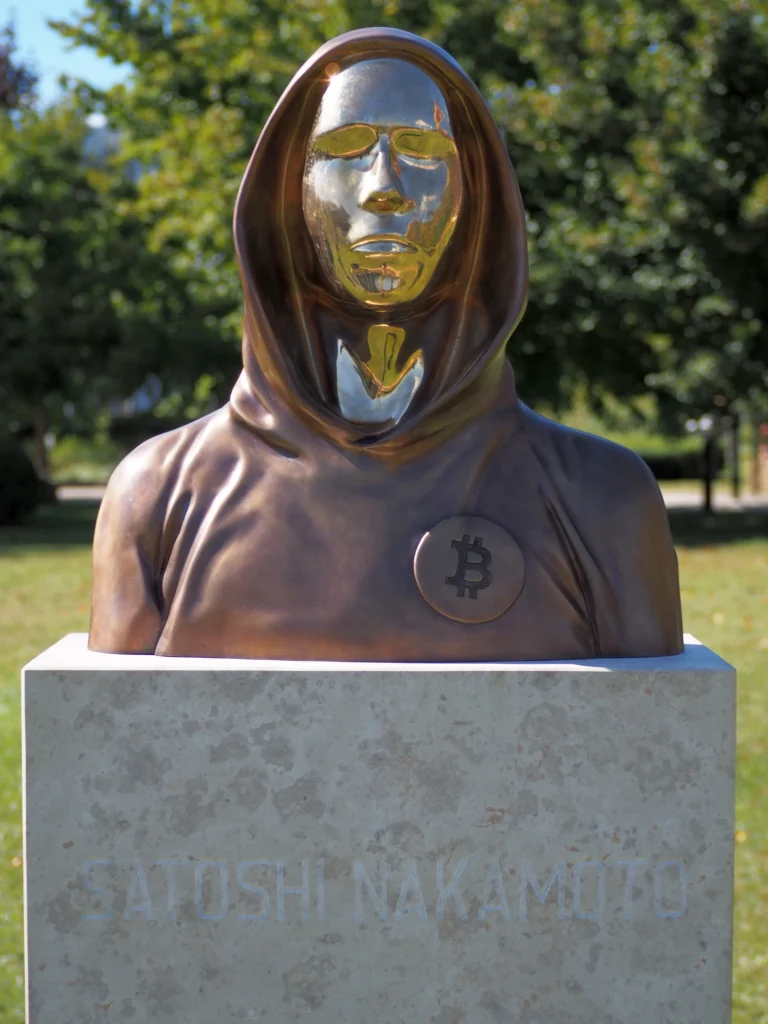
Bitcoin was created by Satoshi Nakamoto, a pseudonymous figure whose true identity remains unknown. The identity of Satoshi Nakamoto remains the most intriguing mystery in the world of technology.
By releasing the protocol to the public in 2008, Satoshi provided a blueprint for trustless interaction. Whether Nakamoto was an individual or a group, their contribution—combining existing cryptographic techniques with a novel incentive structure—created a system that functions without a central authority, forever changing the financial landscape.
In 2008, Satoshi published the Bitcoin whitepaper titled:
“Bitcoin: A Peer-to-Peer Electronic Cash System”
In 2009, the first Bitcoin block (Genesis Block) was mined, officially launching the network.
Despite many theories, Satoshi’s identity has never been confirmed — adding to Bitcoin’s mystique and decentralization.
How Does Bitcoin Work?
Bitcoin runs on a technology called blockchain, which is a distributed ledger shared across thousands of computers worldwide.
Here’s how it works:
1. Transactions
Transactions are the lifeblood of the network. When a user initiates a transfer, it is signed with a private key and broadcast to the peer-to-peer network.
This signature provides the cryptographic proof that the sender has the authority to move the funds, ensuring that the digital assets are secure and cannot be double-spent.
2. Verification
Once a transaction is broadcast, network nodes verify its authenticity. This process ensures that the transaction adheres to the rules of the protocol. This verification mechanism is what allows Bitcoin to operate as a secure payment system without relying on a bank to act as a gatekeeper.
3. Block Creation
Verified transactions are bundled into a “block” by miners. Through Bitcoin Mining, participants compete to solve a complex mathematical puzzle—a process known as proof of work. This creates an energy-intensive but highly secure environment that makes it economically prohibitive for any bad actor to manipulate the network’s history.
4. Blockchain
Each block is cryptographically linked to the previous one, creating an immutable chain known as a blockchain technology-based ledger.
This decentralized ledger serves as the single source of truth for the entire network, ensuring that all participants see the exact same history of balances and transactions.
5. Security
The security of the network is unparalleled. By using digital signatures and cryptographic techniques, Bitcoin ensures that only the holder of the private key can authorize a transaction.
This “not your keys, not your crypto” philosophy is why using a hardware wallet is considered the gold standard for long-term storage.
This system removes the need for trust in a central authority and replaces it with cryptographic proof.
Bitcoin Supply and Scarcity
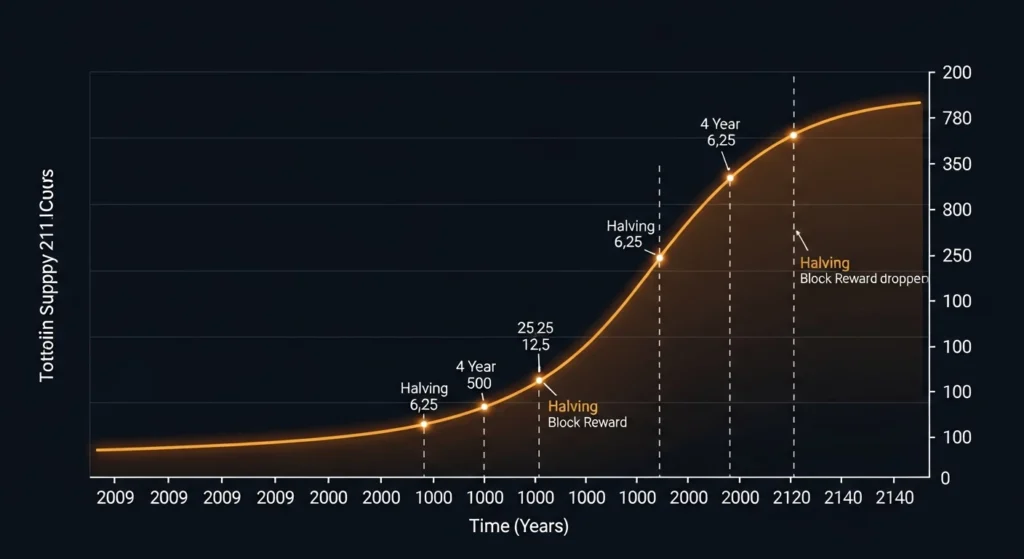
Bitcoin’s programmatic scarcity: The total supply approaches 21 million over time as the issuance rate is cut in half every four years.
Bitcoin’s value proposition is heavily anchored in its programmatic scarcity. Unlike fiat currencies, which can be printed indefinitely, Bitcoin has a hard-coded maximum supply of 21 million coins. This supply schedule is enforced by Bitcoin Mining, a process that secures the network and issues new coins at a predictable, declining rate. Every four years, the issuance rate is halved, creating a supply shock that has historically preceded significant market appreciation. This scarcity is why many economists and institutional investors categorize Bitcoin as digital gold, serving as a reliable store of value that cannot be debased by central bank policy.
One of Bitcoin’s most important features is its fixed supply.
- Maximum supply: 21 million BTC
- No more can ever be created
This scarcity is what gives Bitcoin its value proposition as a hedge against inflation.
Unlike fiat currencies, which can be printed endlessly, Bitcoin becomes more scarce over time.
Bitcoin undergoes a process called halving approximately every 4 years.
- Mining rewards are cut in half
- New Bitcoin supply slows down
- Historically leads to bull markets
Examples:
- 2012 → price increase
- 2016 → major bull run
- 2020 → massive rally
- 2024 → next cycle impact (affecting 2025–2026)
Halving events create supply shocks, which often drive prices higher.
Bitcoin History & Major Milestones
Bitcoin’s journey is defined by its resilience. From the mining of the Genesis Block in 2009 to the massive institutional adoption seen in recent years, the protocol has maintained remarkable protocol stability. Key milestones—such as the creation of the first crypto exchange platform and the emergence of institutional-grade custody—have bridged the gap between early cypherpunks and modern wealth managers. Today, Bitcoin is a major asset class, with cryptocurrency exchanges and major financial institutions building infrastructure to support its growth within the broader financial landscape.
Bitcoin’s journey from a niche experiment to a global financial asset has been defined by key milestones that shaped adoption and price cycles.
- 2009 – Genesis Block: Bitcoin was launched by Satoshi Nakamoto, introducing decentralized money for the first time.
- 2012 – First Halving: Block rewards dropped from 50 BTC to 25 BTC, beginning the supply-shock cycles still seen today.
- 2013 Bull Run: Bitcoin surged past $1,000 for the first time, attracting global attention.
- 2017 Bull Run: BTC reached nearly $20,000, driven by retail hype and ICO speculation.
- 2021 Bull Run: Bitcoin hit new highs near $69,000, fueled by institutional adoption and macro interest.
- 2021 – El Salvador Adoption: El Salvador became the first country to adopt Bitcoin as legal tender.
- 2024 – Spot ETF Approvals: Major financial players gained exposure through spot Bitcoin ETFs, marking a shift toward mainstream finance integration.
👉 For a full breakdown, see the upcoming Bitcoin History guide.
Bitcoin Regulation & Legal Status (High-Level)
The legal status of Bitcoin is evolving as governments grapple with the Sovereign Bitcoin Race. While some nations have embraced the asset as legal tender, others maintain regulatory uncertainties. However, the trend toward global integration is clear. By participating in the Bitcoin Policy Hour and engaging with evolving frameworks, stakeholders are working to harmonize innovation with security. As the US-China Competition for digital supremacy intensifies, Bitcoin’s role as a neutral, global reserve asset is becoming a central point of discussion among policymakers worldwide.
Bitcoin is legal in most parts of the world, but how it is treated varies by country.
- Legal in most developed economies (US, EU, UK, etc.)
- Typically classified as property or a commodity, not currency
- Subject to taxation on profits and transactions
- Exchanges must follow KYC and anti-money-laundering (AML) rules
- Some countries restrict or ban usage, but enforcement varies
👉 A full breakdown is coming in the Bitcoin Regulation & Tax guide.
Follow Crypto Cobra for daily Bitcoin insights:
For those seeking to stay ahead of the Sovereign Bitcoin Race and navigate the nuances of the financial landscape, following expert analysis is vital. We recommend staying engaged with resources that track Coin Metrics and provide high-level updates on policy, energy, and technical breakthroughs.
https://www.youtube.com/@Cryptoscobra
https://x.com/cryptoscobra
https://www.instagram.com/cryptocobra1
https://www.threads.com/@cryptocobra1
https://www.tiktok.com/@cryptoscobra
https://t.me/cryptoscobra
https://www.facebook.com/Cryptoscobra
https://creators.spotify.com/pod/profile/cryptocobra
Why Bitcoin Matters
Bitcoin is more than just a cryptocurrency — it represents a shift in financial systems.
Key reasons Bitcoin matters:
- Decentralization → no central control
- Scarcity → fixed supply
- Security → highly resistant to attacks
- Global access → anyone can use it
- Store of value → often compared to gold
Bitcoin is increasingly being adopted by institutions, hedge funds, and even governments.
Real Use Cases of Bitcoin
Bitcoin has evolved far beyond simple transactions.
1. Store of Value
Many investors hold Bitcoin as a long-term asset.
2. Payments
Used globally for peer-to-peer transfers.
3. Remittances
Send money internationally with lower fees.
4. Hedge Against Inflation
Especially in countries with unstable currencies.
Advantages of Bitcoin
Increasing institutional adoption
Limited supply (scarcity)
Decentralized and censorship-resistant
Transparent blockchain
Borderless transactions
Risks of Bitcoin
No investment is risk-free — Bitcoin included.
Key risks:
- High volatility
- Regulatory uncertainty
- Security risks (if mismanaged)
- Market manipulation
- Scams and fraud
Understanding both sides builds trust and improves SEO (EEAT).
How to Buy Bitcoin
Buying Bitcoin is easier than ever.
👉 Read full guide: /blog/how-to-buy-bitcoin/
Basic steps:
- Choose a crypto exchange
- Verify your account
- Deposit funds
- Buy Bitcoin
- Transfer to a secure wallet
Best Bitcoin Wallets
Storing Bitcoin safely is critical.
👉 See full list: /blog/best-bitcoin-wallets/
Types of wallets:
- Hardware wallet: The safest way to store your private key offline.
- Mobile wallets: Convenient for frequent, small-scale payments.
- Software wallets: Useful for those managing day-to-day interactions.
- SPV wallet: A lightweight option that provides high-speed synchronization with the blockchain.
Always remember:
Not your keys = not your crypto
Bitcoin Mining Explained
Bitcoin Mining serves a dual purpose: securing the network through proof of work and issuing new coins into circulation. It is an industrial-scale operation that balances security with decentralization.
Modern mining strategies are increasingly focused on energy sustainability, often utilizing excess power from the oil crisis or renewable sources to improve efficiency.
👉 Full guide: https://cryptoscobra.com/blog/trusted-cloud-mining-sites-11
Key points:
Rewards miners with BTC
Uses Proof-of-Work
Requires powerful hardware
Consumes electricity
Bitcoin vs Ethereum
While Bitcoin is primarily designed as a store of value, Ethereum serves as a blockchain platform for a smart contract-based ecosystem.
Ethereum’s Virtual Machine (EVM) allows for complex applications, whereas Bitcoin prioritizes protocol stability and security. However, with new tokenization libraries and developments like the Bitcoin Virtual Machine (BVM), Bitcoin is now expanding its capability to support sophisticated layers.
👉 Full comparison: /blog/bitcoin-vs-ethereum/
Key difference:
Ethereum → smart contract platform
Bitcoin → store of value
Bitcoin Price Prediction 2026
Predictions for 2026 are optimistic, driven by institutional adoption and the continued expansion of the Lightning Network. Analysts point to the maturation of the market and the “Sovereign Bitcoin Race” as catalysts for growth.
Rather than focusing on a Day High or Day Low, investors are increasingly looking at the fundamentals of the network as a barometer for its long-term health.
👉 Detailed analysis: https://cryptoscobra.com/blog/bitcoin-price-update-sept-25
Bitcoin’s price is influenced by:
- Halving cycles
- Institutional adoption
- Market demand
- Global economic conditions
Some analysts predict continued growth, while others warn of volatility.
Lightning Network & Layer 2 (Overview)
The Lightning Network is essential for Bitcoin’s scalability. By allowing for off-chain transactions, it drastically reduces processing fees and increases speed, enabling everyday use cases such as Agentic Payments and micro-transactions. This layer allows Bitcoin to serve as a high-frequency payment system while maintaining the base layer’s rigorous security.
This allows Bitcoin to function not just as digital gold, but also as a practical payment network. Transactions on Lightning are:
- Near-instant
- Extremely low cost
- Scalable to millions of users
As adoption grows, Lightning plays a key role in Bitcoin’s long-term utility beyond just storing value.
👉 Learn more in the upcoming Lightning Network guide.
Is Bitcoin a Good Investment in 2026?
Reasons investors buy Bitcoin:
- Scarcity-driven value: The 21 million cap acts as a hedge against inflation.
- Financial inclusion: Provides access to a global payment system for the unbanked.
- Institutional adoption: Inclusion in corporate treasuries and pension funds.
However, Bitcoin is volatile and should be approached with a long-term mindset.
How to Think About Bitcoin as an Investment
Bitcoin is not a typical investment. Understanding how to approach it is critical.
Store-of-Value Thesis
Bitcoin is the first asset to combine the physical properties of gold—scarcity, durability, and divisibility—with the digital advantage of global transferability. Treating it as a long-term investment asset requires patience and an understanding of its role in a diversified portfolio.
Volatility & Drawdowns
While Bitcoin is a powerful tool for wealth preservation, investors must be prepared for short-term price fluctuations. These movements are often driven by market demand and shifting macro-economic conditions. A long-term approach is the most effective way to navigate this asset class, as historical data consistently shows that time-in-market outweighs the risks associated with daily volatility. Investors should view volatility not as a risk to be avoided, but as a feature of a nascent, global market. By utilizing a hardware wallet and maintaining a long-term perspective, you can mitigate the noise of the market and focus on the structural growth of the network.
Bitcoin is highly volatile. Historically, it has experienced:
- Multiple 70–80% drawdowns
- Rapid bull cycles followed by deep corrections
This volatility is normal and part of its market structure.
Time Horizon & Risk Management
Bitcoin tends to reward long-term holders, not short-term traders.
Key principles:
- Think in years, not weeks
- Only invest what you can afford to hold through volatility
- Avoid emotional decisions during market extremes
👉 For deeper analysis, see the upcoming Bitcoin Risk & Volatility guide.
Bitcoin FAQs
Is Bitcoin good for beginners?
Yes, but beginners should start small and focus on understanding wallets, security, and how transactions work before investing larger amounts.
👉 See: Beginner Bitcoin guide (coming soon)
What is Bitcoin used for?
Bitcoin is used for payments, investing, and as a store of value.
Is Bitcoin safe?
Bitcoin itself is secure, but users must protect their wallets and private keys.
Can Bitcoin go to zero?
While unlikely due to adoption, it remains a theoretical risk.
How much Bitcoin should I buy?
Only invest what you can afford to lose — diversification is key.
Is Bitcoin legal?
Bitcoin is legal in many jurisdictions, but the rules vary a lot by country, especially around taxes, licensing, AML/KYC, and exchange supervision. The global picture is fragmented, with some countries allowing broad use, some restricting parts of the ecosystem, and others imposing bans or heavy compliance requirements.
In practice, legality usually depends less on Bitcoin itself and more on how it is used, bought, sold, or taxed in a specific jurisdiction.
How long should I hold Bitcoin?
Most successful investors take a long-term approach (years) rather than trying to time short-term price movements.
Can governments ban Bitcoin?
Governments can restrict exchanges and usage, but Bitcoin itself is decentralized and cannot be shut down globally.
Is Bitcoin safe to invest in?
Bitcoin is secure as a network, but price volatility makes it risky in the short term. Proper risk management is essential.
What is the safest way to Buy and store Bitcoin safely?
For most people, the safest path is to buy Bitcoin from a reputable exchange and then move it to self-custody if you plan to hold it long term. Hardware wallets are widely recommended because they keep private keys offline and reduce exposure to online hacking.
A practical safety checklist is: use a reputable exchange, enable 2FA, withdraw to a hardware wallet, back up the seed phrase securely, and never share private keys or recovery words.
Bitcoin in 2030
What Bitcoin will be worth in 2030 is impossible to know with certainty, but published 2030 targets vary widely. ARK Invest’s 2025 model gives bear/base/bull estimates of about $300,000, $710,000, and $1.5 million per BTC, while other forecasts are much lower or higher depending on assumptions.
$1 In Bitcoin
“$1 in Bitcoin” usually means how much BTC you get for one U.S. dollar at the current price. With BTC quoted around $66,858 per coin on XE’s converter page, $1 would buy about 0.00001495 BTC. Because Bitcoin’s price moves constantly, that amount changes minute by minute.
How Bitcoin Works
Bitcoin works as a decentralized payment network where transactions are broadcast to nodes, grouped into blocks, and validated through proof of work. Each new block references the previous one, which creates the chain and makes history hard to rewrite.
A fuller technical explanation shows that transactions are structured inputs and outputs, then signed and propagated across the network before being confirmed by miners and nodes.
Inflation And Store Of Value
Bitcoin is designed with a fixed supply cap of 21 million coins, and new issuance is reduced through halving events roughly every four years. That scarcity is why people call it “digital gold” and argue it can help resist inflation over time.
That said, Bitcoin is still volatile, so its store-of-value case is based on long-term scarcity and adoption rather than short-term price stability.
What is Bitcoin?
Bitcoin is a peer-to-peer digital asset and payment system that launched in 2009, with the network starting at the genesis block. It is not issued by a central bank or company; instead, it runs on open-source software and a distributed network of participants.
The creator is still unknown publicly, and the name “Satoshi Nakamoto” is a pseudonym.
Bitcoin’s Price History
Bitcoin has gone from fractions of a cent to over $126,000 at its 2025 peak, with huge drawdowns along the way. Over the past decade, its major price cycles have been shaped by halvings, macro liquidity, institutional adoption, regulation, and major market shocks like exchange failures.
Recent history shows especially strong moves after the 2024 ETF launch and then renewed volatility into 2026.
Global Regulation
The biggest regulatory issues are AML/KYC compliance, exchange licensing, tax treatment, consumer protection, custody rules, and uncertainty over whether BTC-related activity should be treated as commodities, securities, payment services, or property. Global coordination is still uneven, which makes cross-border Bitcoin businesses harder to run.
A major trend in 2025–2026 is that regulators are moving from vague enforcement toward clearer frameworks, but the rules are still highly jurisdiction-specific.
Final Thoughts
Bitcoin is more than just a digital currency; it is the infrastructure for a more transparent, secure, and equitable future. From its inception by Satoshi Nakamoto to its current status as a global asset class, it has proven its ability to withstand immense pressure.
Whether you are interested in the technical advancements of the Lightning Network or the macro-geopolitical implications of the Sovereign Bitcoin Race, the path forward is clear: Bitcoin is becoming an operational necessity for the 21st-century digital economy. By prioritizing self-custody with a hardware wallet and maintaining a long-term outlook, you can effectively navigate this evolving landscape and secure your stake in the future of finance.