
In this Bitcoin Price Prediction 2026 I share my personal bitcoin analysis of where I see bitcoin at the end of 2026.
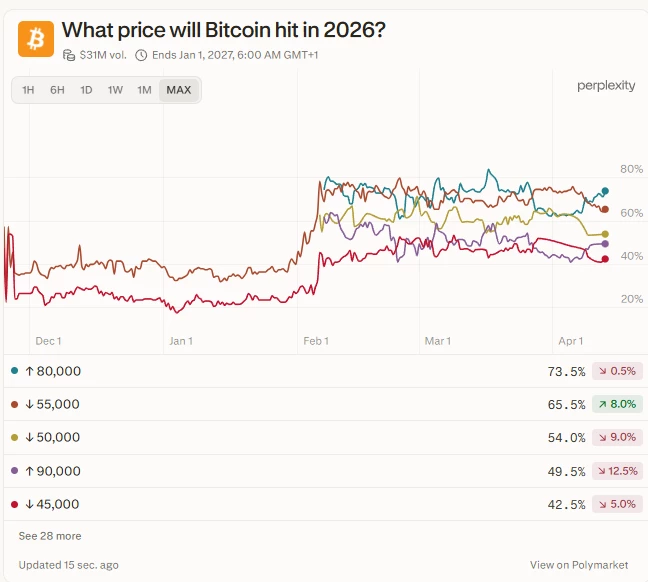
Bitcoin’s price has hovered around $72,000 in early April 2026, down from its 2025 peak of $126,000 but showing signs of recovery amid ETF inflows and policy shifts. Analysts project a range of outcomes for the rest of 2026, from conservative $90,000 targets to bullish $150,000+ forecasts driven by supply dynamics and adoption.[1][2]
Current Market Context
Bitcoin traded between $60,000 and $98,000 in 2026 so far, reflecting post-2025 correction volatility after hitting $126,198 in October 2025. The 2024 halving reduced block rewards to 3.125 BTC, creating a supply shock that historically fuels bull runs 12-24 months later—positioning mid-2026 as a potential inflection point. Exchange reserves hit all-time lows at 2.1 million BTC, with ETFs absorbing 15,000 BTC weekly, tightening liquid supply.
Spot Bitcoin ETFs saw $1.2 billion inflows in early 2026, led by BlackRock’s IBIT ($372 million) and Fidelity’s FBTC, reversing late-2025 outflows and signaling renewed institutional demand. Total U.S. ETF assets under management exceed $115 billion, correlating strongly with price momentum.
Today 12.04.2026 btc is $72k
Key Bullish Drivers
The U.S. Strategic Bitcoin Reserve, holding 328,372 BTC as of February 2026, commits to non-sale policies and explores budget-neutral acquisitions, bolstering scarcity narratives. President Trump’s March 2025 announcement formalized this via executive order, with Treasury and Commerce evaluating further buys.[1][2]
Corporate adoption surged: 194 public companies hold Bitcoin treasuries, up 2.5x in 2025, including MicroStrategy and Tesla, removing supply from circulation. Institutional allocations average 9% of AUM, projected to hit 18% soon, with 86% of investors holding or planning crypto exposure. [3][4]
Macro tailwinds include Federal Reserve easing—Bitcoin’s -0.72 correlation with real rates favors cuts, reducing holding costs for non-yielding assets. Global liquidity growth and QE resumption support risk assets like BTC.[5]
| Factor | Impact on 2026 Price | Evidence |
|---|---|---|
| ETF Inflows | +$150B annualized potential | $1.2B early 2026 cryptobriefing |
| Halving Supply Shock | Reduces issuance 50% | 24 months post-2024 binance |
| U.S. Reserve | Locks 328k BTC | No-sales policy wikipedia |
| Corp Holdings | 194 firms | 2.5x growth mexc |
Bearish Risks and Scenarios
Cycle debates rage: 2025’s post-halving red year broke patterns, shifting BTC toward macro asset status influenced by Fed policy over halvings. A black swan—strict U.S. regs, Fed hikes, or crisis—could test $55k realized price.
Macro tightening or dollar strength (inverse DXY correlation) pressures prices; overleveraged futures risk cascades. Competition from alts or equities could erode dominance if narratives shift.
Conservative forecasts like Kraken’s steady 5% growth imply limited upside without catalysts. Volatility persists: 50% drawdowns common, as seen from 2025 ATH.
Technical and On-Chain Insights
On-chain: Low exchange reserves and whale accumulation signal re-accumulation; CME gaps may fill short-term. MVRV and SOPR metrics suggest undervaluation versus history.
Technicals: Bearish short-term (50-day MA falling), but weekly 200-day MA rising supports trend. Fear & Greed at 15 (Extreme Fear) often precedes rebounds; 50% green days last month.
Cycle timing: Months 18-30 post-halving (now 24 months in) historically explosive; April 2026 as “launchpad” for parabolic phase.
Bitcoin Price Prediction 2026 Price Scenarios

Base Case ($100k-$130k year-end):
Sustained ETF inflows ($150B annualized), Fed easing, reserve buys align with halving momentum. Matches NAGA/Binance clusters.
Bull Case ($150k+):
U.S. active buying, corporate FOMO, liquidity surge propel to $200k-$300k per Standard Chartered. Supply under 7% unmined amplifies.
Bear Case ($60k-$90k):
Reg crackdown, hikes, or recession caps at $75k lows; tests supports if cycle fully mutates.
Bear Case ($60k-$90k):
Reg crackdown, hikes, or recession caps at $75k lows; tests supports if cycle fully mutates.
Bitcoin’s path hinges on policy clarity and liquidity—2026 likely rewards holders amid maturing adoption.
Follow Crypto Cobra for daily Bitcoin insights:
https://www.youtube.com/@Cryptoscobra
https://x.com/cryptoscobra
https://www.instagram.com/cryptocobra1
https://www.threads.com/@cryptocobra1
https://www.tiktok.com/@cryptoscobra
https://t.me/cryptoscobra
https://www.facebook.com/Cryptoscobra
https://creators.spotify.com/pod/profile/cryptocobra
Bitcoin Price Prediction 2026 – FAQs
What will Bitcoin be worth in 2026?
Bitcoin’s price in 2026 is expected to range between $90,000 and $150,000+ depending on market conditions. Bullish scenarios driven by ETF inflows, institutional demand, and post-halving supply shocks could push BTC higher, while macro uncertainty may limit upside.
Can Bitcoin reach $150,000 in 2026?
Yes, a $150,000 Bitcoin price in 2026 is possible if strong ETF inflows, continued institutional adoption, and favorable macro conditions align. Historically, Bitcoin tends to rally 12–24 months after halving events, which supports bullish projections.
What factors will affect Bitcoin price in 2026?
The most important factors include:
– Spot Bitcoin ETF inflows
– Institutional adoption
– Bitcoin halving supply shock
– Federal Reserve interest rates
– Global liquidity and macro trends
These elements collectively determine Bitcoin’s long-term direction.
Is Bitcoin a good investment in 2026?
Bitcoin can be a strong long-term investment due to its scarcity and increasing adoption. However, it remains highly volatile, and investors should be prepared for significant price swings.
Can Bitcoin drop in 2026?
Yes, Bitcoin could decline if:
Regulations tighten
Interest rates increase
Global markets weaken
Bearish scenarios suggest Bitcoin could revisit the $60,000–$90,000 range under adverse conditions.
Why is Bitcoin so volatile?
Bitcoin is volatile because it is still a relatively young asset influenced by:
Market sentiment
Liquidity changes
Macroeconomic factors
Leverage in derivatives markets
This volatility creates both risk and opportunity.
How high can Bitcoin go long term?
Some long-term projections suggest Bitcoin could exceed $200,000+ over time if adoption continues and supply remains constrained. However, this depends heavily on global demand and regulatory clarity.
Does Bitcoin halving affect price in 2026?
Yes, the 2024 halving reduced new supply by 50%, and historically, Bitcoin tends to experience strong price growth in the following 12–24 months — making 2026 a key period.
Is Bitcoin influenced by the stock market?
Yes, Bitcoin is increasingly correlated with macro assets like stocks and liquidity cycles. However, it also has unique supply-driven dynamics that differentiate it over time.
Should you buy Bitcoin before 2026?
That depends on your strategy. Many investors accumulate Bitcoin gradually (DCA) rather than trying to time the market, especially ahead of potential post-halving growth phases.
Final Thoughts
Bitcoin’s price outlook for 2026 remains highly dynamic, shaped by a combination of supply shocks, institutional demand, and global macroeconomic conditions.
After reaching highs above $120,000 in 2025 and correcting significantly, Bitcoin has entered a phase where long-term fundamentals are once again in focus. Analysts now project a wide range of outcomes, with estimates spanning from around $75,000 to over $150,000 depending on adoption, liquidity, and policy direction.
On the bullish side, continued ETF inflows, reduced supply following the 2024 halving, and increasing institutional exposure could create strong upward pressure on price. These factors have historically aligned with major Bitcoin rallies and may position 2026 as a key expansion phase in the current cycle.
At the same time, risks remain. Regulatory changes, macro tightening, or shifts in investor sentiment could limit upside or trigger further volatility. Bitcoin has already demonstrated its ability to experience large drawdowns, even within long-term uptrends.
What makes Bitcoin unique is that it is no longer just a speculative asset — it is evolving into a macro-driven financial instrument influenced by global liquidity, interest rates, and institutional capital flows.
For investors, the takeaway is clear:
Bitcoin offers significant long-term potential, but it requires patience, risk management, and a clear strategy.
As 2026 unfolds, Bitcoin will likely remain one of the most closely watched assets in the world — not just in crypto, but across the entire financial system.
Want a complete breakdown of Bitcoin fundamentals?
Read our full Bitcoin guide here → bitcoin