
Bitcoin Mining & Economics is your hub for understanding how Bitcoin’s proof‑of‑work mining works, how miners get paid, and what drives profitability and long‑term network security.

Bitcoin Miners expend energy to secure the blockchain and are rewarded with block subsidies and transaction fees, whose balance is shifting after repeated halving events cut the block reward over time. Bitcoin Mining & Economics is one of the most fascinating (and sometimes confusing) parts of the cryptocurrency world. If you’ve ever wondered how new bitcoins are created or why mining can be both insanely profitable and risky, you’re in the right place.
At its core, Bitcoin mining is the process that keeps the entire Bitcoin network running. But it’s not just about computers solving puzzles it’s also about money, energy, and global economics.
Table of Contents
Bitcoin Mining & Economics
1. Bitcoin Mining Basics
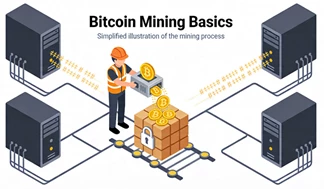
Bitcoin mining is the process of using computational power to solve proof‑of‑work puzzles that validate transactions and add new blocks to the Bitcoin blockchain. This section explains hashes, blocks, difficulty adjustment, and why energy-intensive mining is essential for Bitcoin’s security.
2. How Miners Earn: Rewards & Fees
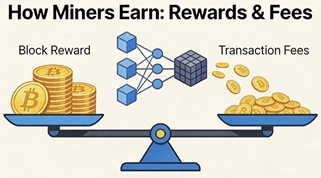
Bitcoin Miners earn revenue from two sources: the block subsidy (newly issued BTC) and transaction fees paid by users competing for limited block space. As halvings reduce the subsidy every 210,000 blocks, fees are becoming an increasingly important share of miner income.
3. Bitcoin Mining Costs, Hardware & Profitability
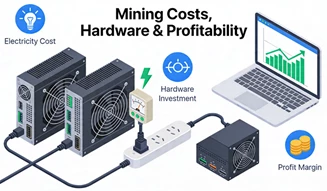
Mining economics are dominated by electricity prices, hardware efficiency, and capex recovery time for ASICs. Here you’ll learn how to estimate operating costs, model ROI, and use mining calculators to find your break‑even power price and payback period.
4. Difficulty, Hashrate & Halvings
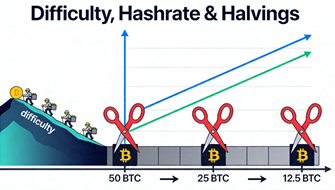
Network hashrate and difficulty determine how much BTC a given miner earns per unit of hash, while halvings cut the block reward by 50% roughly every four years. This section covers the feedback loop between BTC price, hashrate growth, difficulty changes, and post‑halving miner revenue.
5. Energy Use, Environment & Regulation
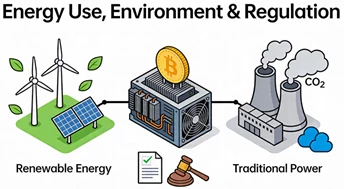
Bitcoin mining’s energy consumption and carbon footprint are hotly debated, with studies examining its mix of fossil and renewable power, emissions, and even water and e‑waste impacts. You’ll find balanced analysis of environmental research, grid-integration case studies, and the evolving policy and regulatory landscape around mining.
6. Bitcoin Mining Business Models & Strategies
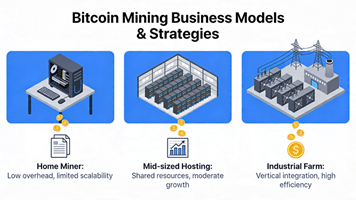
From home miners to industrial-scale operations, business models differ in scale, power sourcing, hosting, and treasury strategy. This section breaks down how professional miners manage capex, hedge price risk, structure energy deals, and position themselves across market cycles.
7. Cycles, Risks & Long‑Term Security
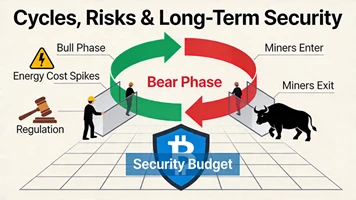
Mining is deeply cyclical: bull markets spur rapid expansion, while price crashes, difficulty shocks, and high energy costs can trigger miner capitulation. Here you’ll explore key risk factors, the debate over Bitcoin’s long‑run “security budget” as subsidies trend to zero, and how a fee‑driven model might sustain the network.
8. Tools, Calculators & Learning Resources

Practical tools like mining profitability calculators, fee-vs-reward charts, and difficulty dashboards help you track real‑time economics. This section curates the best charts, calculators, and educational resources so you can model scenarios and stay on top of mining trends.
Key Bitcoin Mining Economics Drivers (Overview Table)
Bitcoin mining profitability depends on a balance between revenue and costs. Here’s a simplified breakdown:
| Factor | Type | Impact on Miners |
|---|---|---|
| Block Reward | Revenue | Primary income source (decreases over time due to halvings) |
| Transaction Fees | Revenue | Secondary income, expected to grow long-term |
| Bitcoin Price | Revenue | Higher price increases miner profitability |
| Electricity Costs | Cost | Largest ongoing expense |
| Mining Hardware | Cost | Upfront investment + efficiency factor |
| Hash Rate | Network Factor | More competition reduces individual rewards |
| Mining Difficulty | Network Factor | Adjusts to maintain block timing (~10 minutes) |
How Miners Earn Revenue
Miners generate income from two main sources:
- Block rewards (newly created Bitcoin)
- Transaction fees paid by users
Over time, block rewards decrease due to halving events, meaning transaction fees will play a larger role in miner revenue.
👉 Learn more:
How Bitcoin Miners Earn Rewards → /bitcoin/how-bitcoin-miners-earn-rewards
Mining Basics (If You’re New)
If you’re new to mining, start here before diving deeper into economics.
👉 Bitcoin Mining Explained (101) → /bitcoin/bitcoin-mining-explained-101
This guide covers:
- what mining is
- how proof-of-work works
- how blocks are created
Bitcoin Supply & Halving Connection
Mining is directly tied to Bitcoin’s supply.
Each block mined introduces new Bitcoin into circulation—but this issuance is reduced over time through halving events.
This creates:
- predictable supply
- decreasing inflation
- increasing scarcity
👉 Learn more:
Bitcoin Supply & Halving → /bitcoin/bitcoin-supply
Real-World Factors That Affect Mining Profitability
Mining is not static—it constantly changes based on external factors:
- Energy prices: cheaper electricity = higher margins
- Regulation: policies can impact mining operations globally
- Hardware efficiency: newer machines outperform older ones
- Market cycles: bull markets increase revenue, bear markets pressure miners
## Where This Fits in the Bitcoin Ecosystem
Mining economics connects multiple parts of Bitcoin:
- Blockchain security
- Transaction processing
- Supply issuance
- Market cycles
Understanding mining economics gives you insight into:
👉 how Bitcoin sustains itself long-term
Bitcoin Mining & Economics Faqs
What is Bitcoin mining?
Bitcoin mining is the process of using computer hardware to solve cryptographic puzzles that validate transactions and add new blocks to the Bitcoin blockchain.
How do Bitcoin miners make money?
Miners earn revenue from two sources: the block subsidy, which is newly created BTC, and transaction fees paid by users.
Why is Bitcoin mining so energy-intensive?
Bitcoin uses proof-of-work, which requires miners to perform massive amounts of computation to secure the network and compete for block rewards.
What is the Bitcoin halving?
The Bitcoin halving is an event that cuts the block reward in half approximately every four years, reducing the rate at which new BTC is issued.
How do mining fees affect profitability?
Transaction fees can significantly improve profitability, especially when block rewards decline or network activity increases.
What is hash rate?
Hash rate is the speed at which a miner or the entire network performs hashing operations. A higher hash rate means more computational power.
What affects Bitcoin mining profitability the most?
The biggest factors are electricity cost, ASIC efficiency, Bitcoin price, network difficulty, pool fees, and the current block reward.
Is Bitcoin mining still profitable?
It can be, but profitability depends heavily on energy costs, hardware efficiency, and market conditions. Large-scale miners usually have the best margins.
What is the difference between solo mining and pool mining?
Solo mining means mining independently, while pool mining combines many miners’ hash power and shares the rewards more consistently.
Is Bitcoin mining bad for the environment?
Bitcoin mining has environmental concerns because of energy use, but the impact depends on the energy source, location, and operational setup.
Final Thoughts
Bitcoin mining is more than just earning new BTC. It is the mechanism that secures the network, processes transactions, and shapes the long-term economics of Bitcoin itself. As block rewards continue to decline and fees become more important, understanding mining economics becomes even more valuable for investors, miners, and anyone trying to understand how Bitcoin works at a deeper level.
Whether you are exploring mining for the first time or analyzing profitability at a professional level, the key drivers remain the same: energy costs, hardware efficiency, network difficulty, Bitcoin price, and the fee market. Stay informed, model your assumptions carefully, and always account for volatility because mining is one of the most competitive industries in crypto.