Part of the Bitcoin Mining & Economics Series
This guide is part of a broader series explaining how Bitcoin mining works and how miners generate revenue.
👉 Continue exploring:
- Bitcoin Mining Economics (Hub) → /bitcoin-mining-economics
- Bitcoin Mining Explained (101) → /bitcoin/bitcoin-mining-explained-101
Together, these guides give you a complete understanding of:
- how mining works
- how miners earn
- how profitability is determined
How Bitcoin Miners Earn: Rewards & Fees Explained
Bitcoin mining may sound complex, but at its core, it’s simply how new bitcoins enter circulation and how transactions are verified. If you’ve ever wondered how Bitcoin miners earn, you’re in the right place.
Bitcoin Miners are rewarded in two main ways: block rewards (new BTC) and transaction fees. Together, these make up what’s known as Bitcoin mining revenue. Over time, the balance between these two income sources is shifting—and that’s a big deal for the future of Bitcoin.
Let’s break it all down in a simple, easy-to-understand way.
Table of Contents
How Bitcoin Miners Get Paid at a High Level
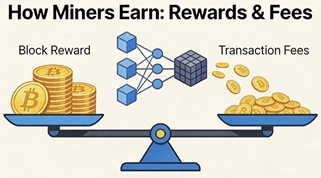
Bitcoin miners earn money by helping run the Bitcoin network. Every time a new block of transactions is added to the blockchain, miners compete to solve a complex puzzle. The first one to solve it gets paid.
Here’s the simple version:
- ✅ Miners validate transactions
- ✅ They bundle them into a block
- ✅ They compete to solve a cryptographic puzzle
- ✅ The winner earns rewards
The reward includes:
- Block reward (new bitcoins created)
- Transaction fees (paid by users)
This is the foundation of how Bitcoin miners earn rewards and fees.
Only one miner (or mining pool) wins each block, which is why mining is competitive. The more computing power (hashrate) you have, the higher your chances of earning that reward.
The Block Reward: New BTC for Miners
What Is a Block Reward?
A block reward is the amount of new Bitcoin given to a miner for successfully mining a block. It’s also called the block subsidy.
This reward comes from a special transaction called the coinbase transaction, which creates new BTC out of thin air—no sender required.
How Block Rewards Have Changed Over Time
Bitcoin started with a generous reward:
- 2009: 50 BTC per block
- 2012: 25 BTC
- 2016: 12.5 BTC
- 2020: 6.25 BTC
- 2024: 3.125 BTC
This reduction is called the Bitcoin halving, and it happens roughly every 4 years.
Why Halving Exists
The halving event is built into Bitcoin’s design to control supply. It ensures:
- Limited total supply (21 million BTC)
- Gradual issuance of new coins
- Increased scarcity over time
But there’s a catch: as block rewards shrink, miners must rely more on transaction fees to maintain income.
Transaction Fees: The Second Source of Income
How Transaction Fees Work
Whenever you send Bitcoin, you attach a fee. This fee goes to the miner who includes your transaction in a block.
Why? Because miners prioritize transactions with higher fees.
How Miners Maximize Fee Revenue
Miners don’t just pick transactions randomly. They:
- Sort transactions by fee rate (sats/vB)
- Fill blocks with the highest-paying ones first
- Maximize total fee income per block
This creates a mini “fee market” inside Bitcoin.
Block Revenue = Reward + Fees
Every mined block includes:
- Block subsidy (e.g., 3.125 BTC)
- Total transaction fees
Together, they form the miner’s total earnings for that block.
This is the core of how Bitcoin miners earn fees alongside rewards.
How Much Do Bitcoin Miners Actually Earn per Block?
Let’s look at a realistic example.
A miner might earn:
- 3.125 BTC (block reward)
- + 0.5–2 BTC (transaction fees)
👉 Total: ~3.6 to 5+ BTC per block
When Fees Become More Important
During periods of high demand (like bull markets), fees can spike.
In some cases:
- Fees have equaled or exceeded the block reward
This shows a key trend:
👉 Bitcoin mining revenue is shifting toward fees
Long-Term Outlook
Eventually, block rewards will drop to zero.
When that happens:
- Miners will earn 100% from transaction fees
- The network will rely entirely on fee-based incentives
Mining Pools and How Rewards Are Shared
Mining pools allow miners to combine their computational resources in order to increase their chances of finding and mining blocks on a blockchain. If a mining pool succeeds, the reward is distributed across the mining pool, in proportion to the amount of resources that each miner contributed to the pool.
Most crypto mining applications come with a mining pool; however, crypto enthusiasts now also join together online to create their own mining pools. Because some pools earn more rewards than others, miners are free to change pools whenever they need to.
Miners consider official crypto mining pools more reliable since they receive frequent upgrades by their host companies, as well as regular technical support. The best place to find mining pools is CryptoCompare, where miners can compare different mining pools based on their reliability, profitability, and the coin that they want to mine.
What Is a Mining Pool?
A mining pool is a group of miners who combine their computing power.
Instead of competing alone, they:
- Work together
- Share rewards
Why Solo Mining Is Rare
Solo mining is like buying a single lottery ticket.
- Low chance of winning
- Huge variance in payouts
Pools solve this by offering:
- Smaller but consistent earnings
How Pools Distribute Rewards
Mining pools use systems like:
- PPS (Pay-Per-Share): Fixed payouts
- PPLNS (Pay-Per-Last-N-Shares): Based on contribution
Your earnings depend on your hashrate share.
This is a major part of how Bitcoin miners make money in practice.
From Rewards & Fees to Real-World Mining Profitability
Earning Bitcoin isn’t the same as making a profit.
Revenue vs Profit
- Revenue = Block reward + fees
- Profit = Revenue − costs
Main Mining Costs
Miners must pay for:
- ⚡ Electricity
- 💻 ASIC mining hardware
- ❄️ Cooling systems
- 🏭 Infrastructure
- 🧾 Pool fees
What Determines Profitability?
Key factors include:
- Electricity price (critical)
- Hardware efficiency (ASIC miners)
- Bitcoin price
- Network difficulty
Who Makes the Most Profit?
Typically:
- Large-scale mining farms
- Locations with cheap electricity
- Access to efficient hardware
That’s why industrial mining dominates today.
Quick Comparison Table: What Miners Earn Over Time
| Era | Block Reward | Role of Fees | Main Income Source |
|---|---|---|---|
| Early Bitcoin (2009–2012) | 50 BTC | Negligible | Block reward |
| Mid-era (2012–2020) | 25 → 12.5 → 6.25 BTC | Growing | Reward + some fees |
| Post-2024 (current) | 3.125 BTC | Significant | Reward + large fees |
| Future (no subsidy) | 0 BTC | 100% | Transaction fees |
How Halving Impacts Miner Rewards
Bitcoin’s block reward is not fixed—it decreases over time through halving events.
Every ~4 years:
- the block subsidy is cut in half
- the amount of new Bitcoin entering circulation decreases
- miner revenue from new coins drops
This is a core part of Bitcoin’s design and directly connects mining to its limited supply model.
👉 Learn more:
Bitcoin Supply & Halving → /bitcoin/bitcoin-supply
The Shift Toward a Fee-Based System
Over time, Bitcoin is designed to transition from a system dominated by block rewards to one supported more by transaction fees.
As block rewards decrease:
- miners rely more on fees
- network activity becomes increasingly important
- fee markets play a larger role in security
This long-term shift is critical to Bitcoin’s sustainability.
Where This Fits in the Bitcoin Ecosystem
Understanding how miners earn rewards helps connect key parts of Bitcoin:
- Market cycles → influence miner profitability
- Mining → secures the network
- Supply → controlled through block rewards
- Fees → driven by user demand
FAQs About How Bitcoin Miners Earn
How do Bitcoin miners earn money?
Bitcoin miners earn through block rewards (new BTC) and transaction fees included in each block.
What is the Bitcoin block reward?
It’s the amount of new Bitcoin created and given to miners for adding a new block to the blockchain.
What are transaction fees in Bitcoin?
They are fees paid by users to prioritize their transactions. Miners collect these as part of their income.
How much do Bitcoin miners earn per block today?
Currently, miners earn 3.125 BTC plus transaction fees, which can vary depending on network demand.
Why do miners join mining pools?
Pools provide steady and predictable income, unlike solo mining, which is highly unpredictable.
Will miners still earn when block rewards end?
Yes. Miners will rely entirely on transaction fees once all bitcoins are mined.
What affects Bitcoin mining profitability?
Electricity costs, hardware efficiency, Bitcoin price, and network difficulty all impact profits.
Are transaction fees becoming more important?
Yes. As block rewards decrease, fees are becoming a larger share of miner revenue.
Conclusion: The Future of Bitcoin Miner Earnings
Understanding how Bitcoin miners earn is key to understanding how Bitcoin itself works.
Right now, miners rely on a mix of:
- ✔️ Block rewards (shrinking over time)
- ✔️ Transaction fees (growing in importance)
As halvings continue, the system is slowly transitioning toward a fee-driven economy.
That shift is intentional—and essential. It ensures that even when no new Bitcoin is created, miners will still have a reason to secure the network.
If you want to dive deeper into Bitcoin’s design, check out the official documentation here:
🔗 https://bitcoin.org/en/how-it-works
Final Thoughts
Bitcoin mining isn’t just about solving puzzles it’s about maintaining a global financial system. And the way miners earn—through rewards and fees—is what keeps the entire network running smoothly.