
Bitcoin market cycles are one of the most important concepts to understand if you want to make sense of Bitcoin’s long-term price action. Bitcoin rarely moves in a straight line. Instead, BTC has historically moved through major bull and bear swings, often connected to the Bitcoin 4-year cycle, halving events, macro liquidity, investor psychology, and changing market narratives.
As of May 1, 2026, Bitcoin is trading around $78,123, after reaching an intraday range of roughly $76,193 to $78,796. That matters because Bitcoin market cycles are not just theory anymore. The 2024 halving, spot Bitcoin ETFs, institutional adoption, and the 2025 cycle high above $125,000 have changed how traders now think about the next phase.
This guide explains how Bitcoin market cycles work, why the Bitcoin 4-year cycle became so famous, the four major Bitcoin cycle phases, the history of previous cycles, and whether Bitcoin market cycles are still valid in 2026.
Table of Contents
What Is a Bitcoin Market Cycle?
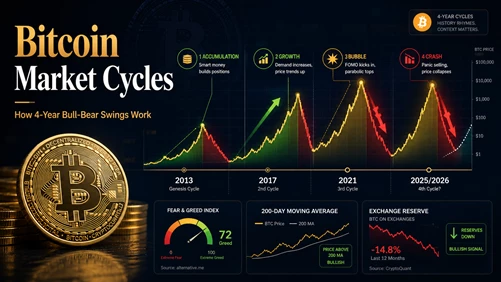
A Bitcoin market cycle is a repeating pattern where Bitcoin moves through periods of accumulation, growth, euphoria, correction, and recovery. These Bitcoin market cycles are not exact copies of each other, but they often follow a similar emotional and structural rhythm.
The classic Bitcoin 4-year cycle is based around the Bitcoin halving. A halving cuts the new BTC block reward in half, reducing the amount of new Bitcoin entering circulation. Bitcoin has had four halvings so far: November 28, 2012, July 9, 2016, May 11, 2020, and April 19–20, 2024. After the 2024 halving, the block reward dropped to 3.125 BTC.
In simple terms, Bitcoin market cycles usually move like this:
| Phase | Market mood | Typical behavior |
|---|---|---|
| Accumulation | Fear, boredom, doubt | Smart money and long-term holders accumulate |
| Growth | Optimism returns | BTC trends higher and breaks resistance |
| Bubble phase | Euphoria and FOMO | Retail returns, leverage rises, prices accelerate |
| Crash phase | Panic and capitulation | BTC corrects heavily and weak hands exit |
Bitcoin bull and bear cycles are driven by more than just supply. Halvings matter, but macro conditions, liquidity, ETF flows, regulation, on-chain activity, and investor psychology also shape every cycle.
That is why Bitcoin market cycles should be used as a framework, not a guaranteed calendar.
Why Bitcoin Market Cycles Happen
Bitcoin market cycles happen because supply, demand, liquidity, and human emotion all interact at the same time.
The first major driver is the Bitcoin halving cycle. Every halving reduces new supply, which strengthens the scarcity narrative. When less BTC is issued and demand rises, price pressure can build. This is why many investors watch the Bitcoin 4-year cycle so closely.
The second driver is macro liquidity. Bitcoin often performs well when financial conditions are easier, interest rates are falling, risk appetite is strong, and investors are looking for growth assets. When liquidity tightens, Bitcoin can struggle. This macro liquidity Bitcoin cycle effect became especially clear after Bitcoin matured into a larger global asset.
The third driver is investor psychology. Bitcoin market cycles are emotional. During the Bitcoin accumulation phase, most people are bored or scared. During the growth phase, confidence returns. During the Bitcoin bubble phase, people often believe prices can only go higher. During the Bitcoin crash phase, fear takes over and many investors sell near the bottom.
The fourth driver is market structure. Earlier Bitcoin market cycles were dominated by retail investors, crypto exchanges, miners, and early adopters. The 2024–2026 cycle is different because spot Bitcoin ETFs, larger institutions, and more professional capital are involved. Fidelity has argued that Bitcoin’s behavior is diverging from older cycles as it becomes larger and more liquid.
So the Bitcoin 4-year cycle still matters, but it is evolving.
Bitcoin Market Cycle Phases
Bitcoin Accumulation Phase
The Bitcoin accumulation phase usually happens after a major crash. Prices are down, sentiment is weak, search interest is low, and most retail investors have lost interest. This is when long-term holders, high-conviction investors, and some institutions quietly build positions.
The Bitcoin accumulation phase can feel boring. Price may move sideways for months. Volume can be low. News coverage often turns negative. Many people ask whether Bitcoin is dead.
But historically, the Bitcoin accumulation phase has been one of the most important parts of Bitcoin market cycles. This is where the next bull market often begins, long before the crowd notices.
Typical signs of a BTC accumulation phase include:
| Signal | What it may suggest |
|---|---|
| Low sentiment | Retail interest has faded |
| Sideways price action | Sellers may be exhausted |
| Long-term holder growth | Strong hands are accumulating |
| Exchange reserves falling | BTC may be moving into cold storage |
| Lower volatility | Market is resetting |
The Bitcoin accumulation phase is not risk-free. Bitcoin can stay weak longer than expected. But in cycle terms, it is often where patient investors start paying attention again.
Bitcoin Growth or Early Bull Phase
The growth phase is where Bitcoin market cycles start to become exciting again. Price begins making higher highs and higher lows. Media coverage improves. Long-term holders are often in profit again. The market starts to believe the next Bitcoin bull cycle may be real.
This phase often connects with the Bitcoin halving cycle. According to Arkham’s cycle analysis, Bitcoin has historically transitioned from accumulation into a new bull market before or around the halving as the market begins pricing in lower future supply.
In the BTC bull-market early stage, investors often look for confirmation from:
| Indicator | Bullish sign |
|---|---|
| 200-day moving average | BTC holds above it |
| Exchange reserves | BTC leaves exchanges |
| Funding rates | Positive but not extreme |
| Fear and Greed Index | Moves from fear to neutral/greed |
| ETF flows | Sustained inflows support demand |
This is usually the part of Bitcoin bull and bear cycles where risk-reward can still be attractive, but volatility remains high.
Bitcoin Bubble or Blow-Off Phase
The Bitcoin bubble phase is when price action becomes aggressive. Bitcoin makes new all-time highs, mainstream attention explodes, social media turns euphoric, and investors begin projecting extreme targets.
The Bitcoin bubble phase is often the most profitable but also the most dangerous part of Bitcoin market cycles. Leverage increases. New investors enter late. Altcoins may run hard. People often believe “this time is different.”
Typical signs of a BTC blow-off phase include:
| Signal | Warning sign |
|---|---|
| Extreme greed | Everyone seems bullish |
| Parabolic price action | BTC rises too fast |
| Heavy leverage | Liquidation risk increases |
| Retail FOMO | New investors chase tops |
| Unrealistic targets | Risk management disappears |
The Bitcoin bubble phase can last longer than skeptics expect, but it usually does not last forever. Historically, the strongest euphoria has often appeared near cycle tops.
Bitcoin Crash or Bear-Market Phase
The Bitcoin crash phase begins when momentum breaks. Price fails to hold key levels, leveraged traders get liquidated, and sentiment turns quickly. During the BTC bear-market phase, Bitcoin can drop hard from the cycle high.
In past Bitcoin market cycles, drawdowns of around 75–80% from the top have happened. That does not mean every future cycle must crash that deeply, especially as Bitcoin becomes more institutional. But the Bitcoin crash phase is still part of the asset’s history.
The Bitcoin crash phase often includes:
| Bear-market feature | What happens |
|---|---|
| Forced selling | Leverage unwinds |
| Altcoin collapse | Riskier assets fall harder |
| Negative headlines | Media turns bearish |
| Miner pressure | Weak miners may sell |
| Capitulation | Investors give up near lows |
The BTC crash phase is painful, but it also resets the market. Eventually, the crash phase can create the next Bitcoin accumulation phase.
Bitcoin Cycle History: 2013, 2017, 2021 and 2025
Bitcoin cycle history shows why the Bitcoin 4-year cycle became so popular. Tops and bottoms have often appeared roughly four years apart, even though every cycle had different drivers.
| Cycle | Main narrative | Approximate peak context | What followed |
|---|---|---|---|
| 2013 | Early adoption and tech speculation | BTC reached around $1,150 | Mt. Gox collapse and major bear market |
| 2017 | ICO boom and retail mania | BTC reached around $19,800 | Deep bear market into 2018 |
| 2021 | Macro liquidity, DeFi, NFTs | BTC reached around $69,000 | 2022 crash, Luna/FTX fallout |
| 2025 | ETFs and institutional flows | BTC reached above $125,000 | Debate over whether cycle topped early |
Fidelity notes that Bitcoin formed major bull-market tops in November 2013, December 2017, and November 2021, with major bear-market bottoms in January 2015, December 2018, and November 2022. Fidelity also noted that if the same cycle rhythm continued, a next bull-market top would have occurred on October 6, 2025, just above $126,200.
That is important because the 2025 cycle did show signs of a new structure. Bitcoin reached a new all-time high above $125,000 in October 2025, helped by institutional demand, ETF flows, and a more favorable regulatory environment.
So are Bitcoin cycles over? Not exactly. Bitcoin cycle history still matters, but the 2025 cycle suggests the pattern may be changing.
Bitcoin Cycle Indicators and On-Chain Signals
Bitcoin cycle indicators help investors judge where BTC might be inside the larger cycle. No single indicator is perfect, but a combination of signals can give a clearer picture.
Common Bitcoin cycle indicators include:
| Indicator | What it helps measure |
|---|---|
| Fear and Greed Index | Market emotion |
| 200-day moving average | Long-term trend |
| Exchange reserves | Whether BTC is moving on or off exchanges |
| Funding rates | Leverage and trader positioning |
| Whale movements | Large-holder behavior |
| MVRV-style metrics | Whether BTC is overheated or undervalued |
| Realized price | Average cost basis of coins on-chain |
Exchange-reserves Bitcoin cycle patterns are especially useful. When BTC leaves exchanges, it can suggest investors are moving coins into longer-term storage. When BTC flows back onto exchanges, it may suggest higher selling pressure.
On-chain cycle signals are not magic. Whales can move coins for many reasons. Exchange balances can be affected by custody changes. ETF flows can also change the meaning of exchange data. But Bitcoin cycle indicators are still useful when combined with price structure, macro liquidity, and sentiment.
For example, if Bitcoin is above the 200-day moving average, exchange reserves are falling, ETF inflows are strong, and sentiment is not yet euphoric, that may suggest a healthier growth phase. If Bitcoin is far above long-term trend, leverage is extreme, retail excitement is everywhere, and funding rates are overheated, that may suggest a Bitcoin bubble phase.
Are Bitcoin Market Cycles Still Valid in 2026?
The big question in 2026 is simple: are Bitcoin market cycles over?
There are two sides.
The “cycles are still alive” argument says Bitcoin continues to move through clear bull and bear periods. The Bitcoin halving cycle still reduces new supply. Investor psychology still creates FOMO and panic. Bitcoin cycle history still shows major tops and bottoms roughly around four-year intervals.
The “cycles are fading” argument says the Bitcoin 4-year cycle is becoming less reliable. Bitcoin is larger, more liquid, and more institutionally owned. Spot ETFs have changed demand. Macro policy can overpower halving narratives. Professional investors may reduce the extreme retail-driven blow-off tops that defined earlier Bitcoin market cycles.
Recent analysis has highlighted this exact debate. Some market commentators argue that the four-year cycle has weakened because Bitcoin reached new highs in 2025 while ETFs, institutional adoption, and regulation changed the structure of the market.
My view: Bitcoin market cycles are not dead, but they are evolving. The rhythm is still there, but each cycle is structurally different. The Bitcoin 4-year cycle should be treated as a guide, not a law.
How to Trade and Invest Inside Bitcoin Cycles
A simple Bitcoin cycle trading strategy is to avoid doing the opposite of what the cycle suggests.
During the Bitcoin accumulation phase, patient investors often build positions slowly. During the growth phase, they may continue to add but become more selective. During the Bitcoin bubble phase, disciplined investors often reduce risk, take profits, or avoid chasing. During the Bitcoin crash phase, the focus shifts to capital preservation and waiting for signs of exhaustion.
A cycle-based BTC DCA strategy can be useful because nobody knows the exact top or bottom. Dollar-cost averaging spreads entries over time, reducing the pressure to perfectly time Bitcoin market cycles.
A basic framework:
| Cycle phase | Possible approach |
|---|---|
| Accumulation | DCA, research, build conviction |
| Growth | Hold, review trend strength, avoid overleverage |
| Bubble | Trim risk, avoid FOMO, protect gains |
| Crash | Preserve capital, wait for bottom signals |
This is not financial advice. Bitcoin is volatile, and Bitcoin bull and bear cycles can move faster than expected. But understanding Bitcoin market cycles can help investors think more clearly and avoid emotional decisions.
Faqs
What are Bitcoin market cycles?
Bitcoin market cycles are recurring bull‑bear patterns BTC tends to follow over roughly four‑year intervals, usually centered around halvings and broader macro conditions. Each cycle includes phases of accumulation, growth, bubble‑top, and deep‑drawdown correction.
How long does a Bitcoin market cycle last?
A typical Bitcoin market cycle lasts about four years, measured from one bull‑market top to the next top, with halvings and bear‑market bottoms also clustering around similar four‑year intervals.
What causes Bitcoin market cycles?
Bitcoin market cycles are driven by halvings (which cut new‑BTC supply), macro liquidity (interest‑rate and QE/QT cycles), and investor psychology (FOMO, panic‑selling, and narrative shifts). These factors combine to create predictable phases of under‑valuation, expansion, euphoria, and crash.
What are the phases of a Bitcoin market cycle?
Most analyses describe four phases: accumulation (low‑price, bearish sentiment), growth (rising prices, recovering sentiment), bubble (parabolic top, extreme greed), and crash (deep drawdown, fear‑filled bear market) before the next cycle resets.
How does the Bitcoin halving affect market cycles?
The halving reduces the rate of new Bitcoin supply roughly every four years, helping to tighten scarcity and often triggering or accelerating a new bull‑market phase. Historically, major BTC tops and bottoms have clustered around halving events, reinforcing the four‑year cycle narrative.
Are Bitcoin market cycles over or weakening?
Some analysts argue cycles are still valid but evolving due to ETFs, institutional flows, and tighter regulation, which can dampen retail‑driven euphoria. Others believe macro shifts and central‑bank policy now overlay the halving rhythm, making tops and bottoms less mechanically predictable.
How do you trade Bitcoin within its market cycle?
A common cycle‑based strategy is to accumulate aggressively in the accumulation phase, add to positions in the early‑to‑mid growth phase, take partial profits in the bubble phase, and preserve capital through the crash phase by using DCA, position sizing, and on‑chain/technical signals.
Where can I see Bitcoin cycle charts and indicators?
Several sites offer Bitcoin‑cycle charts and indicators, including educational hubs like Fidelity, Arkham, Binance, and dedicated on‑chain dashboards that track Fear & Greed, 200‑day MA, exchange‑BTC reserves, and whale‑movement patterns to help identify current cycle phase.
Final Thoughts on Bitcoin Market Cycles
Bitcoin market cycles are one of the best tools for understanding BTC’s long-term behavior. The Bitcoin 4-year cycle became famous because halvings, supply shocks, investor psychology, and liquidity often created repeating bull and bear patterns.
But Bitcoin market cycles in 2026 are different from earlier cycles. Spot Bitcoin ETFs, institutional capital, larger market size, and macro policy have changed the structure. The Bitcoin halving cycle still matters, but it is no longer the only force driving price.
The main lesson is simple: Bitcoin market cycles are not perfect predictions. They are a framework. If you understand the Bitcoin accumulation phase, growth phase, Bitcoin bubble phase, and Bitcoin crash phase, you can make better decisions and avoid getting trapped by emotion.
Bitcoin cycles may be evolving, but they are not irrelevant. For anyone studying BTC, the cycle remains one of the most important maps in the market.