
Global crypto market size
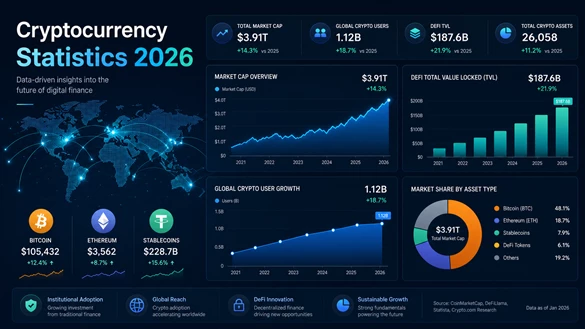
In this page I have put together a in depth Cryptocurrency Statistics article. The global cryptocurrency market cap today sits around 2.64 trillion U.S. dollars, down roughly 25% compared with a year earlier according to CoinGecko’s aggregated chart of 16,357 cryptocurrencies across 1,474 exchanges. Bitcoin alone accounts for about 1.53 trillion dollars of this total, giving it a market dominance of roughly 58.1% at current prices.[1]
Table of Contents
Cryptocurrency Statistics
In 2025, the market experienced a full boom‑and‑cool‑down cycle: total crypto market cap briefly reached a historic peak of about 4.4 trillion dollars before correcting sharply in Q4 and closing the year at roughly 3.0 trillion dollars, marking a 10.4% annual decline and the first yearly drop since 2022. Despite this drawdown, volatility drove heavy trading activity, with average daily spot trading volume in Q4 2025 around 161.8 billion dollars.
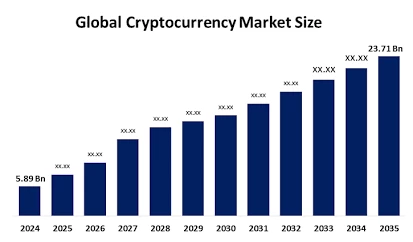
Market research firms that focus on industry revenues (not asset prices) estimate the “crypto market” in a much smaller single‑digit‑billion range, reflecting service and platform revenues rather than token market cap. For example, one report pegs global cryptocurrency industry revenue at 6.78 billion dollars in 2024 with projections to 15.03 billion by 2030 (CAGR about 14.2%), while another estimates 6.34 billion in 2025 growing to 18.26 billion by 2033 with a similar 14.5% CAGR.
Number of cryptocurrencies and exchanges
As of 2026, CoinGecko tracks over 16,300 distinct cryptocurrencies, excluding wrapped and staked versions to avoid double‑counting value. These assets trade on roughly 1,474 centralized and decentralized exchanges worldwide, illustrating how fragmented liquidity has become.
A 2025 exchange‑industry review counted more than 248 listed spot crypto exchanges globally, though only about 200–220 showed consistently active trading volume and listings. Among centralized platforms, Binance continued to dominate with nearly 39.8% market share of top‑10 CEX spot volume in mid‑2025, even as competition from regional and derivatives‑focused venues intensified.[2]
Global crypto user base and adoption
Crypto adoption has moved decisively into the mainstream, with hundreds of millions of people owning some form of digital asset. Crypto.com’s annual Market Sizing Report estimates that global cryptocurrency owners rose from 659 million in 2024 to 741 million in 2025, a 12.4% year‑over‑year increase.
Other aggregators using different methodologies suggest a somewhat lower figure of 559–562 million crypto holders in late 2025, equivalent to around 9.9% of the global population. Reconciling these sources, most analysts frame 2025 adoption in the 0.55–0.75 billion owner range, with methodological differences (exchange KYC accounts vs. on‑chain addresses vs. survey data) explaining the spread.
Forecasts point to further acceleration in 2026, with Crypto.com’s “2025 Review & 2026 Ahead” report projecting 800–900 million crypto owners if markets remain favorable and infrastructure continues to improve. One adoption tracker goes further, estimating that about 1.01 billion people could own crypto by 2026, or roughly 12.2% of the global population, highlighting just how fast penetration is growing from a small base.[3]
On the user‑activity side, one payments‑focused analysis notes that estimated crypto users grew from around 100 million in 2020 to over 420 million by 2023, implying an annual adoption growth rate near 99% over that period. By 2025, the same source suggests there are approximately 630–650 million “active users” and more than 1.3 billion unique wallet addresses, reflecting both real user growth and increased multi‑wallet usage.[4]
Who owns what: Bitcoin, Ethereum, and asset breakdown
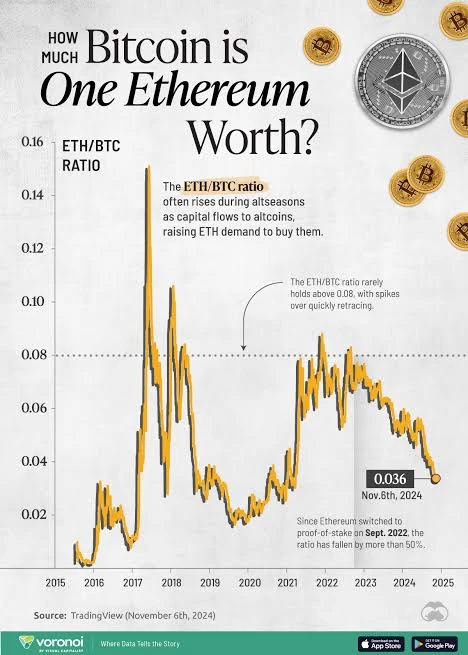
Within the global owner base, Bitcoin remains the primary gateway asset. Crypto.com’s 2025 sizing report estimates around 365 million people hold Bitcoin, making BTC holders roughly 49.3% of all crypto owners worldwide. Ethereum has seen even faster user growth, with ETH holder numbers rising from 142 million in 2024 to 175 million in 2025, or about 23.6% of global crypto owners.
Regionally, adoption is highly uneven. Some markets in Southeast Asia and Latin America report adoption rates above 20% of the adult population, reflecting the use of crypto for payments, remittances, and inflation protection. Country‑level estimates cited for 2026 suggest over 90 million crypto holders in India and around 70 million in the United States, supported by deep exchange infrastructure and growing institutional participation.
Stablecoin market capitalization and dominance
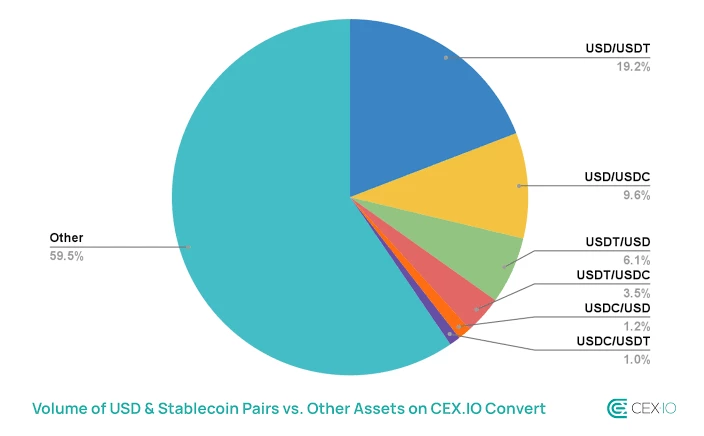
Stablecoins have become a structural pillar of the crypto ecosystem, serving as unit of account, trading collateral, and payments rail. DeFiLlama data summarized by analytics sites show total stablecoin market cap around 265–266 billion dollars in late 2024, with Tether’s USDT enjoying roughly 61.9% dominance.
According to CoinGecko’s global charts, stablecoins as a group had a combined market capitalization of about 319 billion dollars by early 2026, representing roughly 12.1% of total crypto market cap. CoinGecko’s 2025 industry report highlights that stablecoin market value climbed 48.9% during 2025, reaching a record 311 billion dollars in Q4 despite the broader market’s 10.4% annual decline.
A World Economic Forum brief on stablecoins notes that their aggregate market cap is “around 300 billion dollars,” but their economic footprint is far larger because they underpin trillions of dollars’ worth of transactions annually across exchanges, DeFi, and payments. Statista’s historical series shows a multi‑year uptrend in daily stablecoin market cap, along with data for the share of stablecoins in overall crypto market value and dominance of the top five stablecoin issuers.
Stablecoin transaction volume and payments
Stablecoin usage as a payment and settlement layer has exploded even faster than market cap. A 2026 analysis of stablecoin transaction volume reports that USDC processed about 18.3 trillion dollars in volume in 2025, representing roughly 55% of the stablecoin payments tracked in that study. Over the same period, Tether’s USD₮ handled approximately 13.3 trillion dollars in volume, or around 40% market share by payments value, underscoring that the bulk of stablecoin utility is now transactional rather than purely speculative.[5]
Zooming out to broader crypto payments, another report estimates that global crypto transaction volume increased by more than 120% over the past three years, reaching nearly 2.2 trillion dollars in 2025. The number of merchants accepting crypto as a payment method is estimated to have grown about 35% year‑over‑year, driven by easier payment gateways and the relative stability of major stablecoins.[6]
Looking ahead, analysts project that the total value of crypto‑based transactions could surpass 3 trillion dollars in 2026, with stablecoins accounting for close to 60% of that volume thanks to their lower volatility and fiat‑peg. These numbers illustrate how a roughly 300‑billion‑dollar asset class can support several trillion dollars of annual transactional flow when tokens circulate rapidly.
DeFi total value locked (TVL) and users
Total value locked (TVL) in decentralized finance is one of the most closely watched on‑chain metrics. According to an analysis that draws on DeFiLlama data, DeFi TVL stood around 54 billion dollars in January 2024 and surged to approximately 129 billion dollars by early January 2025, a 137% year‑over‑year increase. During the late‑2024 bull run, TVL briefly exceeded 140 billion dollars, the highest level since May 2022.[7]
More recent cross‑chain estimates suggest that DeFi TVL peaked around 171.9 billion dollars in early October 2025, with Ethereum still accounting for the largest share of locked value. The same 2024–2025 data set shows Ethereum maintaining about 55% TVL share, Solana’s share rising from 2.5% to 7.3%, and Tron’s share declining from roughly 15% to 5.9%, indicating rotation among base layers.
There is at least one much higher estimate from another report that claims total value locked “across blockchains” reached about 3.11 trillion dollars in 2025; this figure likely uses a broader definition that includes staking, centralized collateral, or other forms of locked capital, which explains why it diverges sharply from DeFiLlama‑style TVL numbers. When referencing TVL in an educational context, it is important to specify which methodology and universe of protocols are included.
DeFi’s user base has grown even faster than its headline TVL. Data compiled using Dune Analytics indicate that the number of unique DeFi users (measured as unique addresses participating in DeFi interactions) rose from about 5.1 million in January 2024 to more than 12 million by late July, before jumping to 21.7 million unique users by September 2024. Even after a slight pullback, DeFi ended 2024 with roughly 20.7 million unique users, which represents around 300% year‑over‑year growth.
Sector‑specific studies show that lending was one of the strongest‑performing DeFi segments in 2025, with lending TVL rising significantly from the roughly 48.15 billion dollars at the start of the year as more capital flowed into yield‑bearing strategies. This aligns with the narrative that DeFi’s resurgence has been driven by real yield, staking, and credit markets rather than purely speculative farming.[8]
NFT market: supply, sales, and market cap Cryptocurrency statistics
The non‑fungible token (NFT) sector has transitioned from explosive boom to high‑volume, low‑price equilibrium. Data from CryptoSlam, summarized by CoinMarketCap and Binance research posts, show that the total number of NFTs in circulation climbed from about 1 billion tokens in 2024 to over 1.34 billion in 2025, representing roughly 25% growth in supply in a single year and roughly 3,400% growth compared with 38 million NFTs in 2021.
Despite ballooning supply, NFT sales and prices have fallen. CryptoSlam‑based figures indicate that total NFT sales reached about 5.63 billion dollars in 2025, down approximately 37% from 8.9 billion dollars in 2024. Average sale prices slipped to around 96 dollars in 2025, compared with 124 dollars in 2024 and over 400‑dollar averages at the peak in 2021–2022, underscoring a shift toward cheaper, higher‑volume trades.
Market capitalization has compressed even more than sales volume. After recovering to roughly 10.8 billion dollars in December 2024 and hovering near 9.2 billion in January 2025, aggregate NFT market cap slid throughout the year to close 2025 at approximately 2.4 billion dollars, well below the roughly 17‑billion‑dollar peak reached in April 2022. This illustrates mainstream saturation in supply and waning speculative premium.
At the same time, another comprehensive NFT‑industry report estimates the global NFT market size at 34.1 billion dollars in 2025, with Q1 sales already exceeding 8.2 billion dollars and more than 85 million NFTs minted in the first half of the year alone. That study frames “market size” more broadly to include primary and secondary sales, infrastructure revenue, and related services, which explains why its total is much higher than pure on‑chain market capitalization figures.
Lifetime NFT sales since 2017 nonetheless remain impressive. One long‑term analysis finds that by August 19, 2025, NFTs had generated about 71.55 billion dollars in cumulative sales, with roughly 64.78% of that volume coming from Ethereum‑based NFTs and the rest spread across chains like Solana, Bitcoin, Ronin, and others. Even in the cooler 2025 environment, the same report notes that about 3.62 billion dollars in NFT sales occurred in the year‑to‑date period covered.[9]
NFT ecosystems, categories, and demographics
The 34.1‑billion‑dollar 2025 NFT market size estimate breaks down into several major categories and demographic trends. Gaming NFTs account for about 38% of total transaction volume, digital art around 21% of the market with a median sale price near 1,200 dollars, and real‑estate‑linked NFTs (including virtual land and tokenized deeds) forming a roughly 1.4‑billion‑dollar segment growing at 32% annually.[10]
Demographically, around 33% of adults collect physical items while roughly 10% collect NFTs as a hobby or investment, with Millennial and Gen Z cohorts showing the highest propensity to participate. The same report highlights that buyers in the United States represent about 41% of global NFT purchases in 2025, followed by China and South Korea, which together drive a large share of gaming and pop‑culture‑related NFT volume.
Infrastructure remains concentrated on a few networks. Ethereum powers roughly 62% of all NFT transactions, with Solana handling about 18% of traffic and Polygon around 11% of NFT minting, particularly for brand and loyalty programs. Layer‑2 networks like Arbitrum and Optimism collectively process about 9% of NFT transaction volume as scaling and fee concerns push more activity off mainnet.
Exchange volumes and industry revenue
Crypto exchanges are the primary liquidity hubs connecting all of these segments. A 2025 exchange‑statistics breakdown reports that H1 2025 total exchange trading volume reached about 9.36 trillion dollars, marking the strongest first half since 2021. Monthly spot volumes peaked early in the year, with January notching approximately 2.3 trillion dollars in trades and February around 1.7 trillion.[11]
CoinGecko’s 2025 industry report also notes that the annual trading volume of centralized exchanges’ perpetual contracts hit a record 86.2 trillion dollars in 2025, emphasizing how derivatives now dominate exchange revenue. This derivatives expansion has occurred despite the overall market cap ending the year lower than it began.[12]
Industry revenue estimates for crypto exchanges vary by methodology but point to a substantial and growing business. One market research firm estimates the crypto exchange market size (by revenue) at about 43.11 billion dollars in 2024, projecting growth to 48.76 billion in 2025 and 167.3 billion by 2035, a 13.12% compound annual growth rate. Another analysis suggests exchange revenues grew from roughly 50 billion dollars in 2024 to more than 60 billion in 2025, depending on trading activity and institutional involvement.
As noted earlier, there are over 248 listed spot exchanges but only 200–220 with sustained volume, and Binance alone handled nearly 40% of top‑tier CEX spot trading in mid‑2025. CoinMarketCap’s rankings show a continuously shifting leaderboard as newcomers compete on fees, product breadth, and regional compliance.
Crypto payments, merchants, and real‑world use
Beyond trading and speculation, crypto is increasingly used for payments, remittances, and cross‑border business transactions. Over the three years leading into 2025, one payments‑gateway analysis estimates that total crypto transaction value rose by more than 120%, reaching nearly 2.2 trillion dollars in 2025. The same source reports that the number of merchants accepting digital assets grew roughly 35% year‑over‑year, driven by user‑friendly checkout integrations and stablecoin adoption.[13]
Stablecoins are at the heart of this shift. A dedicated study on stablecoin transaction volume finds that USDC alone processed about 18.3 trillion dollars in 2025 payments (around 55% of the stablecoin payments tracked), while USD₮ handled roughly 13.3 trillion dollars (about 40% share), together capturing the vast majority of stablecoin‑based transaction flow. Looking ahead, analysts expect that crypto‑based payments could exceed 3 trillion dollars in 2026, with stablecoins making up close to 60% of the value transacted thanks to their fiat pegs and improving regulatory clarity.
Security incidents, hacks, and losses
Security remains one of the crypto industry’s biggest challenges. According to Immunefi’s “Crypto Losses in 2024” report, Web3 lost about 1.495 billion dollars across 232 incidents that year, with hacks (smart‑contract exploits, key compromises, and infrastructure breaches) accounting for 98.1% of losses and fraud/scams just 1.9%. Two major CeFi incidents — Japan’s DMM Bitcoin hack (305 million dollars) and India’s WazirX breach (235 million dollars) — together represented roughly 36% of 2024’s total losses.[14]
The attack surface shifted further in 2025, and early data indicate that losses increased despite fewer incidents. CertiK’s analysis for H1 2025 reports around 2.47 billion dollars stolen across 344 security incidents, already surpassing the 1.98 billion in net losses recorded across all of 2024. Two large events — the 1.4‑billion‑dollar Bybit exchange hack and a roughly 225‑million‑dollar exploit of Cetus Protocol — accounted for about 1.78 billion dollars or 72% of H1 losses in that dataset.
TechCrunch, citing Chainalysis, TRM Labs, and De.Fi’s REKT database, estimates that cybercriminals stole about 2.7 billion dollars in crypto during calendar 2025, making it the third consecutive record year for crypto‑stealing hacks. A separate security assessment from PeckShield puts 2025 crypto‑related thefts even higher at roughly 4.04 billion dollars, a 34.2% increase compared with the prior year and around 55% more than in 2023, highlighting how a handful of mega‑hacks can greatly skew totals.
Attack vectors and recovery rates tell an important story. In H1 2025, CertiK found that wallet compromise — often via private‑key theft or malware — was the costliest category, resulting in about 1.7 billion dollars stolen across just 34 incidents, while phishing regained the top spot as the costliest vector in Q2 2025 alone with 395 million dollars in losses. Immunefi’s 2024 report noted that CeFi losses surged 77.5% year‑over‑year to 726.2 million dollars across only 11 incidents, while DeFi losses fell 44.8% to 769.3 million across 221 incidents, reflecting fewer but more devastating centralized breaches.
Asset recovery continues to lag behind the scale of theft. PeckShield estimates that only about 334.9 million dollars worth of stolen crypto was recovered or frozen in 2025, down from 488.5 million recovered in 2024, suggesting that laundering techniques and cross‑chain obfuscation are becoming more sophisticated. Immunefi’s CEO has warned that nearly 80% of projects suffering major hacks never fully recover, with reputational damage and operational paralysis compounding the immediate financial loss.finance.
Bitcoin mining, energy consumption, and sustainability
Bitcoin’s energy use remains highly scrutinized but is evolving toward a cleaner mix. A 2025 “Bitcoin Energy Consumption Statistics” overview estimates Bitcoin’s annualized electricity consumption at about 173 terawatt‑hours (TWh) in 2025, corresponding to roughly 10 gigawatts of continuous power draw and around 0.5% of global electricity use. This puts Bitcoin’s energy footprint in the range of mid‑sized countries like Poland or Ukraine.
A separate Cambridge study, the “Digital Mining Industry Report,” estimates Bitcoin’s annual electricity consumption slightly lower, at around 138 TWh, but arrives at a similar conclusion that the network uses roughly 0.5% of global electricity. That study finds that sustainable energy sources (renewables plus nuclear) now account for about 52.4% of Bitcoin mining’s power mix, up from around 37.6% in 2022, indicating a marked shift toward greener sources.[20]
The Cambridge report also notes that natural gas has become Bitcoin mining’s largest single energy source at roughly 38.2% of the mix, while coal’s share has fallen to about 8.9%, down sharply from 36.6% in 2022. Based on its sample, the United States accounts for around 75.4% of reported Bitcoin mining activity, with Canada at about 7.1%, reinforcing North America’s central role in industrial mining. Statista’s long‑running Bitcoin energy consumption series similarly places Bitcoin’s 2025 energy use between that of Australia and the Netherlands, though it emphasizes uncertainty because miners do not report exact figures.
NFTs, regulation, and environmental considerations
NFT regulation and sustainability are maturing alongside the market. A 2025 market‑growth deep dive reports that 35 countries had implemented comprehensive NFT regulation by that year, with the European Union’s MiCA framework in effect and the U.S. SEC evaluating NFTs under securities laws in at least nine active cases. Countries like Japan now mandate KYC and AML for NFT services, while Canada and Australia treat NFTs as capital assets for tax purposes, and India applies a 15% capital‑gains tax on NFT trades.
On the environmental front, the same NFT report estimates that Ethereum’s transition to proof‑of‑stake has reduced the energy requirements for minting and trading NFTs on its network by about 99.95% compared with pre‑Merge levels. Chains such as Tezos, Algorand, and Flow have positioned themselves as eco‑friendly NFT platforms, contributing to an estimated 75% reduction in the sector’s carbon footprint between 2021 and 2025, supported by initiatives like ClimateNFT projects and NFT collections bundled with carbon offsets.[15]
Institutional adoption and macro trends
Institutional participation has become a defining feature of the 2025–2026 cycle. Crypto.com’s adoption analysis attributes much of the 2025 growth in global crypto ownership to pro‑crypto policy shifts in the United States and increasing institutional involvement. One wealth‑management‑oriented survey reports that about 86% of institutional investors say they believe in the long‑term value of blockchain and digital assets, with a significant share planning to increase allocations.
CoinGecko’s 2025 industry report highlights that “Digital Asset Treasury Companies” (DATCos) — corporate entities managing balance‑sheet crypto positions — invested at least 49.7 billion dollars in 2025 alone to acquire more than 5% of the circulating supply of Bitcoin and Ethereum. This accumulation, occurring even as prices declined late in the year, suggests that institutional players increasingly see BTC and ETH as strategic long‑term assets.
Stablecoins and tokenized assets are also drawing regulatory and institutional attention. A World Economic Forum piece notes that with stablecoin market cap near 300 billion dollars and transaction volumes in the trillions, policymakers are grappling with questions around backing, redemption, and systemic risk. Meanwhile, stablecoin volume data showing tens of trillions of dollars of annual on‑chain transfers, led by USDC and USDT, highlight why banks, payment companies, and asset managers are experimenting with tokenized cash and securities.
How to use these crypto industry statistics
Taken together, these statistics show a crypto industry where:
- Trillion‑dollar market caps coexist with billion‑dollar revenue streams and multi‑trillion‑dollar transaction volumes.
- Hundreds of millions of users — potentially approaching a billion — interact with assets led by Bitcoin and Ethereum, while stablecoins and DeFi provide the plumbing for day‑to‑day activity.
- DeFi TVL, NFT markets, and exchange volumes swing with market cycles, yet underlying infrastructure and institutional adoption continue to deepen across each downturn and recovery.
- Security and regulatory risks remain significant, with annual thefts measured in billions of dollars, but energy use is gradually decarbonizing and legal frameworks are becoming clearer.
For an evergreen statistics page, you can periodically refresh the specific numbers (market cap, TVL, user counts, stablecoin cap, annual hack totals) while keeping this structure: global overview, adoption, sector breakdown (DeFi, NFTs, stablecoins, exchanges), security, mining/energy, and institutional trends. This ensures the page stays current while preserving a solid, data‑rich framework that captures the most important crypto industry metrics.
Reference:
- https://www.coingecko.com/en/charts
- https://news.superex.com/articles/1145.html
- https://www.confluentam.com/how-many-people-are-invested-in-crypto-in-2026-key-global-adoption-numbers-trends/
- https://www.linkedin.com/pulse/crypto-payments-numbers-key-trends-heading-2026-cryptomusgateway-68lbe
- https://www.plasma.to/learn/stablecoin-transaction-volume
- https://www.linkedin.com/pulse/crypto-payments-numbers-key-trends-heading-2026-cryptomusgateway-68lbe
- https://focusonbusiness.eu/en/news/total-value-locked-in-defi-soars-137-yoy-to-a-staggering-129-billion/6554
- https://www.dlnews.com/research/internal/state-of-defi-2025/
- https://www.binance.com/en/square/post/28602084117897
- https://vancelian.com/it/news/nft-market-growth-statistics-2025-key-figures-marketplaces-and-blockchain-data
- https://news.superex.com/articles/1145.html
- https://www.binance.com/en-IN/square/post/35231251212113
- https://www.linkedin.com/pulse/crypto-payments-numbers-key-trends-heading-2026-cryptomusgateway-68lbe
- https://crypto.news/crypto-hacks-drained-1-5b-from-industry-in-2024-and-2025-26-is-already-worse/
- https://vancelian.com/it/news/nft-market-growth-statistics-2025-key-figures-marketplaces-and-blockchain-data