
Quick Summary: Staking usually beats mining for most investors in 2026 because it avoids high electricity costs and hardware risks-public miners faced a $79,995 cash cost per Bitcoin in late 2025, leaving little margin. Mining only pays off with ultra-cheap power, top-tier ASICs, and flawless uptime, while staking offers lower effort but exposes you to token price swings and lockup periods. Neither guarantees profit: a 6% staking yield vanishes if the token drops 20%, and mining rewards don’t cover costs if Bitcoin’s price or difficulty spikes. Choose mining for technical operators with a power advantage; staking for simplicity and flexible capital.
For bitcoin mining vs staking, staking usually pays better for investors who value low costs and liquid capital. Mining wins only with cheap power, efficient ASICs, and strong uptime. This bitcoin mining vs staking guide compares true net income, costs, risk, and break-even points. Bitcoin mining vs staking is operating margin versus token exposure.
Bitcoin Mining vs Staking: At a Glance
| Bitcoin mining | Proof-of-stake staking | |
|---|---|---|
| Income source | Block subsidy and transaction fees | Protocol rewards and, in some systems, fees |
| Upfront capital | ASICs, infrastructure, deposits, or hosting | Purchase of the staked token |
| Ongoing costs | Electricity, hosting, maintenance, pool fees | Provider fees, software, custody, and transaction costs |
| Main profitability risk | Power price, difficulty, uptime, ASIC depreciation | Token price, penalties, slashing, provider risk |
| Liquidity | BTC payouts; hardware is slower to sell | Depends on withdrawals, lockups, or liquid staking |
| Best suited for | Operators with cheap power and technical capability | Investors prioritizing simplicity and flexible capital |
How Bitcoin mining and Proof-of-stake staking Compare
Bitcoin mining
Mining uses ASIC hash power to earn BTC block subsidies and transaction fees. It fits operators with low-cost power and the skills to manage hardware, uptime, and changing difficulty.
Key strengths
- Direct BTC payouts
- Supports Bitcoin’s proof-of-work network
Proof-of-stake staking
Staking locks tokens to help validators secure a network and earn token rewards. It suits investors who want a simpler setup, though price moves, provider risk, and penalties still matter.
Key strengths
- No ASIC purchase
- Flexible options, including pooled staking
Which Produces More Net Income in 2026?
Gross Rewards Are Not the Same as Profit
Staking usually wins for small investors because costs stay low. Mining can beat it only with cheap power, efficient hardware, and high uptime. CoinShares reports that public miners faced an average cash cost near $79,995 per BTC in late 2025, showing how fast margins can shrink.
| Method | Subtract before calling it profit |
|---|---|
| Mining | Power, pool fees, repairs, ASIC cost, hosting |
| Staking | Validator fees, lockups, token price loss, tax |
- Calculate rewards in dollars.
- Subtract every direct cost.
- Keep token gains separate from operating profit.
A 6% staking yield is not a 6% cash return if the token falls 20%. Likewise, mined BTC price gains do not make an unprofitable machine profitable.
- Mining suits operators with a true cost edge.
- Staking suits holders who want simpler, lower-cost yield.
Also Read: https://cryptoscobra.com/blog/1-best-crypto-platforms
Costs, Break-Even Points, and Capital Efficiency
A Practical Break-Even Test
Mining needs hardware, power, cooling, pool fees, and repairs. Staking mainly ties up tokens, with validator or platform fees. Public miners averaged about $79,995 cash cost per BTC in late 2025, according to CoinShares.
| Option | Break-even calculation | Main hidden cost |
|---|---|---|
| Mining | BTC mined × BTC price – all cash costs | ASIC depreciation |
| Staking | Rewards × token price – fees and tax | Token price drop |

- Estimate 12 months of rewards.
- Subtract every cash cost and tax.
- Divide upfront capital by monthly net income.
Count token gains separately. A rising coin price is not operating profit.
- Use a lower token-price case.
- Add a 20% repair buffer for mining.
Also Read: Discover 1000x Altcoins: Barsik Coin & Pnut Coin Insights
Risk, Liquidity, and Downside Scenarios
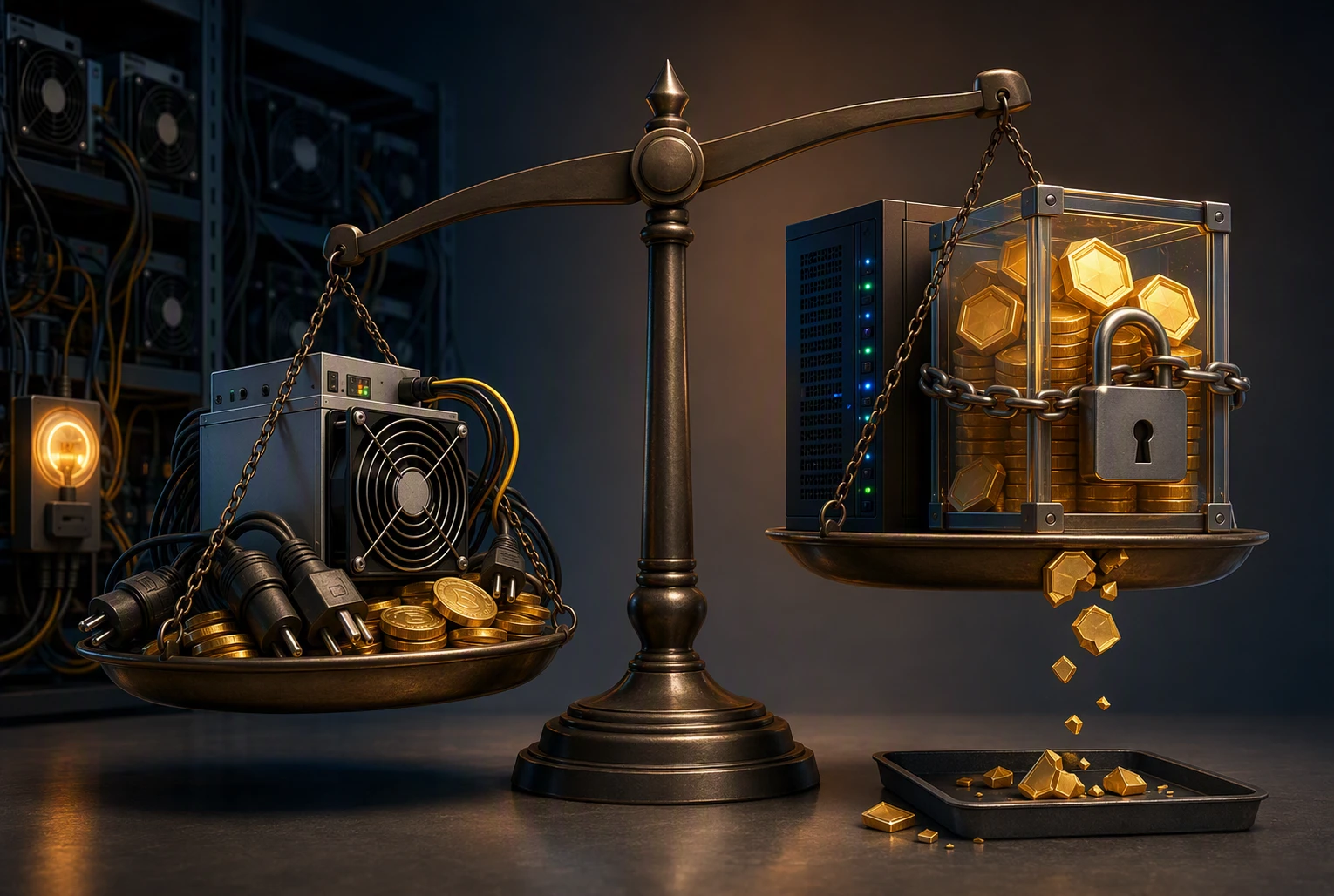
Mining lets you sell earned Bitcoin quickly, but the ASIC, power bill, and pool fees remain. If Bitcoin falls or mining difficulty rises, cash flow can turn negative fast.
Staking avoids power costs, yet tokens may be locked during an unbonding period. The SEC notes staked assets cannot transfer while locked, and validator mistakes can lead to slashing losses.
| Downside | Mining | Staking |
|---|---|---|
| Price drop | Revenue falls | Principal value falls |
| Exit speed | Sell mined BTC | May face lockup |
| Main risk | Power and hardware | Slashing and validator risk |
Stress-test a 30% token drop before you commit capital.
Also Read: Crypto Cobra Blog: Crypto News, Reviews & Market Insights
Which Should You Choose: Bitcoin Mining or Staking?
Choose mining only if you have cheap power, efficient hardware, and can track daily costs. Miners earn rewards for adding computing work to proof-of-work networks, as the SEC explains.
Choose staking for lower effort and no power bill.
| Your situation | Better fit |
|---|---|
| Cheap electricity and hands-on skills | Mining |
| Smaller budget and simple setup | Staking |
| Need quick access to funds | Neither if tokens lock up |
Never treat staking yield or mined Bitcoin as guaranteed profit.
Compare live market signals and assess your real net returns with Crypto Cobra before choosing mining or staking.
Frequently Asked Questions
Q1: Compare mining and staking income, cost, and risk for modern crypto investors.
Mining needs hardware and power. Staking needs tokens and lockup risk. Both returns change with price.
Q2: Can staking lose money?
Yes. Token price drops, validator penalties, and withdrawal delays can erase yield.
Q3: Is mining profitable at home?
Usually not, unless power is cheap and your hardware stays efficient.
Conclusion
Mining can win with cheap power and scale. Staking is simpler but carries token and protocol risk. Compare net income, not yields, as Cambridge research notes.