
The Bitcoin blockchain is a decentralized, public ledger that records all Bitcoin transactions in a secure and transparent way. Instead of relying on banks or a central authority, Bitcoin uses a global network of computers to verify and store data.
Think of the blockchain like a shared digital record book that anyone can view, but no one can control or alter once information is added. This system is what makes Bitcoin secure, trustless, and resistant to manipulation.
Related Bitcoin Guides (Start Here)
Before diving deeper into how the blockchain works, it helps to understand the bigger picture of Bitcoin.
👉 Recommended guides:
These pages give you the full context behind the mechanics explained here.
Table of Contents
Key Bitcoin Concepts Used in This Guide
This page introduces several technical concepts. If you’re new, these definitions will help you follow along:
- Hash: A unique cryptographic fingerprint of data
- UTXO (Unspent Transaction Output): The system Bitcoin uses to track ownership
- Merkle Tree: A structure that organizes transactions inside a block
- Node: A computer that validates and stores the blockchain
- Proof-of-Work (PoW): The system miners use to secure the network
👉 For full explanations, visit the Bitcoin Glossary
What Is the Bitcoin Blockchain?
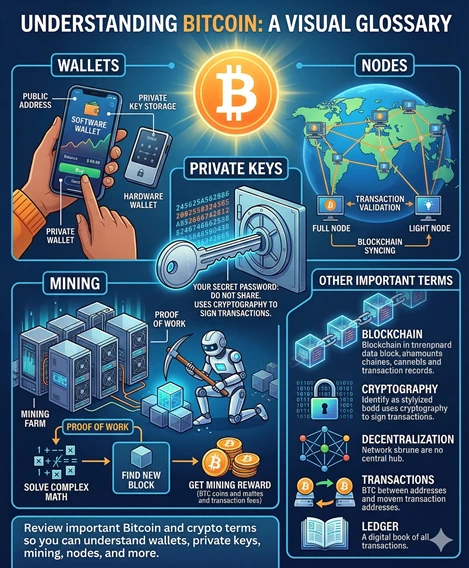
At its core, the Bitcoin blockchain is a chain of blocks, where each block contains a list of verified transactions.
These blocks are:
- Linked together using cryptography
- Stored across thousands of computers (nodes)
- Publicly accessible and transparent
Once a block is added, it becomes immutable, meaning it cannot be changed without redoing all the work that came after it — something that is practically impossible.
Why the Blockchain Matters
Before Bitcoin, digital money had a major problem: double-spending — the risk of spending the same money twice.
Bitcoin solves this by using:
- A distributed network
- Cryptographic verification
- Consensus rules
This ensures that every transaction is valid and only happens once.
How Bitcoin Transactions Work (Step-by-Step)
Here’s what happens when you send Bitcoin:
1. Transaction Creation
You send Bitcoin using a wallet, signing the transaction with your private key.
2. Broadcast to Network
The transaction is shared with the global Bitcoin network.
3. Mempool
The transaction enters a waiting area called the mempool, where unconfirmed transactions sit.
4. Mining
Miners select transactions and bundle them into a block.
5. Confirmation
Once the block is added to the blockchain, your transaction is confirmed.
6. Finality
After multiple confirmations (usually 6), the transaction is considered secure and irreversible.
Blocks and Chain Structure
Each block in the Bitcoin blockchain contains:
- A list of transactions
- A timestamp
- A reference (hash) to the previous block
- A unique number called a nonce
- A Merkle root (summary of transactions)
Because each block is connected to the one before it, altering any data would break the entire chain.
This is what makes Bitcoin’s blockchain tamper-resistant.
Mining and Proof-of-Work
Bitcoin uses a system called Proof-of-Work (PoW) to secure the network.
Miners compete to solve complex mathematical puzzles by trying different numbers (nonces) until they find a valid solution.
This process:
- Requires significant computational power
- Secures the network
- Ensures fairness and decentralization
The first miner to solve the puzzle adds the block to the blockchain and receives a reward.
👉 Current reward (post-2024 halving): 3.125 BTC + transaction fees
Difficulty Adjustment
Bitcoin automatically adjusts mining difficulty every 2016 blocks (~2 weeks).
This ensures:
- Blocks are added roughly every 10 minutes
- The network stays stable regardless of mining power
Nodes and Consensus
Bitcoin is maintained by a network of nodes.
Types of nodes:
- Full nodes → store the entire blockchain and validate all transactions
- Light nodes → rely on full nodes for verification
Consensus is achieved when the majority of the network agrees on the valid version of the blockchain.
👉 This is often referred to as the longest chain rule
Security Features of the Blockchain
Bitcoin’s blockchain is highly secure due to:
🔐 Cryptographic Hashing (SHA-256)
Links blocks together securely.
🔐 Digital Signatures (ECDSA)
Prove ownership of Bitcoin without revealing private keys.
🔐 Decentralization
No single point of failure.
🔐 Proof-of-Work
Prevents spam and attacks.
Can Bitcoin Be Hacked?
A 51% attack would require controlling most of the network’s computing power — something that would cost billions and is considered highly impractical.
Transaction Fees and Speed
Bitcoin transactions include fees that depend on network demand.
- Higher fee → faster confirmation
- Lower fee → slower confirmation
To improve speed and reduce costs, Bitcoin uses the Lightning Network, a second-layer solution for near-instant payments.
Limitations of the Bitcoin Blockchain
While powerful, Bitcoin has some limitations:
- Slower transaction speeds compared to traditional systems
- High energy consumption
- Limited scalability on the base layer
These challenges have led to innovations like the Lightning Network.
Bitcoin vs Other Blockchains
Bitcoin was the first blockchain, but others have expanded its concept.
For example:
- Ethereum → smart contracts
- Other chains → faster speeds, different consensus
👉 However, Bitcoin remains the most secure and decentralized network.
How a Bitcoin Transaction Works (Real Example)
To understand the blockchain, it helps to follow a real transaction step by step.
Step 1: You send Bitcoin
You initiate a transaction from your wallet to another address.
Step 2: Transaction enters the mempool
The transaction is broadcast to the network and waits in the mempool for confirmation.
Step 3: Miners select the transaction
Miners pick transactions (usually those with higher fees) and include them in a candidate block.
Step 4: Block is mined
Through Proof of Work, a miner solves a complex problem and adds the block to the blockchain.
Step 5: Confirmations begin
Once added, your transaction receives confirmations as new blocks are built on top.
- 1 confirmation → transaction included
- 3–6 confirmations → widely considered secure
👉 Want to try it yourself?
Learn step-by-step:
→ How to Send & Receive Bitcoin
Key Takeaways
- Bitcoin uses a decentralized blockchain to record transactions
- Blocks are linked together using cryptography
- Mining secures the network through Proof-of-Work
- Transactions become immutable once confirmed
- The system removes the need for trust in intermediaries
Visualizing the Bitcoin Blockchain (Simple Explanation)
Think of the blockchain as a chain of connected blocks:
- Each block contains multiple transactions
- Each block links to the previous one via a hash
- Changing one block would break the entire chain
This is what makes Bitcoin:
- tamper-resistant
- transparent
- secure without a central authority
Final Thoughts
The Bitcoin blockchain is one of the most important innovations in modern finance. By combining decentralization, cryptography, and economic incentives, it creates a system that is secure, transparent, and resistant to manipulation.
Understanding how the blockchain works gives you a strong foundation for navigating Bitcoin — whether you’re investing, sending transactions, or exploring the broader crypto ecosystem.
Bitcoin Blockchain FAQs
Below are common questions people ask about Bitcoin and how the blockchain works.
How is Bitcoin connected to blockchain?
Bitcoin runs on blockchain technology. The blockchain acts as a public ledger that records all Bitcoin transactions, ensuring they are secure, transparent, and cannot be altered once confirmed.
How long does it take to mine 1 block of Bitcoin?
On average, it takes about 10 minutes to mine a Bitcoin block. This timing is maintained by automatic difficulty adjustments in the network.
Can blockchain exist without Bitcoin?
Yes, blockchain can exist without Bitcoin. While Bitcoin was the first use case, blockchain technology is now used in many applications, including smart contracts, supply chains, and digital identity systems.
How do you get your money off blockchain?
You don’t “remove money” from the blockchain itself. Instead, you transfer Bitcoin to an exchange and sell it for traditional currency, which can then be withdrawn to your bank account.
Can you turn Bitcoin into cash?
Yes, Bitcoin can be converted into cash by selling it on a cryptocurrency exchange or using peer-to-peer platforms. The funds can then be withdrawn to your bank.
What is Bitcoin backed by?
Bitcoin is not backed by physical assets or governments. Its value comes from scarcity, network security, adoption, and the trust of its users.
What happens when all 21 million Bitcoin are mined?
Once all Bitcoin are mined (expected around year 2140), miners will no longer receive block rewards and will instead earn money from transaction fees.
Who is behind Bitcoin?
Bitcoin was created by an anonymous person or group known as Satoshi Nakamoto, whose true identity remains unknown.
How did people get Bitcoin originally?
Early users obtained Bitcoin through mining or by participating in early transactions. At the beginning, Bitcoin had little to no monetary value and was mainly used by enthusiasts.
Can you explain Bitcoin in simple terms?
Bitcoin is digital money that allows people to send and receive payments without banks. It runs on a decentralized network and uses blockchain technology to keep transactions secure.