Bitcoin ATMs are physical kiosks that allow you to buy Bitcoin with cash. Some two-way Bitcoin ATMs also let you sell Bitcoin and collect cash, although many locations are buy-only.bankrate+1
To use a Bitcoin ATM, you will normally need a Bitcoin wallet, a mobile phone, cash and possibly a government-issued ID. The precise fees, limits, verification rules and supported transactions depend on the ATM operator and your location.bitcoin+1
Important scam warning: Never deposit cash because an unexpected caller, government official, bank representative, technical-support agent or online contact told you to use a Bitcoin ATM. Never scan a wallet QR code sent to you by someone else. Government agencies and legitimate businesses will not send you to a Bitcoin ATM to protect your money, pay a fine or resolve an account problem.consumer.ftc+1
This guide explains how Bitcoin ATMs work, how to find one near you, how to buy and sell Bitcoin, what fees to expect and how to avoid costly scams.
Table of Contents
What Is a Bitcoin ATM?
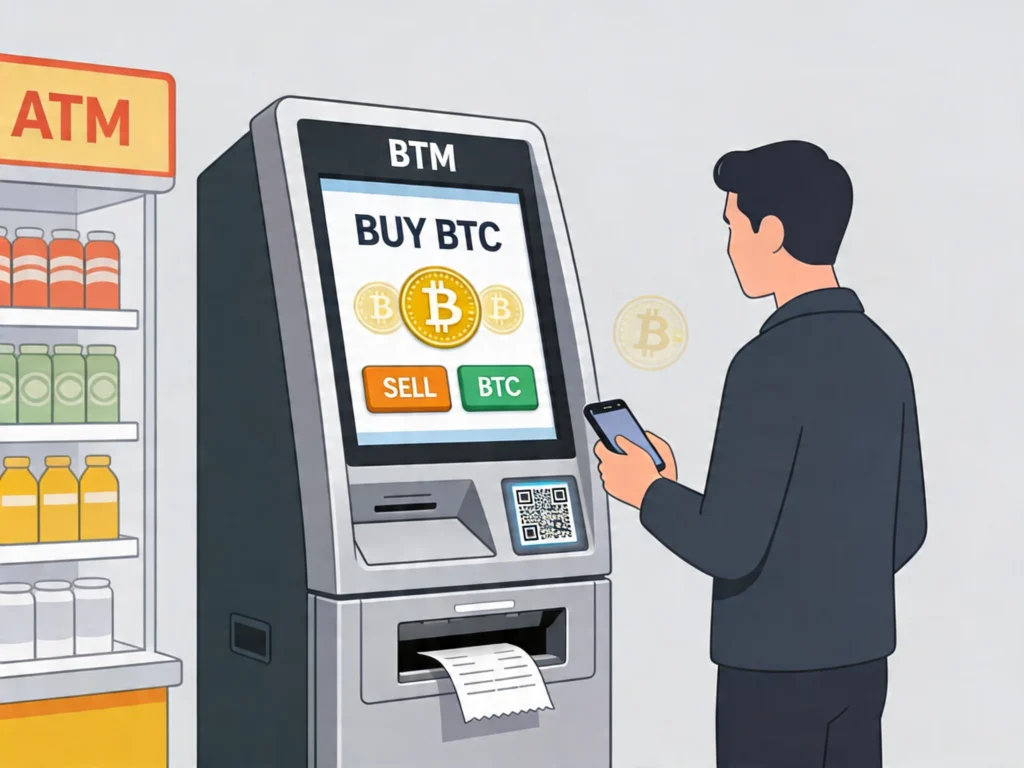
A Bitcoin ATM—also called a BTM, crypto ATM or cryptocurrency kiosk—is a physical machine that helps users exchange cash and cryptocurrency.
Unlike a conventional bank ATM, a Bitcoin ATM does not normally connect to your checking account. When you buy Bitcoin, the operator processes the purchase and sends BTC to the Bitcoin wallet address you provide.fincen+1
Bitcoin ATMs generally fall into two categories:
- Buy-only Bitcoin ATMs: Accept cash and send Bitcoin to your wallet.
- Two-way Bitcoin ATMs: Support both purchases and sales, allowing eligible users to buy Bitcoin or sell it for cash.
Some crypto ATMs support assets other than Bitcoin, including Ether, Litecoin, Tether and USD Coin. Supported cryptocurrencies vary between operators and individual machines.fincen
Before traveling to a machine, verify that it supports Bitcoin and the type of transaction you want to make.
Find Bitcoin ATMs Near You
The easiest way to locate a Bitcoin ATM is to use an online Bitcoin ATM locator.
A locator lets you search by city, ZIP code, postal code or current location. Depending on the service, you may also be able to filter machines by supported cryptocurrency, buy or sell functionality, operator and opening hours.
One of the most established options is Coin ATM Radar, which maintains a worldwide directory and current industry statistics.coinatmradar
Individual ATM operators also provide location maps for their own networks. Examples include:
- Bitcoin Depot
- CoinFlip
- Coinhub
- Coinme
- RockItCoin
- Bitomat
Bitcoin ATMs are frequently installed inside convenience stores, gas stations, grocery stores, shopping centers and other retail locations.consumer.ftc+1
Check Before Visiting
Do not rely solely on a map pin. Open the machine’s location page and check:
- Whether the machine supports buying, selling or both.
- Whether Bitcoin is one of its supported cryptocurrencies.
- The store’s opening hours.
- The machine’s current operational status.
- The operator’s fees and exchange rate.
- Minimum and maximum transaction amounts.
- Phone-number and identification requirements.
- Accepted cash denominations.
- Whether registration is required.
A machine may be described as available 24/7 even though it sits inside a store with limited opening hours. Confirm the host business’s hours before traveling.
Example: using a Bitcoin ATM map
Platforms like CoinATMRadar provide one of the most popular Bitcoin ATM maps, allowing you to quickly find nearby machines, filter by features, and compare fees.
Things to prepare before using a Bitcoin ATM
Before using a Bitcoin ATM, make sure you have everything ready to avoid delays or mistakes.
1. A Bitcoin wallet
You’ll need a Bitcoin wallet (mobile or hardware) to receive your funds.
- Open your wallet
- Tap “Receive”
- Generate your wallet address QR code
This QR code will be scanned at the ATM.
2. Cash or debit card
Most machines support:
- Cash (most common)
- Some support debit cards
If you want to buy Bitcoin with cash, bring physical currency.
3. ID verification (KYC)
Depending on the amount:
- Small purchases may require only a phone number
- Larger transactions may require ID verification (KYC)
4. Phone and internet access
You may need your phone to:
- Receive verification codes
- Access your wallet
- Confirm transactions
How Many Bitcoin ATMs Are There?
The number of operational Bitcoin ATMs changes constantly as operators install, relocate and remove machines. Coin ATM Radar provides frequently updated statistics, making its live charts more reliable than an undated number in an article.coinatmradar
Reporting based on Coin ATM Radar data placed the worldwide total at approximately 27,358 machines in late September 2026, following a significant reduction during the year.news.bitcoin
Because the number can change quickly, use a live locator when looking for a nearby machine.
What You Need
Prepare everything before visiting the ATM. This reduces the chance of making a mistake under pressure.
Your Own Bitcoin Wallet
You need a wallet that can generate a Bitcoin receiving address.
Open the wallet and select an option such as:
- Receive
- Receive Bitcoin
- Deposit BTC
Your wallet will display a Bitcoin address and usually a corresponding QR code. The ATM scans this code to identify where it should send your Bitcoin.
If you do not have a wallet yet, start with the best Bitcoin wallets for 2026.
Security rule: A Bitcoin receiving address is safe to share when receiving a payment. Your seed phrase and private keys must never be shared with an ATM, operator, caller or support agent.
A Mobile Phone
You may need your phone to:
- Access your wallet.
- Display your receiving QR code.
- Receive an SMS verification code.
- Create or access an operator account.
- Receive a digital receipt.
- Check the transaction afterward.
Make sure your phone is charged before you leave.
Cash
Cash is the standard payment method at many Bitcoin ATMs. Some operators and machines may offer other payment options, but you should not assume that a particular ATM accepts debit or credit cards.coinhubatm+1
Check which banknote denominations the machine accepts. Bitcoin ATMs may not provide change after cash has been inserted.
Identification
Bitcoin ATM identification requirements vary based on the operator, jurisdiction, transaction amount and compliance rules.
A machine might ask for:
- A mobile-phone number.
- An SMS verification code.
- Your name and address.
- A government-issued ID.
- A photograph or selfie.
- A Social Security number or partial number in the United States.
- Additional information for larger transactions.
Do not assume that a Bitcoin ATM is anonymous or requires no identification. Many machines use know-your-customer checks, and verification requirements can change according to transaction size and risk controls.
How to buy Bitcoin at a Bitcoin ATM (step-by-step)
The exact interface varies between operators, but most cash purchases follow a similar process.
Find a Reputable Machine
Use Coin ATM Radar or the operator’s official website to locate a machine.
Before visiting, confirm:
- The address.
- Opening hours.
- Current machine status.
- Purchase limits.
- Identification requirements.
- Published fees.
- Whether Bitcoin purchases are supported.
Avoid using an unlisted machine that has no visible operator name, support number or terms.
Buying Bitcoin at a Bitcoin ATM is straightforward. Here’s the full process:
Step 1: Find a Bitcoin ATM
Use a Bitcoin ATM locator or map to find a nearby machine. Confirm it supports buying.
Step 2: Select “Buy Bitcoin”
At the ATM, choose Buy Bitcoin, Buy Crypto or a similar option.
If the machine supports several cryptocurrencies, select Bitcoin or BTC. Be careful not to select Bitcoin Cash, which is a separate cryptocurrency.
On the ATM screen:
- Tap “Buy Bitcoin” or “Buy Crypto”
Step 3: Enter verification details
Depending on the machine:
- Enter your phone number or email
- Verify using a code (SMS or email)
Step 4: Scan your wallet QR code
- Open your wallet
- Tap Receive
- Scan wallet QR code at the ATM
This ensures the Bitcoin is sent to your address.
Step 5: Insert cash
- Insert bills into the machine
- The screen shows how much Bitcoin you’ll receive
- Check the transaction fee and exchange rate
Step 6: Confirm transaction
- Review details
- Confirm purchase
Step 7: Receive Bitcoin
- Bitcoin is sent to your wallet
- You’ll receive a receipt (printed or email)
- Transaction appears after blockchain confirmation
Complete Verification
Enter the requested information and complete any required identity checks.
Depending on the ATM, this might involve:
- Entering your phone number.
- Typing an SMS code.
- Scanning a government-issued ID.
- Taking a photograph.
- Creating a PIN.
- Accepting the operator’s terms.
Use only accurate information. Attempting to bypass transaction limits or identification requirements could violate the operator’s terms or applicable laws.
Scan Your Wallet QR Code
Open your own Bitcoin wallet and select Receive Bitcoin.
Hold the wallet’s receiving QR code under the ATM scanner. The machine should read the Bitcoin address and display it on the screen.
Check the displayed address carefully. At minimum, compare several characters at the beginning and end with the address shown in your wallet.
Never scan a QR code supplied by a caller, stranger, employer, romantic interest, investment adviser or technical-support agent. That QR code may contain the scammer’s wallet address, causing the Bitcoin to be sent directly to the scammer.ic3+1
Review the Fees and Exchange Rate
Before inserting cash, review the full quote.
Check:
- The amount of cash you are paying.
- The amount of Bitcoin you will receive.
- The operator fee.
- Any fixed service charge.
- Any separately listed network fee.
- The exchange rate used by the machine.
- The receiving wallet address.
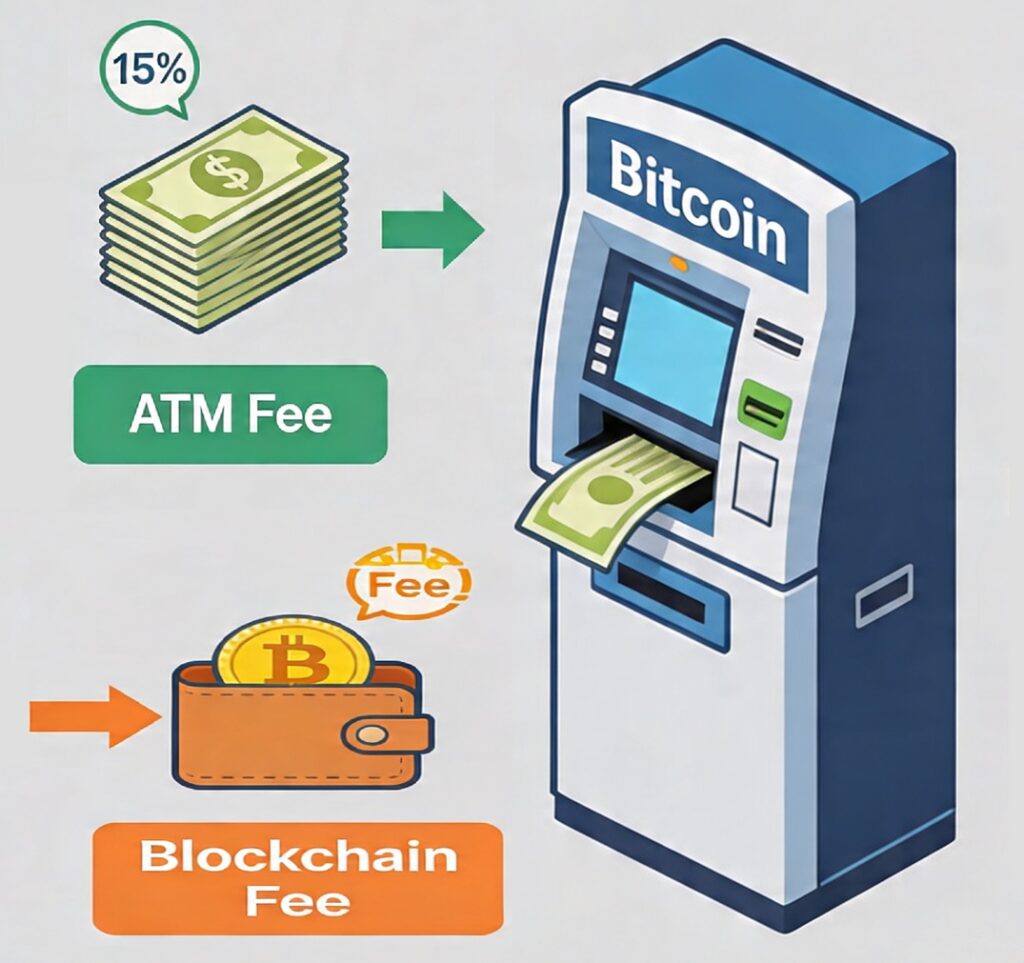
A Bitcoin ATM’s cost may be included partly in the quoted Bitcoin price rather than presented entirely as a separate fee. Compare the machine’s BTC price with a current market price before confirming.
Insert Cash
Insert the accepted banknotes one at a time.
The ATM should update the estimated amount of Bitcoin you will receive as you add cash. Watch the screen carefully and stop when you reach your intended purchase amount.
Some machines may not let you cancel the transaction or return inserted cash after a particular stage. Read the on-screen instructions before feeding money into the machine.
Confirm the Purchase
Review the final transaction details before selecting Confirm, Buy or Finish.
Double-check:
- The cash amount.
- The Bitcoin amount.
- The total fees.
- The receiving address.
- Your contact information.
Bitcoin transactions are generally irreversible after they have been processed. A transaction sent to the wrong wallet address may not be recoverable.
Save the Receipt
Keep the printed or digital receipt.
It may contain:
- Transaction number.
- Transaction date and time.
- ATM location.
- Operator name.
- Cash amount.
- Bitcoin amount.
- Destination address.
- Blockchain transaction ID.
- Customer-support details.
The purchased Bitcoin may appear in your wallet quickly, but the timing depends on the operator’s processing procedure and Bitcoin network confirmations.bitcoin+1
Do not throw away the receipt until the Bitcoin has arrived and you have confirmed the transaction.
⚠️ Important: Bitcoin transactions are irreversible, so always double-check your wallet address.
How to sell Bitcoin at a Bitcoin ATM (if supported)
Not every Bitcoin ATM lets you withdraw cash. You need a machine described as two-way, bidirectional, sell-enabled or supporting cash withdrawals.changehero+1
Check the machine’s capabilities before traveling.
Step 1: Select “Sell Bitcoin”
ChooAt the kiosk, select:
- Sell Bitcoin
- Withdraw Cash
- Cash Out
- Sell Crypto
Complete any required phone, account or identity verification.
Step 2: Enter amount
Enter how much Bitcoin you want to sell or how much cash you want to receive.
Review the quoted exchange rate, fee and estimated payout before continuing.
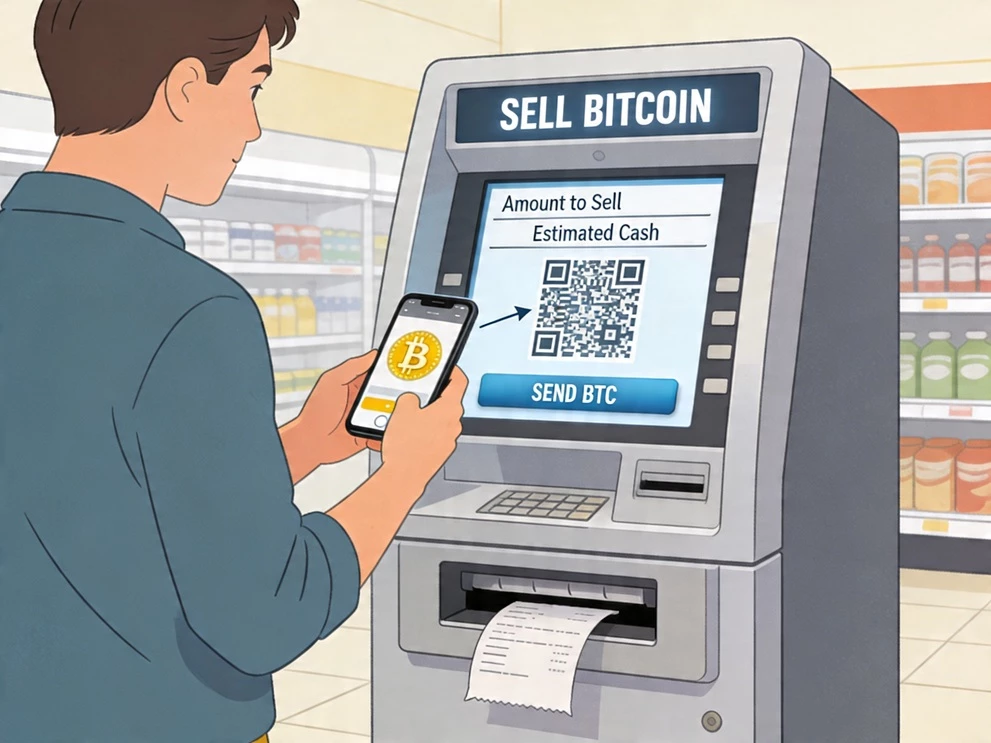
Step 3: Scan ATM QR code
The ATM will generate a Bitcoin receiving address, usually displayed as a QR code.
Open your wallet’s Send Bitcoin function and scan the code. Verify that the address shown in your wallet matches the address displayed by the machine.
Step 4: Send the Exact Amount
Send the precise amount requested by the ATM.
Check whether your wallet deducts the Bitcoin network fee from the amount being sent or adds it separately. Sending less than the requested amount could delay or prevent the cash redemption.
Step 5: Wait for confirmation
The operator may wait for one or more Bitcoin network confirmations before releasing the cash.
Depending on the machine, you may receive:
- A printed redemption ticket.
- An SMS code.
- A digital receipt.
- A transaction reference number.
- Instructions to return after confirmation.
Some machines require you to begin the transaction, send the Bitcoin and then return later to collect the cash. Other machines allow you to wait and finish the entire process during the same visit.
Step 5: Redeem cash
Follow the operator’s instructions after the Bitcoin payment has been confirmed.
You may need to:
- Scan the original ticket.
- Enter a redemption code.
- Enter your phone number.
- Enter your account PIN.
- Confirm the withdrawal.
Count the cash before leaving and retain the receipt.
Bitcoin ATM Limits
Bitcoin ATM transaction limits vary widely.
Limits can depend on:
- The ATM operator.
- Country, state or local regulations.
- Verification level.
- Transaction history.
- Type of identification supplied.
- Whether you are buying or selling.
- Available cash inside the machine.
- Operator risk controls.
A machine may have minimum transaction amounts as well as daily maximums.
Do not depend on a general online limit such as “$500 to $5,000.” Check the exact machine or operator before traveling because a different location may apply different rules.
Do Bitcoin ATMs Require ID?
Many Bitcoin ATMs require some form of customer verification.
A small purchase might require only phone verification at one machine, while another operator may require government-issued identification from the first transaction. Larger or higher-risk transactions can trigger more extensive checks.koinly+1
In the United States, cryptocurrency-kiosk operators involved in money transmission can have registration, recordkeeping, monitoring and reporting obligations under the Bank Secrecy Act framework.fincen+1
For that reason, avoid describing Bitcoin ATMs as:
- Completely anonymous.
- Automatically private.
- No-KYC machines.
- Untraceable.
- Guaranteed to work without identification.
Check the specific operator’s requirements before visiting.
Bitcoin ATMs vs apps / exchanges
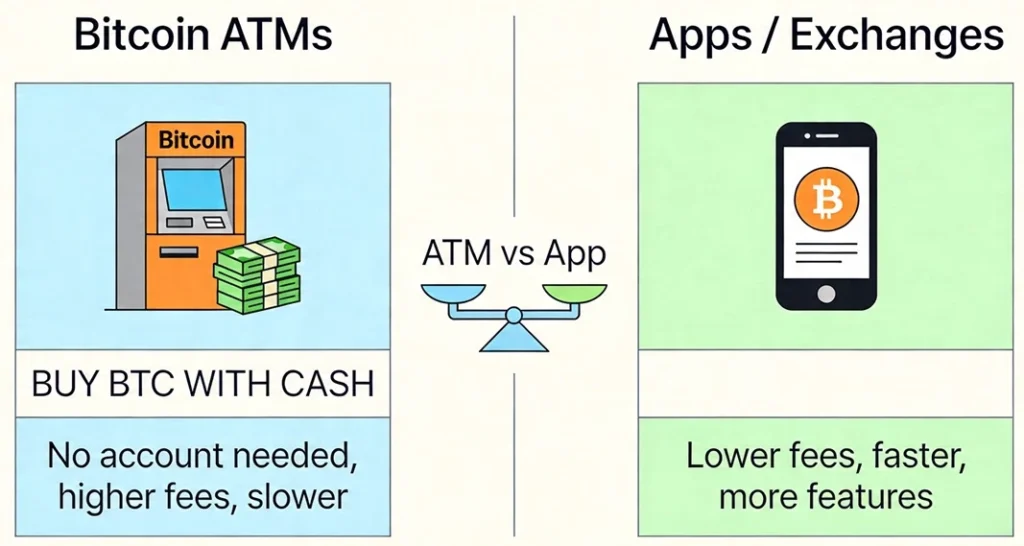
When Bitcoin ATMs make sense
Bitcoin ATMs are useful if you want:
- To buy Bitcoin with cash
- No bank account or card
- Quick access without signing up
- A no-account-needed option (for small amounts)
When exchanges are better
Apps and exchanges offer:
- Lower fees
- Faster execution
- More features
Role of Bitcoin ATMs
Bitcoin ATMs act as a cash on-ramp, especially for:
- Beginners
- Unbanked users
- Privacy-focused transactions (within legal limits)
Quick cheat-sheet
| Action | Where you go | What you need | What to watch |
|---|---|---|---|
| Find a Bitcoin ATM | Locator map / app | City or ZIP code | Hours, supported coins |
| Buy Bitcoin with cash | ATM → “Buy” | Cash, wallet, phone | Fees, daily limit |
| Sell Bitcoin for cash | ATM → “Sell” | Bitcoin in wallet | Confirmations |
| Safety | Anywhere | Self-custody wallet | Double-check address |
Final thoughts
Bitcoin ATMs provide one of the simplest ways to buy Bitcoin with cash or sell Bitcoin for cash, especially for users who want fast access without relying on banks or exchanges.
While fees are higher, the convenience, accessibility, and ease of use make them a powerful entry point into crypto.
If you’re just getting started, using a Bitcoin ATM near you can be a great first step—just make sure to follow basic security practices and always control your own wallet.
Are Bitcoin ATMs Safe?
A legitimate Bitcoin ATM can be used safely if you control the destination wallet, understand the fees and are making the transaction for your own reasons.
However, Bitcoin ATMs are frequently used in payment scams because cryptocurrency transfers can be difficult to reverse.
The FBI’s Internet Crime Complaint Center received more than 13,400 complaints involving cryptocurrency kiosks during 2025, with reported losses exceeding $388 million. More than half of the complaints involved people over 50, and that age group reported over $302 million in losses.ic3
Major Scam Warning Signs
Stop the transaction if someone:
- Contacts you unexpectedly about a financial emergency.
- Claims to be from a government agency.
- Claims to be a police officer or court representative.
- Says your bank account or identity has been compromised.
- Pretends to work for Amazon, Microsoft, Apple or another major company.
- Tells you to withdraw cash from your bank.
- Directs you to a specific Bitcoin ATM.
- Sends you a QR code to scan.
- Says moving money to Bitcoin will protect it.
- Demands payment for taxes, fines or legal problems.
- Promises guaranteed investment returns.
- Asks for cryptocurrency during an online relationship.
- Insists that you stay on the phone at the machine.
- Tells you not to speak with bank, store or ATM employees.
- Pressures you to act immediately.
- Demands secrecy.
The FTC warns that scammers may impersonate businesses or government agencies and then instruct victims to deposit cash into Bitcoin ATMs using QR codes controlled by the scammers.ftc+1
Protect Yourself
Follow these security rules:
- Use only your own Bitcoin wallet.
- Generate the receiving QR code inside your wallet.
- Never use a QR code sent by another person.
- Check the address before confirming.
- Review the total cost before inserting cash.
- Start with a small transaction when using a new machine.
- Keep the receipt.
- Avoid using public Wi-Fi.
- Never share your seed phrase.
- Do not let strangers “help” you operate the machine.
- Contact the operator through its official website if something goes wrong.
What to Do After a Scam
If you sent money because of a Bitcoin ATM scam, act immediately.
Contact the ATM operator using the official support number shown on its website or your receipt. Explain that the transaction was fraudulent and ask whether it can be stopped.
Preserve the following evidence:
- ATM receipt.
- Transaction ID.
- Bitcoin wallet address.
- Machine address.
- Date and time.
- Phone numbers.
- Emails and text messages.
- Screenshots.
- Names used by the scammer.
- Bank-withdrawal records.
In the United States, report the incident to:
- FBI Internet Crime Complaint Center
- FTC ReportFraud
- Local law enforcement
Cryptocurrency transfers can be difficult to reverse, but quick reporting gives the operator and authorities the best available opportunity to investigate.
Bitcoin ATMs vs Exchanges
Bitcoin ATMs provide convenient access to Bitcoin using physical cash, but they are not usually the cheapest way to buy.
| Feature | Bitcoin ATM | Online Exchange |
|---|---|---|
| Best for | Buying Bitcoin with physical cash | Regular purchases and lower-cost transactions |
| Fees | Usually higher | Usually lower |
| Payment methods | Primarily cash | Bank transfer, card and other supported methods |
| Account setup | Depends on operator | Usually required |
| ID requirements | Depend on operator, amount and location | KYC is common |
| Buying Bitcoin | Available at most machines | Widely available |
| Selling Bitcoin | Only at supported two-way machines | Usually available through the platform |
| Availability | Depends on physical locations and store hours | Available online, subject to regional restrictions |
| Trading tools | Limited | May include recurring purchases, limit orders and charts |
A Bitcoin ATM may make sense if you:
- Need to buy Bitcoin using physical cash.
- Do not have access to the exchange’s supported payment methods.
- Want a local, in-person transaction.
- Are willing to pay more for convenience.
- Understand the verification requirements and total cost.
An online exchange may be a better choice if you:
- Want lower fees.
- Plan to buy Bitcoin regularly.
- Want to compare prices before purchasing.
- Need recurring-purchase or trading features.
- Want higher account-based limits.
Read How to Buy Bitcoin Safely before choosing where to make your purchase.
After Buying Bitcoin
Confirm that the Bitcoin arrived in the wallet you control.
If the transaction does not appear immediately:
- Check the ATM receipt.
- Look for a transaction ID.
- Check the receiving address in your wallet.
- Search for the transaction using a Bitcoin block explorer.
- Contact the ATM operator if the transaction is missing or delayed.
Keep the receipt until the transaction has been fully resolved.
If this is your first Bitcoin purchase, begin with a small amount. This lets you verify that the wallet and ATM work as expected before risking more money.
For larger or long-term holdings, learn how private keys, seed phrases and wallet backups work. Continue with the Bitcoin Self-Custody Guide.
Bitcoin ATM Checklist
Before using a Bitcoin ATM, confirm each item:
- I found the machine through a reputable locator.
- I checked the location and store opening hours.
- I confirmed whether it supports buying or selling.
- I checked its current status.
- I reviewed its fees and limits.
- I know which identification is required.
- I have my own Bitcoin wallet.
- I generated the receiving QR code inside my wallet.
- Nobody instructed me to use this machine.
- I am not scanning a QR code sent by another person.
- I checked the final Bitcoin amount and exchange rate.
- I checked the wallet address.
- I will save the receipt.
If somebody directed you to the machine, sent you a QR code or told you the transaction would protect your money, stop immediately.
FAQ
What is a Bitcoin ATM and how does it work?
A Bitcoin ATM is a machine that allows users to buy or sell Bitcoin using cash or debit card by sending crypto to a wallet address.
How do I find a Bitcoin ATM near me?
You can use a Bitcoin ATM locator or map like CoinATMRadar to find nearby machines by entering your location.
How do I buy Bitcoin with cash at a Bitcoin ATM?
Select “Buy Bitcoin,” scan your wallet QR code, insert cash, and confirm the transaction to receive Bitcoin.
Can I sell Bitcoin at a Bitcoin ATM for cash?
Yes, if the ATM is bidirectional, you can send Bitcoin to the machine and receive cash after confirmation.
How much does it cost to use a Bitcoin ATM?
Fees typically range from 10% to 20%, depending on the machine and operator.
What do I need to use a Bitcoin ATM?
You need a Bitcoin wallet, cash, a phone for verification, and sometimes ID depending on the amount.
Are Bitcoin ATMs safe and how to avoid scams?
Yes, if used properly. Always verify the wallet address and avoid sending Bitcoin to unknown addresses.
What are the daily limits at Bitcoin ATMs?
Limits vary but typically range from $500 to $5,000 or more depending on verification level.
Learn More About Bitcoin
Bitcoin ATMs are one way to buy Bitcoin, but convenience comes with higher costs and significant scam risks.
Before completing a transaction:
- Learn how to buy Bitcoin safely
- Compare the best Bitcoin wallets
- Understand Bitcoin self-custody
- Explore Bitcoin fundamentals
- Read the complete Bitcoin guide
Always control your own wallet, verify the final cost and stop if someone else instructed you to use the machine.