
If you’ve been considering Bitcoin as part of your investment portfolio, you’re not alone. Millions of people worldwide are exploring cryptocurrency, drawn by headlines of fortunes made and the promise of financial independence. Yet for every success story, there are countless cautionary tales of people who made preventable Bitcoin Investment mistakes and lost significant money in the process.
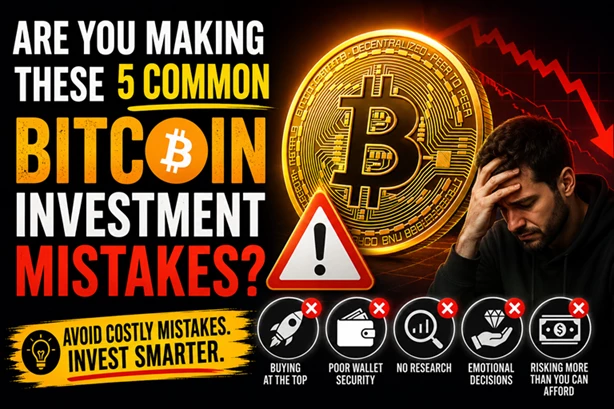
This guide breaks down the 5 common bitcoin investment mistakes beginners make—and more importantly, how to avoid them. Whether you’re brand-new to crypto or considering your first Bitcoin purchase, understanding these pitfalls could save you thousands of dollars and years of regret.
Table of Contents
Mistake #1: Treating Bitcoin Like a Get-Rich-Quick Lottery Ticket
One of the most dangerous common bitcoin investment mistakes is entering the market with unrealistic expectations about speed and returns.
Bitcoin has made some early adopters extraordinarily wealthy. Someone who bought $1,000 of Bitcoin in 2011 at $1 per coin would have seen that turn into millions by today’s prices. These stories are seductive—and they’re also the exception, not the rule.
New investors often buy Bitcoin because they heard a friend made 10x returns, watched a TikTok video promising wealth, or read yet another headline about crypto millionaires. This FOMO (fear of missing out) mentality leads them to make three critical errors:
They oversize their position. Beginners frequently allocate 20%, 30%, or even 100% of their liquid savings into Bitcoin on day one, treating it like a lottery ticket that’s guaranteed to pay off.
They expect fast returns. They expect to 2x their money in weeks or months. When Bitcoin inevitably experiences a 10–20% correction (which happens regularly), they panic and sell at a loss.
They chase narratives instead of valuations. They buy based on hype cycles: “Everyone’s talking about it,” or “It’s going to $100k by next quarter,” rather than understanding what Bitcoin actually is and why it has value.
How to Avoid This Bitcoin Buying Mistake
Start by reframing Bitcoin in your mind: it’s a high-volatility, long-term asset class, not a scratch-off ticket.
Use position sizing. A common rule among experienced investors is to allocate only what you can afford to lose entirely without affecting your life—typically 1–5% of your net worth for aggressive investors, and 0.5–2% for conservative ones. If losing that amount wouldn’t change your sleep, you’ve sized correctly.

Think in cycles, not days. Bitcoin has historically moved in 4-year cycles tied to its halving events. Approach it as a multi-year holding with the expectation that you’ll see 30–50% drawdowns along the way. If those swings make you uncomfortable, reduce your position size.
Invest with a plan, not a prayer. Before you buy your first satoshi (the smallest unit of Bitcoin, equal to 0.00000001 BTC), write down: Why are you buying? What’s your time horizon? How much are you willing to lose? If you can’t answer these clearly, wait.
Mistake #2: Investing Without Research (Following Hype, Not Facts)
The second of the common Bitcoin investment mistakes is jumping in without doing your own research (DYOR).
A beginner logs onto Twitter or Reddit and sees influencers with thousands of followers posting: “Just loaded up on Bitcoin—this is the trade of the decade.” Without understanding anything about Bitcoin’s fundamentals, they FOMO-buy the same day.
Or they hear a friend’s cousin made money on some altcoin and immediately search for “the next Bitcoin,” only to discover they’ve bought into a scam or a project with zero real utility.
This mistake is compounded by the fact that crypto is complex. Bitcoin’s design, blockchain technology, and market dynamics aren’t intuitive. It’s far easier to trust someone else’s opinion—especially if that person seems successful or confident.
The result? Investors who don’t understand:
- What Bitcoin actually does (store of value and medium of exchange, not a company with earnings or cash flow)
- How custody works (where their coins actually are and who controls them)
- The difference between Bitcoin and altcoins (Ethereum, Solana, etc. have different purposes and risk profiles)
- How exchanges work or why self-custody matters
Simple DYOR Framework for Bitcoin and Crypto
You don’t need a PhD in cryptography to invest safely. Here’s a plain-English checklist:
Understand Bitcoin’s core purpose: Bitcoin is digital money secured by a global network of computers. It’s designed to be resistant to censorship and government control. If that thesis doesn’t appeal to you—or if you’re buying it because a celebrity endorsed it—reconsider.
Learn how to custody your coins: Before buying, understand the difference between leaving Bitcoin on an exchange (like Coinbase) and holding it yourself via a hardware wallet or seed phrase. Know what “not your keys, not your coins” means.
Distinguish Bitcoin from altcoins: Bitcoin is the largest and oldest cryptocurrency. Altcoins (Ethereum, Solana, etc.) have different purposes and far higher risk. Don’t assume all crypto is created equal.
Understand basic mechanics: Know how to buy, where your coins live, how to send them, and what fees you’ll pay. Spend 30 minutes learning before you spend $300 buying.
Start small. Use your first purchases as “tuition.” Buy a small amount—maybe 100–500—learn the process firsthand, make your bitcoin investment mistakes on a small scale, and build confidence before you increase your position.
Mistake #3: Ignoring Security and Leaving Everything on Exchanges
This mistake could be the most expensive of all: ignoring Bitcoin security and leaving significant holdings on exchanges.
Many beginners buy Bitcoin and leave it sitting on the exchange where they purchased it (Coinbase, Kraken, Binance, etc.). This feels convenient—the exchange holds it for you, and you can sell instantly if you want.
But here’s the problem: exchanges are prime targets for hackers. And even if an exchange is well-managed, you don’t truly own the Bitcoin—the exchange does. If the exchange gets hacked, goes bankrupt, or restricts your account, your coins are vulnerable.
This is among the most critical bitcoin investment mistakes to avoid because you could be perfectly right about Bitcoin’s price direction and still lose everything due to a security breach.
Equally dangerous: beginners use weak passwords, don’t enable two-factor authentication (2FA), or worse—they write their seed phrase (the master key to all their coins) on a Post-it note and stick it to their monitor, or share it with a “helpful” person online who claims they can help them recover a “lost wallet.
How to Avoid Bitcoin Security Pitfalls
The fundamentals of Bitcoin security are simple, though they require discipline:
Enable 2FA on every account. Use an authenticator app (like Google Authenticator or Authy), not SMS. SMS can be intercepted. This alone stops the vast majority of hacks.
Use unique, strong passwords. Use a password manager (1Password, Bitwarden, LastPass) to generate 16+ character passwords. Never reuse passwords across accounts. If one exchange gets hacked, hackers won’t have access to your others.
Move long-term holdings to self-custody. For amounts you plan to hold for years, buy a hardware wallet (50–50–100). The most popular options are Ledger and Trezor. A hardware wallet stores your Bitcoin offline, isolated from internet-connected devices where hackers operate.
Treat your seed phrase like cash or gold. If someone can see your seed phrase, they own your Bitcoin. Write it down on paper (not digitally), store it in a secure location (safe deposit box, home safe), and never photograph it or email it. Never share it with anyone, regardless of their title or claims to help.
Verify addresses before sending. When you send Bitcoin, always double-check the receiving address. Typos are irreversible; once Bitcoin leaves your wallet, you can’t get it back.
Mistake #4: Emotional Trading – Buying High and Panic Selling Low
Among the most common crypto trading mistakes is emotional decision-making driven by price action.
Bitcoin is volatile. It’s not unusual to see 10% moves in a single day, and 30–50% drops in a few months. This volatility triggers powerful emotions—greed on the way up, fear on the way down.
For beginners, this often plays out like a predictable tragedy:
Phase 1: FOMO Buying. Bitcoin rallies from $40k to $60k over three months. News headlines scream “Bitcoin surges!” Every social media post celebrates gains. The beginner finally cracks and buys at $59k, betting that it’ll reach $100k next week.
Phase 2: Doubt. Two weeks later, Bitcoin drops to $52k. It’s a normal 13% pullback, but the beginner begins to doubt their thesis. They check the price compulsively—20 times a day. Every dip feels like a sign they made a mistake.
Phase 3: Panic Selling. Bitcoin drops another 5% to $49k. The beginner can’t stand the sight of red anymore. They sell, locking in a $10k loss—exactly the moment before Bitcoin rebounds to $75k.
Phase 4: Revenge Trading. Furious at themselves, they buy again at $68k, trying to “make back” what they lost. They repeat the cycle, each time with more emotion and less logic.
This is one of the most common bitcoin investment mistakes beginners make because it’s driven by human psychology, not by anything actually changing about Bitcoin’s fundamentals.
Practical Ways to Reduce Emotional Bitcoin Investment Mistakes
You can’t eliminate emotions, but you can structure decisions to bypass them:
Set a time horizon and stick to it. Decide before you buy: “I’m holding this Bitcoin for 4 years minimum. I will not sell it for any reason except a major life emergency.” Write it down. When panic hits, read what you wrote.
Define buying and selling rules in advance. Decide on a specific price or percentage drop where you’ll buy more (e.g., “I buy $500 of Bitcoin every time it drops 20%”). Decide on a goal price or portfolio percentage where you’ll take profits (e.g., “I sell 10% when Bitcoin doubles”). Make these rules before emotions are running high, then follow them mechanically.
Use dollar-cost averaging. Instead of a lump-sum buy, invest the same amount every week or month regardless of price. This removes the pressure to “time the market” and reduces the impact of buying at the top. If Bitcoin is $40k one month and $60k the next, your average purchase price is less volatile.
Reduce price-checking. You don’t need to check your portfolio daily. Set a calendar reminder once per month to review your position. The less frequently you check, the less emotional volatility you’ll experience.
Separate long-term from speculation. If you can’t resist day-trading, set aside a small, defined “trading stack”—maybe 5–10% of your crypto allocation—and trade that. Keep the rest in a hardware wallet untouched. This caps your emotional damage.
Mistake #5: No Clear Plan – All-In, Overleveraged, or Scattered
The final critical mistake is investing without a written plan. This ties together all the previous errors: without clarity, people overreact to noise, panic-sell during dips, and flip their thesis every time a celebrity tweets.
Investors who make this mistake often:
Go all-in on day one. They dump their entire investable cash into Bitcoin because they’re convinced it’s guaranteed to 10x. When it doesn’t immediately, they’re in a psychologically fragile state.
Use leverage or margin. They borrow money to amplify their Bitcoin bet, turning a potential 30% loss into a 90% liquidation. Leverage is how fortunes are made—and lost—in crypto.
Scatter their allocation. Instead of building conviction in Bitcoin, they buy a little of 50 different coins because they’re afraid of missing “the next Bitcoin.” This dilutes their focus, increases their research burden, and typically leads to worse results than concentrating on one or two assets.
Never rebalance or review. They buy Bitcoin and then… never think about it again, or think about it obsessively without ever making a deliberate adjustment. Both are Bitcoin Investment mistakes.
These errors all stem from the same root: no clear plan.
Building a Simple Bitcoin Investment Plan
Here’s a template you can use today:
Step 1: Decide your allocation.
- What percentage of your net worth will you allocate to Bitcoin? For most beginners, 1–5% is reasonable. For aggressive investors, up to 10%. For very conservative investors, 0.5% or less.
- This should be money you can afford to lose entirely without changing your life.
Step 2: Decide your time horizon.
- Are you holding for 5 years? 10 years? Until Bitcoin reaches a specific price?
- Write this down: “I’m holding this Bitcoin until [date or condition].”
- The longer your time horizon, the easier it is to ignore short-term volatility.
Step 3: Decide your entry and rebalancing rules.
- Will you buy a lump sum today, or dollar-cost average over 3–6 months?
- If you dollar-cost average, decide the amount and frequency (e.g., “$500 every two weeks”).
- Plan to rebalance annually: if Bitcoin has become a larger percentage of your portfolio due to gains, consider taking some profits. If it’s dropped, you might buy more (only if this fits your plan).
Step 4: Decide what percentage is long-term vs. trading.
- For example: 80% is in a hardware wallet, untouched for years. 20% is a “trading stack” you can actively manage.
- This mental separation reduces the temptation to panic-sell your core position.
Step 5: Write it down and commit.
- Put your plan in a document. Review it once per quarter. Stick to it unless your life circumstances genuinely change (not because Bitcoin moved 20%).
What Is Eric Trump Saying About Crypto—And Why It Matters (or Doesn’t)
In recent years, various public figures—including Eric Trump, members of Congress, and business leaders—have made statements about Bitcoin and cryptocurrency. Some are bullish, some are skeptical, and some are opportunistic.
Eric Trump, for instance, has made comments suggesting interest in crypto and blockchain technology, largely in the context of broader discussions about innovation and financial markets. These statements have received attention in crypto communities, partly because of Trump’s platform and partly because political narratives can influence market sentiment.
Here’s the critical point: following political figures or celebrities is itself a form of the bitcoin investment mistakes discussed above. It’s a variation of Mistake #2 (investing without research) and Mistake #4 (emotional trading based on narratives).
When Eric Trump—or any public figure—says something positive about crypto, it can create a temporary wave of buying and hype. This pumps prices but often doesn’t reflect changes in Bitcoin’s fundamentals. Similarly, skeptical comments can create selling pressure.
How to Filter Noise from Signal in Crypto Narratives
As an investor, your job is to distinguish between meaningful information and pure sentiment-chasing.
Macro narratives matter; soundbites don’t.
- Meaningful information: “The U.S. is developing Bitcoin-friendly regulations” or “A major corporation is adding Bitcoin to its balance sheet.” These represent real adoption and could affect Bitcoin’s long-term value.
- Soundbites don’t matter: “Elon Musk likes crypto” or “Eric Trump tweeted about blockchain.” These move price short-term but reveal nothing about whether you should buy.
Track how narratives affect you emotionally.
- For a week, notice how often you check crypto news on social media. Notice how many times you feel an urge to buy or sell after reading a headline or tweet.
- If you’re making trades based on what a celebrity said, you’re not investing—you’re gambling based on sentiment.
- A good rule: if you can’t explain why you’re buying Bitcoin without mentioning a person’s name, you have a real reason. If you can only explain it by referencing what “they” said, you don’t.
Focus on what you can control.
- You can’t predict what Eric Trump, Elon Musk, or the next influencer will say.
- You can control your position size, your entry price, your security, and your time horizon.
- Spend 90% of your energy on what you control, and 10% on macro narratives.
Quick Checklist: Bitcoin Investment Mistakes to Avoid
Here’s a plain-English reference guide to ensure you’re not repeating the most common errors:
Before you buy:
- ☐ Have I sized my position to an amount I can afford to lose?
- ☐ Do I understand what Bitcoin is and why it has value?
- ☐ Have I researched custody and security basics?
- ☐ Have I written down my investment plan (time horizon, allocation, rebalancing rules)?
- ☐ Am I buying because I understand the asset, or because someone on the internet told me to?
As you buy:
- ☐ Am I buying gradually (dollar-cost averaging) or all at once? (Both can work; gradual is easier psychologically.)
- ☐ Have I enabled 2FA on my exchange account?
- ☐ Do I understand which coins I’m moving to self-custody vs. leaving on the exchange?
After you buy:
- ☐ Have I moved long-term holdings to a hardware wallet?
- ☐ Have I written down my seed phrase and stored it securely?
- ☐ Am I checking the price less frequently (weekly or monthly, not hourly)?
- ☐ If the price drops 30%, am I panicking, or does my plan account for this?
- ☐ Have I set rules for rebalancing (e.g., “I’ll sell 10% if Bitcoin reaches $X price”)?
FAQ: Common Bitcoin and Crypto Investment Mistakes (For Beginners)
Are you making these 5 common crypto investment mistakes?
Possibly. The five mistakes covered in this article are treating Bitcoin as a get-rich-quick scheme, investing without research, ignoring security, emotional trading, and having no plan. If you recognize yourself in any of these, don’t panic—it means you’re now aware and can adjust.
What are the biggest bitcoin investment mistakes beginners make?
The biggest are oversizing positions (investing too much too fast), leaving coins on exchanges rather than using self-custody, panic-selling after normal 20–30% corrections, chasing hype instead of understanding the asset, and trading without a time horizon in mind.
What are the most common bitcoin Investment mistakes?
Chasing pumps (buying after a price surge), panic-selling (dumping coins after a sharp drop), overtrading (buying and selling multiple times per day), using leverage when they don’t understand the risks, and trading based on social media sentiment rather than a plan.
What bitcoin buying mistakes should I avoid?
Avoid FOMO-buying at all-time highs. Avoid buying without understanding custody (where your coins actually are). Avoid borrowing money to buy Bitcoin. Avoid concentrating too much of your wealth into one purchase. Avoid talking about your Bitcoin holdings publicly (it makes you a target). Avoid buying coins you can’t explain to a friend in one sentence.
How much of my portfolio should be Bitcoin?
This depends on your risk tolerance and timeline. A common range is 1–5% of your investable net worth. Conservative investors might go 0.5–1%. Aggressive investors might go 5–10% or more. Key rule: don’t allocate more than you can afford to lose completely without affecting your life.
Is it too late to buy Bitcoin?
This is a subjective question that depends on your time horizon. If you’re investing for the next 5–10+ years and believe Bitcoin will be widely adopted, the entry price is less important than your time horizon and consistency (dollar-cost averaging). If you’re trying to time the market or make quick profits, the answer is: it’s always “too late” to make fast money, because Bitcoin is fundamentally a long-term asset.
Conclusion: Start Small, Learn Fast, Build Conviction
The path to becoming a successful Bitcoin investor isn’t glamorous. It doesn’t involve catching every pump or getting rich in a year. It involves:
- Sizing your position appropriately
- Taking time to understand what you’re buying
- Prioritizing security over convenience
- Controlling your emotions through rules and time horizons
- Having a written plan and sticking to it
The good news: these aren’t complicated. You don’t need advanced technical skills or financial expertise. You just need discipline and patience.
Start with a small amount—even $100 is enough to learn the basics of buying, custody, and storing Bitcoin. Treat it as tuition while you build conviction and knowledge. As you become more comfortable, you can increase your allocation.
And remember: avoid bitcoin investment pitfalls aren’t really about Bitcoin. They’re about mastering yourself—your emotions, your discipline, your ability to follow a plan even when the world is screaming at you to do something else.
That’s the real skill that separates successful investors from perpetual losers.