If you are constantly asking, “Best altcoin analysis for active traders?” you are not alone. The cryptocurrency landscape has mutated beyond recognition since the early 2020s, and by 2026, winning trades are rarely the product of gut feeling or lucky timing. They are the disciplined output of rigorous, systematic altcoin research. The problem facing today’s active trader is no longer a lack of data; it is filtering genuine signal from overwhelming noise across thousands of tokens, fragmented Layer-2 ecosystems, AI-generated misinformation campaigns, and sophisticated wash-trading schemes. Active traders need curated intelligence, not just colorful charts. They need altcoin research infrastructure that operates in real time, adapts to regime changes, and surfaces opportunities before they reach mainstream Twitter feeds.

This article breaks down the most effective analysis stack for traders who execute multiple positions per week and cannot afford to be late, wrong, or illiquid. Whether you swing trade low-cap gems on emerging smart-contract platforms or scalp mid-tier volatility across perpetual futures, your altcoin research workflow must keep pace with institutional-grade algorithms, high-frequency market makers, and on-chain whales whose movements can reprice an entire sector in minutes.
The Evolution of Altcoin Research
By 2026, altcoin research has evolved from static CoinMarketCap pages, rudimentary GitHub star counting, and Discord rumor mills into a professional discipline that rivals traditional equity analysis. Regulatory clarity in major jurisdictions has forced legitimate projects to disclose verifiable treasury data, token unlock schedules, and granular revenue metrics. Meanwhile, zero-knowledge proofs and improved oracle networks now allow traders to audit tokenomics directly on-chain without trusting a centralized dashboard or opaque API. For active traders, this maturation means altcoin research now spans three critical dimensions: technical price action, fundamental on-chain health, and predictive sentiment modeling.

The best tools do not simply display candles or circulating supply figures. They synthesize cross-chain capital flows, social graph anomalies, GitHub developer velocity, and derivatives funding rates into coherent, actionable signals. Below are the platforms and methodologies defining elite altcoin research this year and likely for the remainder of the decade. You also have Crypto Cobra where I share different altcoin reviews and trading tips.
1. Unified On-Chain Intelligence Terminals
Glassnode and Nansen set the standard years ago, but 2026 belongs to next-generation terminals that treat altcoin research as a cross-chain forensic exercise rather than a static reporting layer. Platforms like Arkham X, Santoris, and the recently relaunched Dune AI have merged probabilistic wallet labeling with real-time pattern detection, allowing traders to trace smart-money rotation from Solana SVM environments into Ethereum Layer-2s and Move-language ecosystems within seconds of confirmation.

For active traders, speed is everything. When a dormant whale wallet awakens after eighteen months of hibernation and bridges four million dollars into an obscure governance token, your altcoin research terminal should push a customizable alert before the second five-minute candle closes. Modern explorers now offer execution-grade APIs and low-latency webhooks, meaning your trading bot can parse whale accumulation patterns while you verify the fundamental thesis manually. Effective altcoin research at this level requires subscribing to a terminal that covers not just EVM chains but also Bitcoin Layer-2 assets, Cosmos SDK ecosystems, and the growing landscape of app-specific rollups. If your on-chain tool only tracks Ethereum mainnet in 2026, you are effectively trading with one eye closed. Serious altcoin research demands this kind of multi-chain coverage.
2. AI-Powered Predictive Analytics Suites
Artificial intelligence is no longer a buzzword in crypto Twitter bios; it is the hardened backbone of quantitative altcoin research. Tools like Kaito AI Augment, Messari Pro Vision, and the open-source Alternative Sense engine use large language models and transformer architectures trained on years of granular on-chain history to generate probabilistic price-path scenarios and volatility cones. These are not magic eight balls dressed in Python. They are rigorous regression models that weigh exchange inflow gradients, GitHub developer commit consistency, funding rate divergences, and global macro liquidity conditions simultaneously.
Active traders use these AI suites during the pre-trade altcoin research phase to stress-test directional assumptions and identify asymmetric risk-reward setups. Skipping this altcoin research step is no longer optional in modern markets. For example, before entering a leveraged long on a decentralized finance protocol’s native token, you can simulate how historically similar tokens reacted during past Federal Reserve pivot announcements, banking crises, or stablecoin depeg events. The best AI tools in 2026 highlight their confidence intervals, Sharpe ratios, and out-of-sample backtesting transparency, ensuring your altcoin research remains grounded in statistical reality rather than narrative hype. When an AI terminal suggests a sixty-eight percent probability of a twenty-percent move within seventy-two hours, you have a quantified edge that most retail participants lack.
3. Sentiment and Social Graph Analysis Engines
Retail sentiment still drives altcoin volatility, often more violently than Bitcoin due to thinner order books and lower market capitalization. However, modern altcoin research can no longer rely on rudimentary Twitter trend scrapers that drown active traders in bot noise, duplicate spam, and paid shill campaigns. Platforms such as LunarCrush Quantum, Alphractal, and the Farcaster-native Moodcaster have advanced to natural-language sentiment engines that distinguish between organic community growth, developer authenticity, and coordinated astroturfing operations funded by venture capital marketing budgets.
These tools map influencer credibility scores across time, track narrative origination across Telegram channels, Discord servers, Farcaster frames, and decentralized forums, and quantify emotional extremity using linguistic biomarkers. When a new Layer-1 begins trending across social channels, your altcoin research protocol should identify within moments whether the conversation started with verified core developers shipping code or with a network of paid promotion accounts recycling identical memes.
For scalpers and day traders, real-time sentiment divergences offer short-term statistical edge: if funding rates are deeply negative but social volume is exploding alongside negative funding, the contrarian long setup may present an immediate opportunity. Integrating narrative tracking into your daily altcoin research routine helps you avoid buying local tops orchestrated by viral marketing and helps you spot accumulation phases disguised as apathy.
4. Derivatives and Flow Analytics Platforms
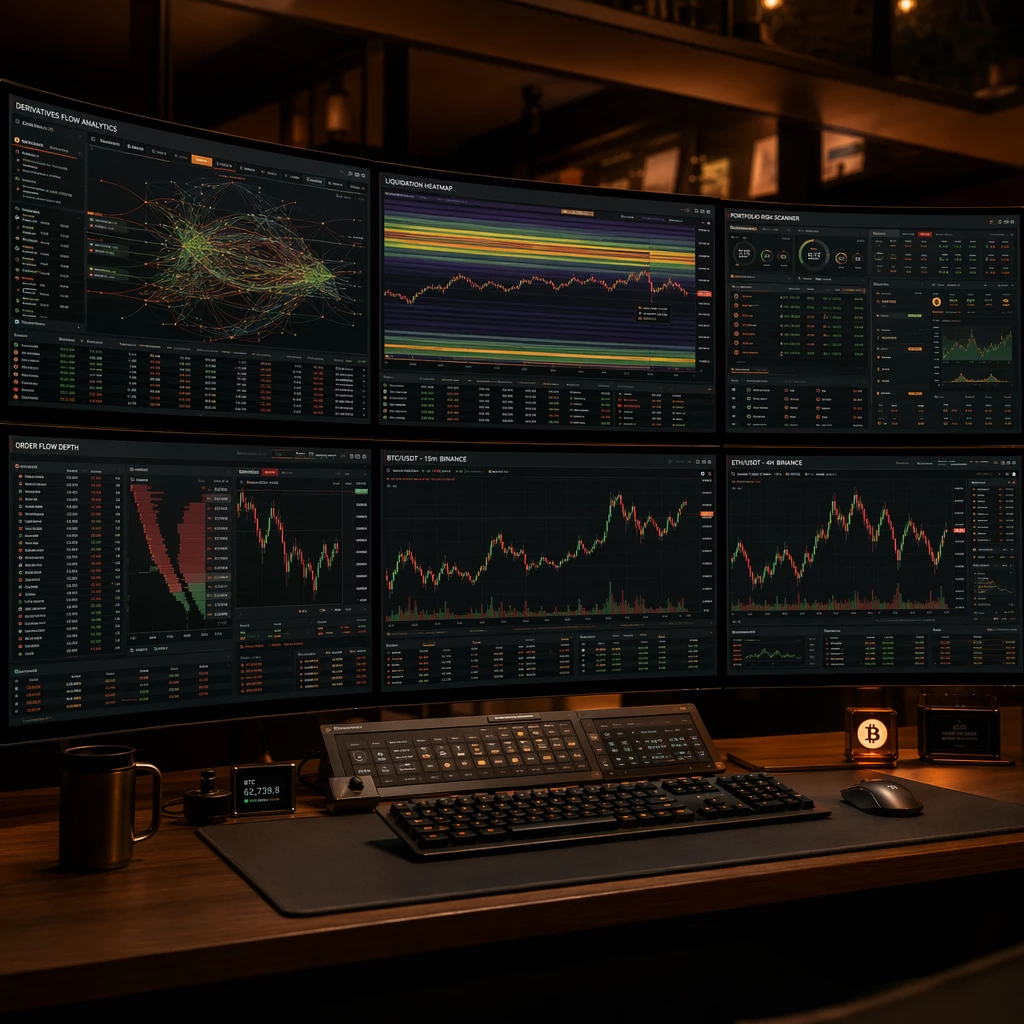
Spot price action is only half the story in modern crypto markets. Sophisticated altcoin research in 2026 demands granular, per-exchange insight into derivatives markets because price discovery increasingly happens in perpetual futures rather than spot order books. Platforms like Coinalyze Hyper, CryptoQuant Derivatives Lab, and The Block’s Flow Terminal now offer per-asset open-interest heatmaps, liquidation cluster visualizations, and delta-adjusted gamma exposure maps that reveal exactly where forced unwinds will accelerate.
Active traders use this flow data to anticipate volatility expansions before they appear on candlestick charts. When your altcoin research process includes options flow analysis, you gain visibility into institutional positioning that spot traders simply cannot see. Are market makers aggressively shorting gamma on a newly listed perpetual, creating a pin-risk scenario into expiry? Is there a significant block trade on an offshore options desk indicating hedging activity by a venture-capital unlock recipient? Tools that parse CME-equivalent altcoin derivatives data, even for assets outside the top ten, give retail traders the same situational awareness that proprietary trading desks enjoyed during previous market cycles. If you trade with any amount of leverage, your altcoin research toolkit must include a dedicated flow terminal or you are flying blind into engineered liquidity grabs.
5. Automated Portfolio and Risk Scanners
Speed of execution means absolutely nothing without disciplined risk control. Active traders running concentrated books exposed to dozens of altcoins require surveillance capabilities that manual altcoin research cannot realistically provide across a twenty-four-hour market. Platforms like DeFiPulse Sentinel, CoinStats Ultra, and Step Finance Monitor allow traders to track cross-protocol health factors, impermanent loss drift, correlation spikes, and wallet exposure limits in true real time.
In 2026, smart wallets have become standard infrastructure, but so have smart alerts. If your altcoin research engine detects that three holdings in your book have suddenly correlated above 0.85 with Bitcoin during a macro downtrend, the scanner can trigger an automatic delta-neutral hedge or send a critical alert to your mobile device. These surveillance layers also audit smart contract risk continuously, flagging when a token you hold upgrades its proxy contract implementation, when a bridge backing your asset experiences validator slashing, or when an unaudited farming contract is added to a protocol you are staking within. For active traders, automated risk layers transform altcoin research from a pre-trade chore into a tireless twenty-four-seven guardian that protects capital while you sleep.
6. Regulatory and Compliance Scanners
One of the most consequential shifts by 2026 is the seamless integration of regulatory data into everyday altcoin research workflows. With the Markets in Crypto-Assets regulation fully enforced across European Union member states, and with United States federal framework litigation largely settled and operational, tokens now carry dynamic compliance scores that fluctuate based on enforcement actions, securities classification updates, and exchange licensing changes. Tools like Elliptic Lens, Chainalysis Market Watch, and TRM Labs Real-Time classify assets by jurisdictional risk, sanctions exposure, mixing history, and exchange delisting probability with remarkable granularity.
Before deploying capital into a privacy coin, a cross-chain bridge token, or a recently airdropped governance asset, active traders must include compliance verification in their altcoin research checklist. A position can be technically perfect, with beautiful chart structures and bullish on-chain accumulation, yet fundamentally toxic if the issuer faces an imminent enforcement action or if the token has been tainted by association with a sanctioned mixer. Modern compliance scanners plug directly into exchange APIs and custody platforms; they will preemptively block deposits from flagged contracts or warn you that withdrawable liquidity is shrinking due to delisting rumors. Ignoring regulatory dimensions during your altcoin research in 2026 can lock capital unexpectedly or trigger taxable events that destroy your annual returns.
7. Integrated Workflow and Command Centers
The final piece of the modern analysis puzzle is orchestration. Active traders cannot afford disparate browser tabs, fragmented mobile alerts, and delayed email digests that destroy reaction time. Elite altcoin research in 2026 happens inside unified command centers such as TradingView Ultimate, DEXTools Evolution, hyper-customized Grafana dashboards fed by Flipside Crypto SQL streams, or Notion-based command hubs integrated with Zapier automation.
These platforms allow you to build a personal altcoin research cockpit where on-chain whale alerts, customized technical indicators, verified news feeds, derivatives flow data, and live position PnL share a single cognitive canvas. When you first asked, “Best altcoin analysis for active traders?” the honest answer is that no single application wins in isolation; the victory goes to the trader who architecturally integrates multiple validated data streams into a seamless, low-latency decision loop. Your altcoin research command center should allow you to move from anomalous signal generation to verified thesis confirmation to order execution within ten seconds. In a market where directional edges persist for minutes rather than hours, workflow integration is itself an alpha-generating tool.
Building a Sustainable Altcoin Research Routine
Sophisticated tools are only as valuable as the human processes surrounding them. Active traders should block dedicated, distraction-free altcoin research windows during low-volatility periods to avoid FOMO-driven analysis during parabolic pumps. A sustainable daily routine involves a morning scan of overnight on-chain shift reports, a mid-day sentiment and funding-rate check, and an evening risk audit using portfolio correlation scanners. Sunday evenings are ideal for weekly macro calendaring and strategy backtesting.
Journaling is equally critical for long-term improvement. Every trade entry should reference the specific altcoin research data point, indicator confluence, or on-chain anomaly that triggered the decision, while exits should be annotated with emotional state and slippage data. Over a quarterly sample size, this journal reveals which tools actually improve your risk-adjusted expectancy and which merely generate comforting noise. In 2026, data availability is effectively infinite, but cognitive bandwidth remains finite. Ruthless curation separates profitable, efficient altcoin research from anxious busywork that leads to overtrading.
The Limits of Tooling
No stack, however advanced, is omniscient. Even the best-funded altcoin research infrastructure cannot predict black-swan smart contract exploits, exchange insolvencies, or geopolitical shocks that reroute global liquidity overnight. Active traders must remember that tools provide probabilistic edge, not deterministic certainty. Overfitting your strategy to AI backtests or whale-alert chasing can lead to catastrophic curve-fitted destruction when market regime change arrives without warning.
Diversify not just your portfolio allocations but your altcoin research sources and methodologies. If every indicator in your terminal is derived from the same underlying on-chain dataset or the same social graph API, you suffer from dangerous single-source risk. Maintain a healthy skepticism toward any signal and always ask what the tool is deliberately not showing you. Truly excellent altcoin research questions its own inputs, validates across independent data silos, and maintains humility in the face of market randomness.
Conclusion
So, what is the best altcoin analysis for active traders in 2026? It is definitively not a single mobile app, a secret Discord group, or a magic indicator. It is a layered, redundant altcoin research ecosystem that intelligently combines on-chain forensics, AI-driven prediction, authentic sentiment parsing, derivatives flow telemetry, automated risk management, and dynamic regulatory filtering. The traders who thrive this year are those who treat altcoin research as a full-time profession rather than a casual pre-trade hobby. Markets will always be chaotic, asymmetric, and occasionally cruel, but with the right stack, your altcoin research can cut through that chaos with institutional speed and surgical precision. Build your terminal, validate your signals, manage your downside risk relentlessly, commit to daily altcoin research discipline, and let rigorous, repeatable altcoin research be the unshakeable foundation of every trade you take.
Faqs
How do I research an altcoin before investing?
Start with a structured, repeatable process so you’re not swayed by hype. A solid workflow looks like this:
– Define the problem it solves – Read the whitepaper and docs; ask: “What real pain point does this address, and why blockchain?”
– Map the landscape – Identify direct competitors and how this project claims to be different or better.
– Check the team & backers – Look for verifiable founders, engineers, advisors, and reputable VC/accelerator ties.
– Analyze tokenomics – Study supply, unlocks, vesting, allocation, utility, and emissions.
– Validate activity & adoption – Inspect GitHub commits, testnet/mainnet usage, partnerships, and on‑chain metrics.
– Assess liquidity & markets – Review exchanges, order book depth, trading volume, and price history.
– Stress‑test risks – Identify regulatory, technical, competitive, and token‑unlock risks before sizing any position.
What should I look for when researching an altcoin?
Use a pillars checklist to avoid tunnel vision on price alone.
– Utility and fit — Clear use case, target users, and why the token is needed in the product flow.
– Tokenomics quality — Supply schedule, inflation or deflation mechanics, staking, burns, and fairness of initial distribution.
– Development and delivery — Active repos, regular releases, audited code, and a roadmap with shipped milestones.
– Adoption signals — Real users, transaction counts, TVL if DeFi, integrations, and revenue or fees where applicable.
– Liquidity and market structure — Enough depth to enter or exit without excessive slippage; healthy volume across venues.
– Governance and transparency — On-chain or off-chain governance, treasury visibility, and clear communication from the team.
How do I evaluate an altcoin’s tokenomics?
Tokenomics is the economic design of the token — how it’s created, distributed, used, and sustained. Poor tokenomics can drain value even if the product is good.
Focus on:
– Supply and emissions — Total vs circulating supply, inflation rate, and whether emissions drop over time.
– Unlock schedule — When do team or VC tokens unlock? Large cliffs can create sell pressure.
– Allocation fairness — What percent went to public sale, community, treasury, team, and investors?
– Utility and demand loops — Fees paid or burned, staking rewards, collateral use, governance rights, or access rights that create real demand.
– Treasury and sustainability — How is the project funded long-term? Is there a runway without constant dilution?
A simple rule: if the token’s main job is “go up in price,” that’s weak tokenomics; if it’s integral to the protocol’s function and cash flows, that’s stronger.
What are the biggest risks in altcoin research?
Even well-researched projects can fail. The biggest buckets are:
– Execution risk — The team can’t ship, scale, or compete.
– Adoption risk — No real users or revenue; growth is purely speculative.
– Token-unlock risk — Heavy future supply hitting the market depresses price.
– Smart-contract or tech risk — Bugs, exploits, or centralization such as admin keys.
– Regulatory risk — Classification as a security or bans in key jurisdictions.
– Liquidity risk — Thin markets lead to slippage or inability to exit.
– Narrative risk — The sector rotates out of favor and funding dries up.
How can I identify red flags in an altcoin project?
Red flags often appear before price action. Watch for:
– Anonymous or unverifiable team with no prior credible work.
– Overhyped marketing but vague technical docs or no whitepaper.
– Unrealistic promises like guaranteed returns or no risk.
– Extreme insider allocation or unclear treasury control.
– Aggressive unlock schedules near all-time highs.
– No code activity or closed-source core components.
– Liquidity concentration in a single pool or a few wallets.
– Audit theater — “Audited” by unknown firms or multiple conflicting reports.
What sources are reliable for altcoin research?
Combine data aggregators, primary docs, and independent analysis.
Primary sources
– Official website, docs, and whitepaper.
– GitHub or GitLab for code, commits, and release history.
– Official blog, governance forums, and treasury dashboards.
Market and on-chain data
– CoinMarketCap or CoinGecko for listings, supply, and basic metrics.
– DeFiLlama, Token Terminal, Dune, Nansen, or Arkham for on-chain usage, revenues, and flows.
– DexScreener or GeckoTerminal for liquidity, holders, and new token checks.
Community and third-party
– Reputable crypto research outlets and analyst threads, cross-verified.
– Reddit, Discord, or Telegram for sentiment — but treat as signals, not proof.
Always triangulate: if a claim only exists in marketing and not in docs or data, assume it’s unproven.
How do I compare different altcoins?
You can compare different altcoins by using a side-by-side scorecard and evaluating them across the same dimensions so you are comparing like with like. The main things to review are the project’s problem and niche, tokenomics, adoption, development, liquidity, and risks. You should compare use case clarity, target users, competitor set, supply, unlocks, utility, emissions, allocation, users, transactions, revenue, integrations, commits, releases, audits, bug bounties, exchanges, volume, holder distribution, and downside risks. A simple way to do this is to score each dimension from 1 to 5 and then weigh the results based on your strategy, such as long-term holding or trading.
Can on-chain data improve altcoin research?
Yes, on-chain data can improve altcoin research because it shows actual behavior rather than just promises. It is especially useful for Layer 1, Layer 2, DeFi, and other token-centric projects. Important signals include active addresses, transactions, fees, revenue, holder distribution, exchange flows, and staking or locking trends. Growth in active addresses and transactions can suggest real usage, while stronger fees and revenue can support token value. A concentrated holder base can increase manipulation risk, and exchange inflows or outflows can help signal selling or accumulation. On-chain data does not replace fundamental research, but it can confirm or challenge the project’s narrative.