The design of a decentralized network determines its limits. For years, the crypto industry struggled with the “blockchain trilemma,” where networks were forced to sacrifice speed or security to maintain decentralization. The Solana blockchain technology architecture was introduced to challenge this paradigm, offering a fundamentally different approach designed to maximize speed, ensure massive scalability, and maintain exceptionally low fees.
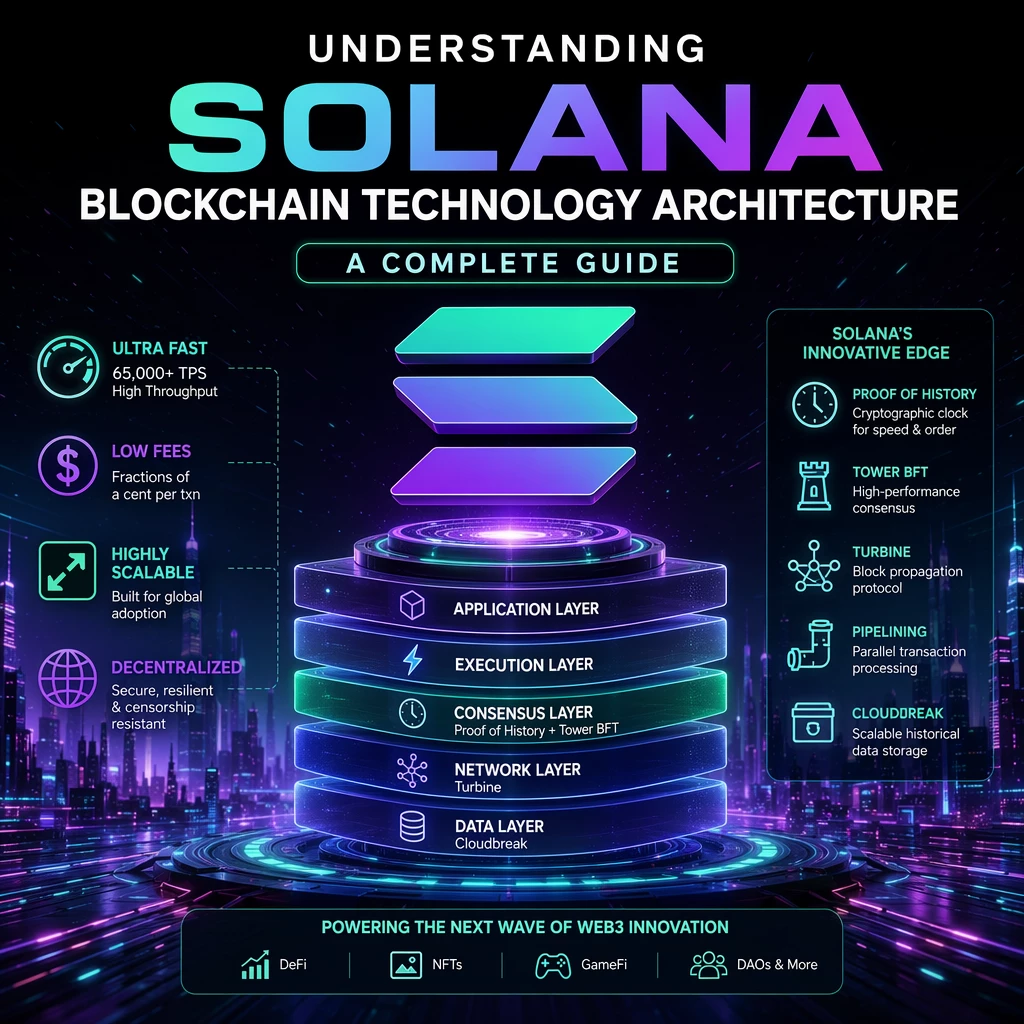
Solana Blockchain Technology Architecture
Rather than relying on the sequential processing models that defined early cryptocurrency networks, Solana reorganizes how data moves, how time is measured, and how nodes agree on the state of the network. Whether you are a developer looking to build applications or an investor trying to understand the fundamentals, grasping this architecture is essential.
This guide breaks down exactly how Solana works. We will explore its unique consensus mechanisms, efficient transaction flow, distinct account model, and the core network components that make it a truly high-performance system.
2. What Makes Solana Different
Solana is built from the ground up to be a high performance blockchain capable of supporting mass adoption. While traditional blockchains process transactions one by one and often suffer from severe bottlenecks during periods of high demand, the Solana architecture is optimized across both hardware and software layers to eliminate these constraints.
At the heart of the network’s philosophy is the drive to maximize Solana throughput and achieve incredibly low latency. To do this, the network cannot afford to wait for nodes to talk back and forth just to agree on what time a transaction occurred. The Solana blockchain technology architecture combines strict time ordering, rapid network propagation, and concurrent processing to ensure the network operates as fast as modern hardware allows.
By removing the communication overhead that slows down traditional consensus models, the Solana network architecture allows decentralized applications (dApps) to run at speeds that rival centralized web servers.
3. Proof of History: The Network’s Cryptographic Clock
The most defining feature of the Solana blockchain technology architecture is Proof of History (PoH). In distributed systems, agreeing on the exact time and sequence of events is notoriously difficult. Usually, nodes must halt processing and communicate with the rest of the network to confirm which transaction happened first.
Proof of History solves this by acting as a decentralized, cryptographic clock. It uses a Verifiable Delay Function (VDF)—specifically, a continuous sequence of SHA-256 hashes. Each hash output becomes the input for the next, creating an unbroken, verifiable chain of data. Because these hashes take a predictable amount of time to compute on standard hardware, the network can definitively prove that time has passed between two events.
Think of it like taking a photograph of yourself holding today’s newspaper: the image proves that the photograph was taken after the newspaper was printed. By cryptographically timestamping events, PoH removes the need for validators to check in with each other before adding to the ledger. This continuous time-ordering mechanism drastically reduces network overhead and is the primary driver behind massive Solana throughput.
4. Validator and Leader Flow
The way nodes interact is a critical component of the Solana network architecture. The network relies on a strict leader and validator model to manage incoming data.
At any given moment, one validator is designated as the “leader” for a brief slot (typically 400 milliseconds). The leader’s job is to receive client messages, sequence them using Proof of History, and execute the transactions. Once sequenced and executed, the leader broadcasts the state changes to the rest of the network.
To prevent the leader from becoming a bandwidth bottleneck, the Solana blockchain technology architecture uses a smart packet distribution system. Instead of sending the entire block to every single validator, the leader breaks the block down into smaller packets and distributes them to a small subset of nodes. Those nodes then transmit the packets to another tier of nodes, and so on. This downstream splitting splits the bandwidth load efficiently, ensuring fast propagation and fault tolerance even if some nodes drop offline.
5. Transaction Processing
Efficient transaction processing is vital for any fast network. Solana transactions are incredibly lightweight and highly structured, designed specifically to be executed as quickly as possible without gumming up the pipeline.
When a user initiates an action, their wallet packages a transaction that includes an array of instructions, the required cryptographic signatures, and a “recent blockhash.” The recent blockhash is crucial because it acts as a time-to-live mechanism; if the transaction is not processed before the blockhash expires, it is safely dropped. This eliminates the “mempool” issue seen in other networks, where unconfirmed transactions pile up and cause network congestion.
Furthermore, Solana transactions execute atomically. This means that if a transaction contains multiple instructions (e.g., swapping a token and then depositing it into a liquidity pool), all instructions must succeed, or the entire transaction fails. This strict, predictable structure supports rapid state changes and is a foundational reason why the Solana blockchain technology architecture operates so smoothly under pressure.
6. Accounts and State: The Foundation of Data
Unlike Ethereum’s state model, which inherently couples smart contract logic with the data it manages, the Solana blockchain technology architecture drastically separates the two via its unique account model.
On this network, everything is considered an account. Solana accounts act much like files in an operating system. They are used to store network state, user balances, and application data. There are two primary types of accounts: executable accounts (which store code) and non-executable accounts (which store data).
Every account specifies strict ownership and data rules. Only the program that owns an account can modify its data, which prevents unauthorized state changes. Furthermore, to keep the network clear of dead data, accounts must maintain a minimum balance of SOL to pay for “rent”—the cost of storing data on the validators’ hardware. This distinct approach to Solana accounts allows the network to know exactly which pieces of data will be read or written before a transaction even runs, paving the way for scalable architecture and parallel execution.
7. Parallel Execution: Sealevel
One of the most powerful aspects of Solana architecture is its ability to process thousands of operations at the exact same time. This is achieved through an execution environment known as Sealevel.
Because every transaction on Solana requires the sender to explicitly declare which Solana accounts they intend to read from or write to, the network can sort incoming transactions into a massive matrix. If two transactions are interacting with completely different accounts, they are non-overlapping workloads. Sealevel uses this information to execute them via parallel execution.
This is a massive leap forward for smart contracts—known internally as Solana programs. While traditional blockchains process one program call at a time in a single-file line, Solana programs can run concurrently. This parallel environment is exactly why the network is so well-suited for applications that require high transaction volumes, such as Decentralized Finance (DeFi) order books, high-frequency trading bots, complex on-chain gaming, and large-scale NFT mints.
8. Network Resilience and Data Propagation
High speed means high data generation, which requires a robust system to keep the network synced without failing. The Solana blockchain technology architecture relies on several specialized networking protocols to ensure resilience.
- Block Propagation (Turbine): As mentioned in the leader flow, Solana uses a block propagation protocol called Turbine. Heavily inspired by BitTorrent, Turbine prevents the leader from having to upload full blocks to thousands of nodes. Instead, it breaks data into chunks and passes it down a hierarchical tree of validators, significantly reducing bandwidth requirements.
- Reed-Solomon Erasure Coding: Because network packets can easily get lost when moving at such high speeds, Turbine employs Reed-Solomon data encoding. This allows downstream validators to reconstruct missing data packets without having to request the original data again, effectively mitigating packet loss.
- Gossip Network and CRDT: To keep track of which nodes are active, how much stake they have, and where they are located, the network uses a gossip network. Validators constantly ping each other with small updates. To ensure these updates are resolved correctly without conflicts across a globally distributed system, the architecture utilizes a CRDT (Conflict-free Replicated Data Type) structure. This helps the network gracefully handle node churn and network variability.
9. Developer and Validator Implications
The intricacies of the Solana blockchain technology architecture have real, practical implications for the people building and securing the network.
For developers, writing Solana programs requires a mindset shift. Because logic and data are separated, developers must structure their applications to interact safely with various Solana accounts. They utilize sophisticated client SDKs (Software Development Kits) to craft highly specific Solana transactions that declare their read/write intents clearly. This strictness demands a steeper learning curve but rewards developers with unparalleled application performance.
For network operators, running Solana validators requires serious commitment. Because the network pushes the limits of physical hardware to achieve its speed, validators must equip themselves with high-end CPUs, massive amounts of fast RAM, and ultra-fast NVMe solid-state drives. Solana scalability does not rely on complex layer-2 scaling solutions or sharding; instead, it scales alongside Moore’s Law. As hardware and bandwidth improve globally, the capacity of the validators—and by extension, the network itself—increases naturally.
10. Conclusion
The Solana blockchain technology architecture represents a bold divergence from traditional blockchain design. By prioritizing high-speed hardware optimization and software efficiency, it provides a blueprint for what a globally scalable network can look like.
From the cryptographic time-ordering of Proof of History to the simultaneous processing of Sealevel, every component is engineered to eliminate bottlenecks. The network’s robust block propagation and strict account models ensure that Solana scalability remains a reality even as network usage spikes.
Understanding how Solana works reveals why it continues to be a premier choice for developers and enterprises seeking a high performance blockchain. By proving that decentralized networks can offer low fees, immense throughput, and parallel execution without fracturing the core network state, the Solana blockchain technology architecture has firmly positioned itself as a leading scalable blockchain platform built for the future of decentralized computing.