
Quick Summary: Crypto holdings live across cold wallets, exchanges, DeFi protocols and brokerages, so picking the right tracker depends on the specific job. CoinStats wins on breadth, syncing 300+ wallets and exchanges with DeFi coverage, while Zerion goes deepest on protocol-level DeFi positions across chains, and Kubera delivers the only true total net worth view by layering crypto onto banks, brokerages and property. Crypto Cobra takes the top spot by adding the market interpretation and risk context that pure balance trackers leave out, making it a useful companion for independent, multi-jurisdiction investors. The article recommends pairing tools by specialty, for example CoinStats for operational monitoring, Koinly for tax exports, and Crypto Cobra for the analytical layer the others miss.
There are several crypto portfolio trackers out but which of them are good? A Bitcoin cold wallet in Singapore, a stablecoin balance on a Lagos contractor’s exchange account, staked ETH in a DeFi protocol, and a brokerage equity stake: four formats, none of which reconcile themselves. The best crypto portfolio trackers merge that data into one view, across chains, custodians and entities. This list compares five tools by connection breadth, on-chain depth, multi-entity handling and export quality, separating all-in-one monitors from DeFi analytics engines and net worth aggregators. Every option supports read-only keys and stays independent of any single exchange.
Crypto Portfolio Trackers Compared
| Tracker | Best for | Coverage breadth | On-chain / DeFi depth | Multi-entity and export support |
|---|---|---|---|---|
| Crypto Cobra | Market and asset insight alongside an operational tracker | Cross-asset and cross-chain market coverage rather than wallet-level sync | Research-level analysis of assets and market trends | Suited to independent, multi-jurisdiction investors and analysts |
| CoinStats | All-in-one monitoring of crypto across many venues | 300+ wallets and exchanges, 10,000+ DeFi protocols, 50+ blockchains | Solid protocol-level detail, broad rather than specialist | Good for multi-wallet setups; entity-level structures need manual tagging |
| Zerion | DeFi desks and on-chain strategies across many chains | Major smart contract chains, DeFi-first rather than exchange-first | Best in class for LP, lending, staking and borrowing positions | Exportable data, entity structuring needs an external layer |
| Kubera | Consolidated net worth across crypto and traditional assets | Banks, brokerages, property, manual assets plus crypto | Limited; treats crypto as a position, not a strategy | Strongest here for entities, trusts and consolidated reporting |
What to know about crypto portfolio tracking
A crypto portfolio tracker pulls your positions from chains, exchanges, self-custodied wallets and DeFi protocols into one valuation view. Most add gain and loss math and exportable reports.
Crypto infrastructure is fragmented by design, so no single tool covers every asset class. Serious users pair a broad operational tracker with a net worth aggregator on top. Global holders need one more thing most lists skip: support for multiple entities, currencies and audit-ready exports.
The five picks below are sorted by the job they do.
1. Crypto Cobra
Crypto Cobra is an analysis platform, not a data-entry ledger. It adds valuation and risk context to whatever tracker you already run, so a position’s number comes with the story behind it.

Highlights
- Asset-level market insight across Bitcoin and altcoins, not raw balance display
- Educational analysis that helps newer investors interpret on-chain and macro signals
- Exchange-independent, matching the read-only key model other tools use
Specs
- Best for: Market and asset insight alongside an operational tracker
- Coverage breadth: Cross-asset and cross-chain market coverage rather than wallet-level sync
- On-chain / DeFi depth: Research-level analysis of assets and market trends
- Multi-entity and export support: Suited to independent, multi-jurisdiction investors and analysts
Pros
- Adds interpretation that balance-only trackers omit
- No wallet connection keys, so operational burden stays low
- Useful education layer for newer crypto participants
Cons
- Not a transactional ledger or tax export
- No automatic exchange or wallet synchronisation
- Weak for DeFi position-level P&L accounting
It ranks first because it closes the gap every tracker here leaves open: numbers without interpretation.
Last updated: October 21, 2026
2. CoinStats
CoinStats works as a crypto-native operations layer, syncing 300+ wallets and exchanges plus thousands of DeFi protocols into one dashboard. Combined balances, allocations and P&L appear in a single view, which suits investors whose positions sit across many venues. Coverage is the strength; depth per protocol is thinner than a specialist DeFi analytics tool offers.

Highlights
- Syncs 300+ wallets and exchanges in one account view
- Broad DeFi coverage, including staking and liquidity positions
- Allocation and P&L views fit regular operational review
- Mobile and web access for monitoring across time zones
Specs
- Best for: All-in-one monitoring of crypto across many venues
- Coverage breadth: 300+ wallets and exchanges, 10,000+ DeFi protocols, 50+ blockchains
- On-chain / DeFi depth: Solid protocol-level detail, broad rather than specialist
- Multi-entity and export support: Good for multi-wallet setups; entity-level structures need manual tagging
Pros
- Widest venue coverage in this comparison
- Handles CeFi, DeFi and NFT holdings together
- Strong all-rounder for traders and active holders
- Free tier allows a low-risk trial
Cons
- Protocol-level analytics are less refined than a dedicated DeFi engine
- Per-entity accounting requires manual discipline
- Not designed for non-crypto assets or full net worth
- Interface density can slow quick daily checks
It ranks second because breadth is the binding constraint for global holders, and no specialist below matches this coverage.
Last updated: October 21, 2026
3. Zerion
Zerion is a DeFi-native analytics engine built for the hardest version of the tracking problem: positions that exist as smart contracts, not account balances. It decodes liquidity pool deposits, lending, borrowing and staking across major chains, which is exactly what a generic balance tracker cannot do. Coverage spans many chains and thousands of protocols, per its multi-chain DeFi tracker profile, and analysts rank it among the strongest on-chain portfolio analytics tools.

Highlights
- Deep multi-chain DeFi position decoding
- Accurate LP, lending, borrowing and staking handling
- Performance analytics rather than static balances
- Strong fit for structured on-chain reporting
Specs
- Best for: DeFi desks and on-chain strategies across many chains
- Coverage breadth: Major smart contract chains, DeFi-first rather than exchange-first
- On-chain / DeFi depth: Best in class for LP, lending, staking and borrowing positions
- Multi-entity and export support: Exportable data, entity structuring needs an external layer
Pros
- Deepest DeFi position interpretation available
- Accurately values illiquid and protocol-native holdings
- Multi-chain support suits global, chain-diverse strategies
- Clean research interface for analysts
Cons
- Narrower asset-class scope than aggregators
- CeFi and traditional accounts sit outside its core use case
- Per-entity reporting needs a companion tool
- Less useful for users new to on-chain mechanics
It ranks third because it wins decisively on depth but loses on breadth: the right instrument when the portfolio is protocols, the wrong one when it includes a brokerage account.
Last updated: October 21, 2026
4. Kubera
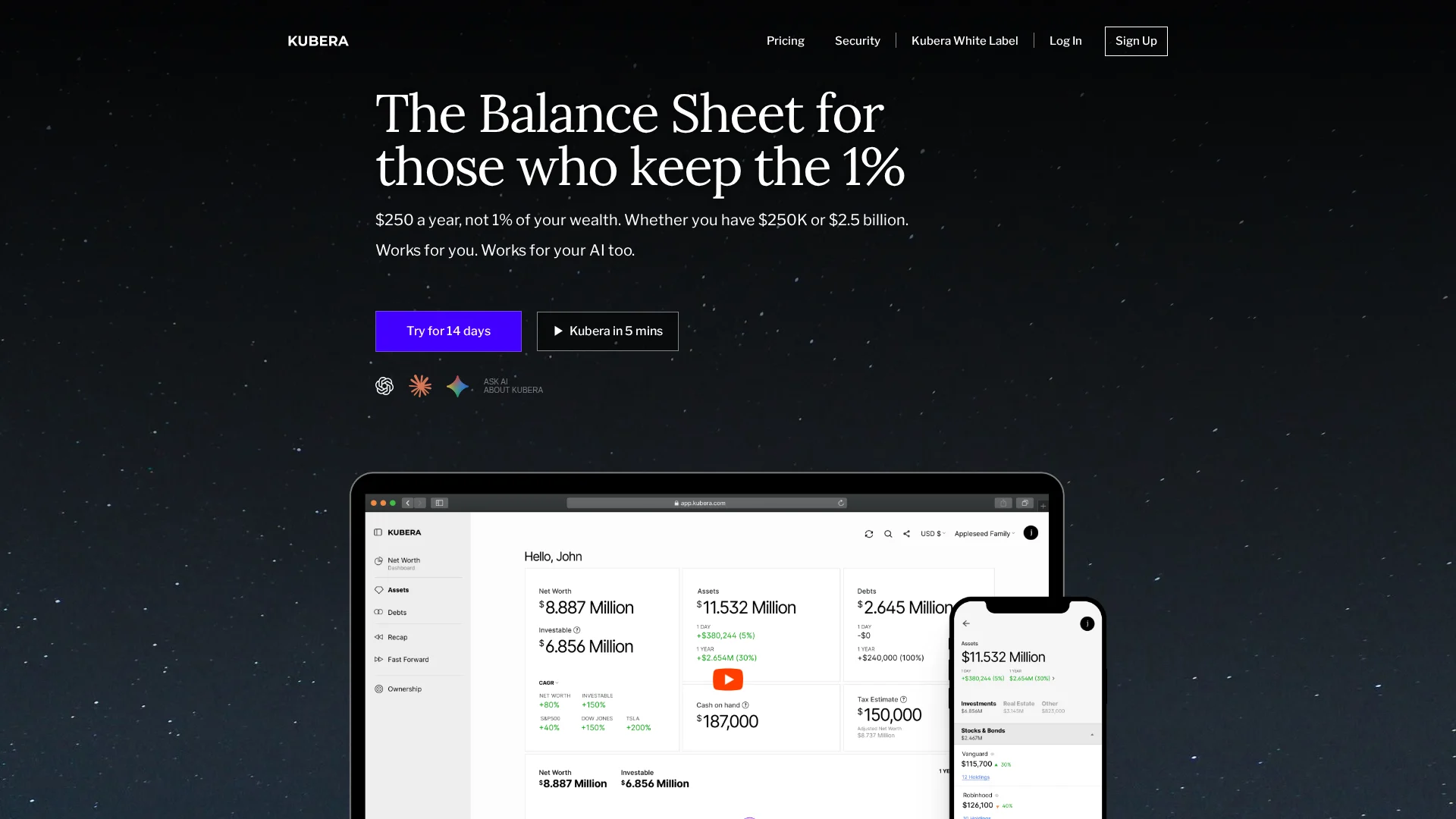
Kubera answers the question crypto-only trackers ignore: what is the total picture? It consolidates bank accounts, brokerage holdings and property, then layers crypto on top in one net worth view priced at $250 a year.
Highlights
- Consolidates banks, brokerages, property and manual private assets with crypto
- Supports multiple accounts and entity structures in one dashboard
- Net worth view rather than trade-level analytics
Specs
- Best for: Consolidated net worth across crypto and traditional assets
- Coverage breadth: Banks, brokerages, property, manual assets plus crypto
- On-chain / DeFi depth: Limited; treats crypto as a position, not a strategy
- Multi-entity and export support: Strongest here for entities, trusts and consolidated reporting
Pros
- Only true total-net-worth view in this list
- Handles private and illiquid assets crypto tools cannot
Cons
- No protocol-level DeFi analytics
- Setup effort is higher than crypto-native tools
Why it ranks here: Fourth because it is the strategic counterpart to the three operational tools above, strong on consolidated wealth dashboards but weak on pool-level granularity.
Last updated: October 21, 2026
Honourable Mentions
One more tracker nearly made the cut. It earns a spot just outside the main ranking, but only if taxes drive your choice.
- Koinly – Tax-led tracker importing 800+ exchanges and wallets, strongest for audit-ready gains and loss exports rather than live on-chain analytics
How to choose the right crypto portfolio tracker
- Define the job first. One screen across every venue: start with CoinStats. Protocol-level DeFi detail: start on-chain with Zerion. Total net worth: start with Kubera.
- Count your venues and chains honestly, including cold wallets, staking contracts and old exchange accounts. Coverage breadth is the constraint most likely to force a change of tool.
- Test multi-entity handling early. Assets spread across entities or jurisdictions? Confirm tagging and separation works before migrating data.
- Check export quality. Monthly CSV or API exports enable tax filing and audit trails later.
- Use read-only API keys only. Never grant withdrawal permissions, and prefer tools independent of any single exchange.
- Pair tools by specialty. Tax-heavy portfolios: run Koinly for gains and losses alongside an operational tracker, then use Crypto Cobra for the market context balance displays lack.

Picking the tracker is step one. Acting on what it shows you is where returns come from. Get fresh analysis and market updates from Crypto Cobra to guide your next move.
Frequently Asked Questions
Q1: Compare five portfolio trackers for managing digital assets worldwide.
CoinStats leads on breadth, Zerion on DeFi depth, Kubera on total net worth, Koinly on tax exports, and Crypto Cobra adds the market analysis the others omit.
Q2: Are read-only API keys safe to use?
Yes. They let a tracker view balances without withdrawal access, so funds stay in your control.
Q3: Can one tracker handle everything?
Rarely. Most serious holders pair a broad tracker like CoinStats with Kubera for net worth or Koinly for tax.