Most people do not lose money in crypto simply because “Bitcoin is bad.” They lose because they repeat the same psychological, financial and security errors seen during every market cycle.
This guide is for anyone buying cryptocurrency for the first time—or preparing to invest after watching a few videos and seeing impressive returns posted online. Before you click Buy, Crypto Cobra explains five of the biggest crypto beginner mistakes, why they are dangerous and the practical steps you can take to avoid them.
Crypto is volatile, scams are common and there are no guaranteed returns. A sensible strategy should therefore prioritize protecting your money over chasing the next coin that might supposedly “go to the moon.”
Important: This article is general education, not personalized financial, legal or tax advice. Cryptocurrency can lose substantial value, and rules vary by country.
Table of Contents
5 Biggest Crypto Beginner Mistakes Still Hurting Portfolios
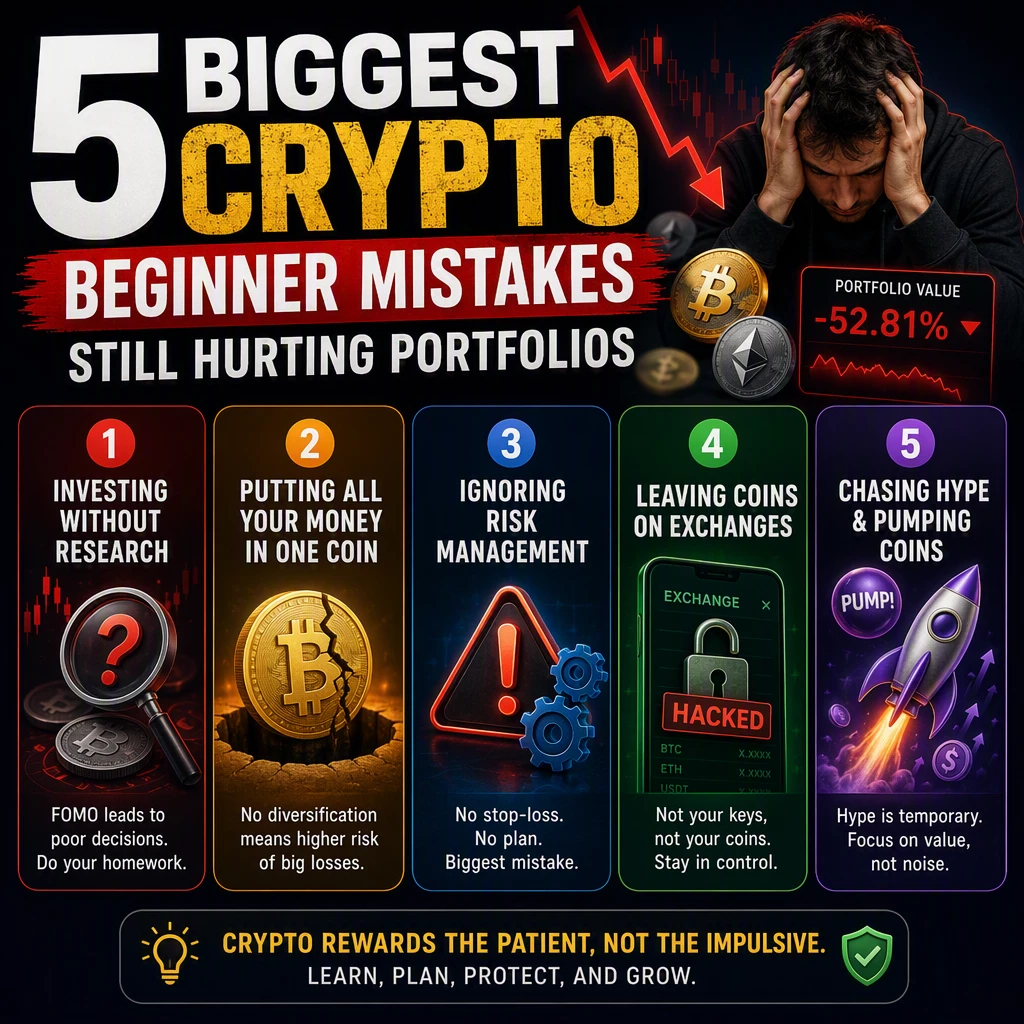
The most common cryptocurrency mistakes are not especially complicated. They usually involve:
- Buying because of FOMO
- Trusting hype instead of conducting research
- Using poor security practices
- Risking more money than you can afford to lose
- Ignoring scams, transaction costs and taxes
These errors often overlap. For example, FOMO can lead someone to buy an unresearched token, store it insecurely and trade it repeatedly without calculating fees or tax consequences.
Understanding each risk before investing gives you a much better chance of making calm, deliberate decisions.
Mistake #1: FOMO Buying After Prices Have Already Pumped
FOMO—the fear of missing out—is one of the strongest forces in crypto markets.
It usually appears when a coin’s price is rising rapidly, social media is filled with profit screenshots and friends start talking about easy money. Influencers may announce aggressive price targets, while online communities insist that anyone who does not buy immediately will miss a “once-in-a-lifetime” opportunity.
The resulting thought process is simple: If I wait, the price will keep climbing without me.
That is precisely when risk can be highest.
Why FOMO buying causes losses
A rapidly rising asset can continue rising, but it can also reverse without warning. When beginners buy after a parabolic move, they may be entering near a short-term peak.
A correction of 30% to 50% is not unusual for highly volatile crypto assets. Smaller or less liquid tokens can fall much further. Someone who bought solely because the price was rising may have no conviction when it drops, so they panic-sell and turn a temporary decline into a permanent loss.
This is one of the most common crypto beginner mistakes because buying during excitement can feel rational in the moment. Everyone else appears confident, and waiting feels more dangerous than participating.

How to control crypto FOMO
Use a written plan rather than making decisions based on social media activity:
- Set an allocation limit. Decide how much of your portfolio can go into crypto before prices begin moving.
- Use dollar-cost averaging. Invest smaller amounts on a schedule instead of committing all your money at one price.
- Avoid chasing parabolic moves. If a coin has risen dramatically in a short period, pause and research why.
- Create a waiting period. Give yourself 24 or 48 hours before purchasing an unfamiliar token.
- Plan your downside. Ask what you would do if the price fell 30%, 50% or more immediately after you bought.
Dollar-cost averaging does not guarantee a profit or prevent losses. It simply reduces the pressure to identify the perfect entry price and can limit the damage caused by one emotional purchase.
Mistake #2: Investing Without Research and Trusting Influencers

Among the most damaging crypto investing mistakes is buying an asset without understanding what it is.
A token’s logo, active social media community and rising price do not prove that the project has a sustainable purpose. Even a professional website and detailed-looking roadmap can be created by an anonymous or dishonest team.
Influencers can also have financial incentives that their audiences do not fully understand. They may receive payment or free tokens to promote a project. In other cases, early holders promote unrealistic predictions to attract new buyers, then sell into the resulting demand.
Popularity is not the same as legitimacy.
What “doing your own research” actually means
DYOR—“do your own research”—should involve more than watching another creator’s review. Before buying a cryptocurrency, investigate the following:
1. The project’s purpose
What problem is the project trying to solve? Does it need a blockchain or token to solve it? Look for evidence of real use rather than vague claims involving artificial intelligence, gaming, tokenization or “the future of finance.”
2. The team
Are the founders identifiable, and do their claimed backgrounds withstand basic scrutiny? Anonymous teams are not automatically fraudulent, but anonymity can increase accountability risks.
3. Documentation and development
Read the official documentation or whitepaper. Look for specific technical and economic explanations rather than buzzwords. If the project claims to be actively developed, check whether there is credible evidence of ongoing work.
4. Token supply and unlocks
Find out:
- The current circulating supply
- The maximum or total supply
- How many tokens insiders control
- Whether major token unlocks are approaching
- How new tokens enter circulation
A low-priced token is not necessarily “cheap.” Market capitalization and future supply matter more than the price of one unit.
5. Liquidity and concentration
Low liquidity may make it difficult to sell without moving the market. If a handful of wallets control most of the supply, those holders may be able to cause a sharp decline by selling.
6. Information quality
Cross-check claims using multiple reputable sources. Treat anonymous posts, referral-driven reviews and guaranteed price predictions as marketing—not independent research.
You do not need to become a blockchain developer before buying Bitcoin. You should, however, understand what you are purchasing, why you want to own it and what could make your investment thesis wrong.
For foundational reading, start with our beginner’s guide to Bitcoin and compare platforms through our cryptocurrency exchange reviews.
Mistake #3: Poor Security and Leaving Everything on an Exchange
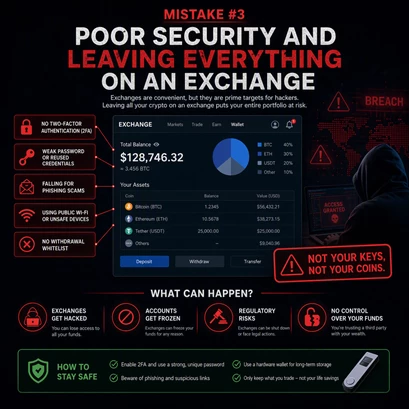
Some losses have nothing to do with market prices. They happen because a user’s account, wallet or recovery phrase is compromised.
Common crypto security mistakes include:
- Reusing a password from another website
- Choosing a short or predictable password
- Relying only on SMS verification
- Saving seed phrases in email, screenshots or cloud notes
- Clicking links in unsolicited direct messages
- Installing fake wallet applications
- Approving malicious smart contracts
- Sharing a screen while sensitive wallet information is visible
Unlike a conventional bank transfer, a cryptocurrency transaction generally cannot be reversed by calling customer support. If a criminal obtains your recovery phrase or convinces you to authorize a malicious transaction, recovering the funds may be impossible.
Understand the risks of centralized exchanges
A reputable exchange can be convenient for buying and selling crypto, but it is still a custodian. It controls the private keys associated with assets held on the platform.
Centralized exchanges may be hacked, suspend withdrawals, face regulatory restrictions or become insolvent. The collapse of FTX demonstrated that a large, widely recognized platform can fail. Size, celebrity endorsements and past popularity do not eliminate custodial risk.
That does not mean every beginner should immediately move every purchase into self-custody. Managing your own wallet creates a different responsibility: if you lose the recovery phrase or expose it to someone else, there may be no account-recovery process.
A practical crypto security checklist
Take these steps before building a significant balance:
- Use a unique password. Generate and store it with a reputable password manager.
- Enable strong two-factor authentication. Prefer an authenticator app, security key or passkey where supported rather than SMS alone.
- Activate withdrawal allowlisting. If your exchange provides this feature, limit withdrawals to approved addresses.
- Secure your email account. Your email is often the route to resetting other accounts.
- Never share your seed phrase. Legitimate wallet support will not ask for it.
- Store recovery words offline. Keep durable backups in private, physically secure locations.
- Verify wallet addresses. Malware can replace copied addresses, so check the beginning and end before confirming.
- Send a test transaction. When moving a large amount, send a small amount first.
- Buy hardware wallets from trusted sources. Use the manufacturer or an authorized seller, and never use a device supplied with a prewritten seed phrase.
- Review wallet approvals. Disconnect from applications you no longer use and revoke unnecessary token permissions.
A useful rule is that assets intended for long-term holding should not be left indefinitely on a trading platform purely out of convenience. Learn about self-custody through our guide to storing cryptocurrency safely before moving substantial funds.
These precautions address many Bitcoin beginner mistakes, but self-custody should only be used once you understand how backups, private keys and test transactions work.
Suggested in-article image alt text: Bitcoin beginner mistakes involving exchange accounts, passwords and wallet security
Mistake #4: Risking Money You Cannot Afford to Lose
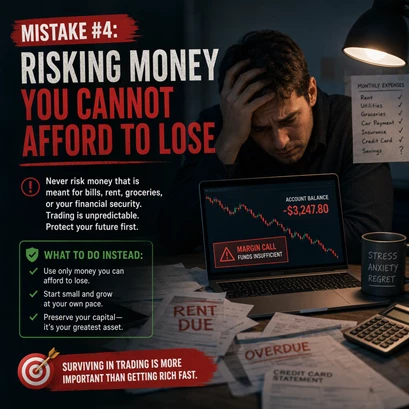
Crypto can produce large gains, but it can also experience severe and prolonged declines. Even established assets have historically suffered drawdowns exceeding 50%. Smaller tokens can lose most of their value and never recover.
One of the most dangerous crypto mistakes beginners make is treating volatility as a guaranteed fast track to wealth.
The problem becomes much worse when someone invests:
- Rent or mortgage money
- Emergency savings
- Tuition funds
- Money needed for taxes
- Borrowed money
- Their entire investment portfolio
- Funds required within the next few years
A person in that position may be forced to sell during a decline, regardless of whether they still believe in the asset.
Avoid going all-in
Concentrating everything in one coin creates asset-specific risk. A project can suffer a technical exploit, regulatory problem, loss of developers, governance dispute or collapse in demand. Diversification cannot remove crypto’s market risk, but it can reduce dependence on one speculative project.
Your allocation should reflect both your financial circumstances and your emotional tolerance for losses. If a 50% decline would prevent you from sleeping, paying bills or sticking to your plan, your position is probably too large.
Be especially careful with leverage
Leverage allows traders to control a larger position using a smaller amount of capital. It magnifies gains, but it also magnifies losses. A relatively small price movement can liquidate the position and erase the collateral.
New investors often underestimate how quickly this can happen in a market that operates 24 hours a day. Avoiding leverage is generally safer until you have substantial experience, a tested system and a complete understanding of liquidation mechanics. For many long-term investors, leverage may never be necessary.
A sensible starting framework is:
- Keep emergency savings outside crypto.
- Pay essential bills before investing.
- Treat crypto as speculative capital.
- Set a maximum portfolio allocation.
- Assume major drawdowns will occur.
- Never depend on guaranteed returns.
- Avoid borrowing to purchase volatile assets.
“Only invest what you can afford to lose” does not mean expecting your investment to reach zero. It means a worst-case outcome should not destroy your financial stability.
Mistake #5: Ignoring Scams, Fees and Taxes
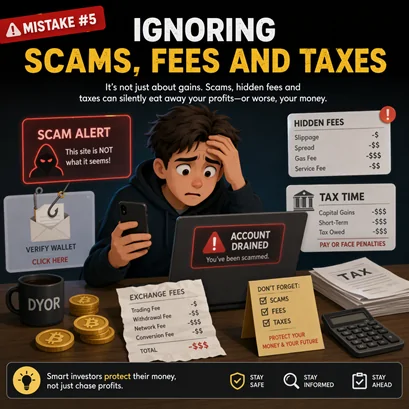
The final category combines three risks beginners frequently overlook. Scams can steal your holdings, fees can quietly reduce returns, and poor tax records can create expensive administrative or legal problems later.
Common crypto scams in 2026
Scam tactics change, but the underlying promises remain familiar. Watch for:
- Fake giveaways claiming “send 1 BTC and receive 2 BTC”
- Fraudulent airdrops that require wallet approval
- Phishing websites designed to copy exchange or wallet login pages
- Impersonators pretending to be support representatives
- Romance or “pig-butchering” investment schemes
- Fake recovery services promising to retrieve stolen funds
- Rug-pull tokens whose creators remove liquidity
- Pump-and-dump groups coordinating purchases before insiders sell
- Malicious advertisements or search results
- AI-generated videos or deepfakes promoting fake investments
No legitimate individual or company needs your recovery phrase. No guaranteed coin-multiplication scheme is genuine. Be suspicious whenever someone creates urgency, promises risk-free returns or asks you to move a conversation to a private channel.
Bookmark official websites instead of relying on search advertisements. Check URLs character by character, and verify announcements through more than one official channel.
Trading costs can destroy small returns
A profitable-looking trade is not necessarily profitable after expenses. Depending on the platform and network, costs may include:
- Trading commissions
- Bid-ask spreads
- Deposit or withdrawal charges
- Blockchain gas fees
- Currency conversion costs
- Slippage
- Funding rates on leveraged positions
Over-trading compounds the problem. Frequent buying and selling can generate costs even when your overall portfolio goes nowhere.
Before placing an order, review the full transaction preview and calculate the approximate break-even price. Consider using limit orders where appropriate, and do not assume a platform advertising “zero commission” offers zero total cost—the expense may be embedded in the spread.
Crypto may be taxable
Cryptocurrency is not automatically invisible to tax authorities. Depending on your jurisdiction, taxable or reportable events may include:
- Selling crypto for conventional currency
- Trading one token for another
- Spending crypto on goods or services
- Receiving staking or mining rewards
- Receiving certain airdrops
- Earning income in cryptocurrency
Rules differ significantly by country and can change. Keep transaction records from the beginning rather than trying to reconstruct years of activity before a filing deadline.
Record dates, amounts, asset types, fees, wallet transfers and the value in your local currency. A crypto tax tool can help organize this information, but complex situations may require a qualified local tax professional.
Scam, fee and tax checklist
Before completing any transaction:
- Confirm that you are using the official website or application.
- Never send coins to a “money multiplier.”
- Never reveal a private key or seed phrase.
- Review token approvals before connecting a wallet.
- Check the spread, network fee and expected slippage.
- Download exchange transaction histories regularly.
- Track purchases, sales, swaps and rewards from day one.
- Consult a qualified professional if you are unsure about local tax rules.
How to Avoid All Five Crypto Beginner Mistakes
You do not need a perfect prediction model to improve your chances of surviving crypto’s volatility. Start with this simple playbook:
1. Control FOMO
Do not buy solely because an asset is rising or trending. Decide your allocation in advance and consider investing gradually.
2. Always conduct independent research
Understand the project, team, supply, token unlocks, liquidity and risks. Cross-check claims instead of trusting one influencer or community.
3. Secure your holdings
Use unique passwords, strong two-factor authentication and withdrawal protections. Learn self-custody before transferring long-term holdings.
4. Limit your financial exposure
Keep essential and emergency funds outside crypto. Avoid excessive concentration, borrowed money and leverage.
5. Stay alert and keep records
Check every URL, reject guaranteed-return schemes, review all transaction costs and maintain tax records from your first purchase.
Save this checklist and revisit it whenever the market makes you feel unusually excited, frightened or impatient. Emotional urgency is often a signal to slow down.
If you avoid these crypto beginner mistakes, you are already ahead of many new investors in any market cycle.
Final Thoughts
Making mistakes while learning about a new asset class is normal. The goal is to avoid errors capable of wiping out your portfolio or exposing you to preventable scams.
You cannot control what Bitcoin or another cryptocurrency will be worth tomorrow. You can control how much you invest, what you buy, where you store it and which security practices you follow.
The most important lesson is simple: survival matters more than hype. A cautious investor who protects their capital and continues learning is in a stronger position than someone chasing every new token, influencer prediction or sudden price rally.
Use these five crypto beginner mistakes as a personal safety checklist before every significant decision. For your next step, read Crypto Cobra’s Bitcoin beginner guide or explore our complete crypto wallet security guide to learn how to protect your holdings.