A crypto wallet does not actually store your Bitcoin, Ethereum, or Solana. Instead, it stores the private keys that prove ownership and allow you to spend or move assets on the blockchain. Think of it as a password manager for your funds: the coins live on-chain, but the wallet controls access. Whether you are a complete beginner, an active trader chasing DeFi yields, a Bitcoin-only maximalist, or a long-term holder looking for ironclad security, choosing the right wallet is one of the most important decisions in your digital asset journey.
In this guide, we deliver the top 20 crypto wallets you should know about in 2025, organized by use case, security architecture, and platform support. We go beyond basic lists to explain why each option matters, how wallet types differ, and what critical safety habits will keep your assets safe.
How We Ranked the Top 20 Crypto Wallets
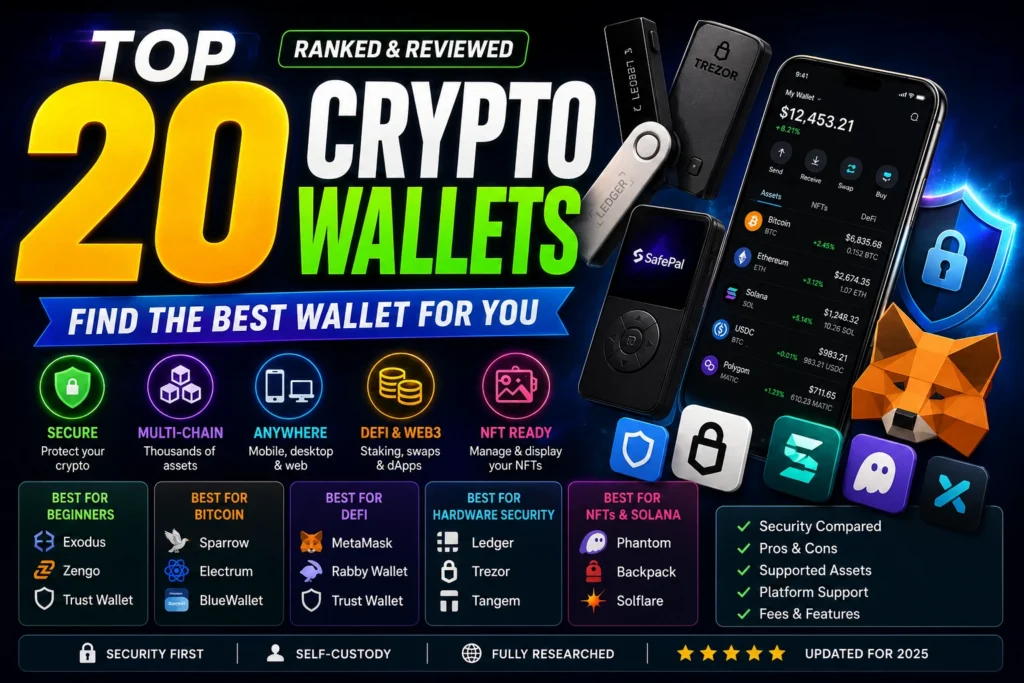
Creating a reliable crypto wallet ranking requires more than counting downloads. To build this top 20 crypto wallets list, we evaluated each entry across seven core criteria: (1) security model and track record, (2) supported assets and blockchain compatibility, (3) wallet type and custody model, (4) ease of setup and daily use, (5) platform availability (mobile app, desktop app, browser, or hardware), (6) fees and transaction cost transparency, and (7) backup and recovery options.
We also considered whether a wallet is a hot wallet connected to the internet or a cold wallet that keeps keys offline, and whether it is custodial (a third party controls the keys) or non-custodial (you control the keys). Because no single wallet fits every user, this methodology prioritizes versatility, transparency, and verifiable security over marketing hype.
Table of Contents
The Top 20 Crypto Wallets List
Below is our definitive top 20 crypto wallets list, mixing hardware and software solutions to serve every intent—from mobile trading to long-term cold storage. Each profile includes the wallet type, best use case, supported assets, strengths, and weaknesses.
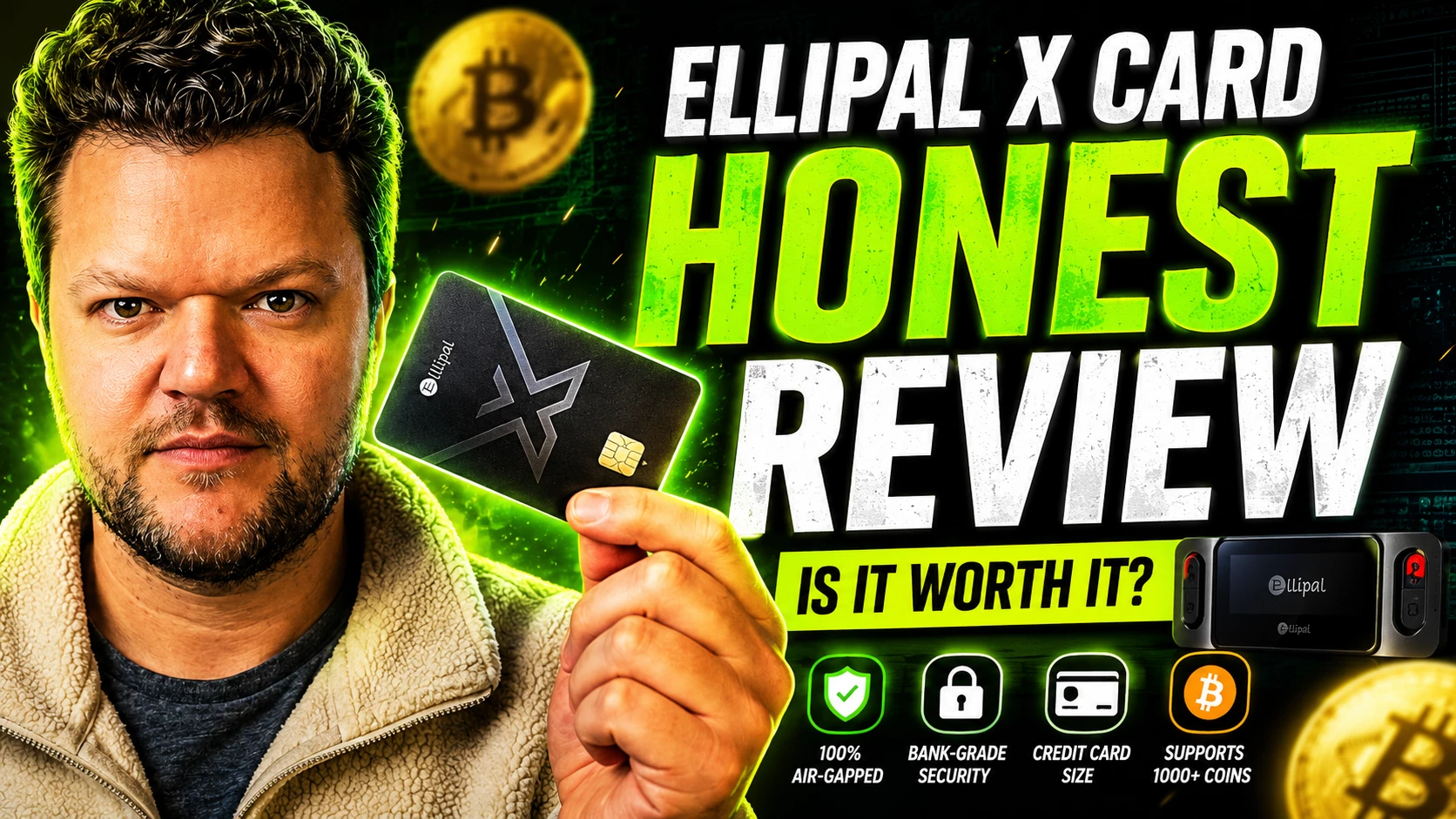
1. Ellipal Titan
Best for: Holders who want a fully air-gapped, QR-only hardware fortress.
Wallet type: Non-custodial cold wallet (hardware).
The Ellipal Titan is a completely air-gapped hardware wallet that communicates solely through QR codes, eliminating USB, Bluetooth, Wi-Fi, and NFC attack vectors entirely. With a large touchscreen, anti-tamper chassis, and support for thousands of tokens across dozens of chains, it is built for users who refuse to let their private keys touch an internet-connected device.
2. Ledger Nano X
Best for: Long-term holders wanting robust hardware security.
Wallet type: Non-custodial cold wallet (hardware).
Supported assets: 5,500+ tokens across Bitcoin, Ethereum, Solana, and more.
Pros: Offline private key storage via a certified secure chip; Bluetooth for mobile without exposing keys; integrates with Ledger Live for staking and swaps.
Cons: Higher price point than entry-level hardware; Bluetooth stack adds a minor attack surface.
The Ledger Nano X remains a gold standard among secure crypto wallet options and ranks among the top 20 crypto wallets for diversified portfolios. Its CC EAL5+ certified element keeps your private key entirely offline, while Ledger Live provides a polished interface for portfolio tracking and DeFi access.
3. Trezor Safe 3
Best for: Privacy-focused users seeking open-source hardware.
Wallet type: Non-custodial hardware wallet.
Supported assets: 8,000+ coins and tokens via Trezor Suite.
Pros: Fully open-source firmware and hardware schematics; modern secure element; intuitive Trezor Suite interface.
Cons: No native Bluetooth or battery; relies on USB-C connection.
Trezor’s latest generation reinforces its reputation among the best crypto wallets for transparency. Because its design is open source, security researchers can audit every component. The Trezor Safe 3 excels for self-custody purists who want verifiable cold storage without proprietary black boxes.
4. Tangem
Best for: Users wanting a card-shaped cold wallet with no cables.
Wallet type: Non-custodial cold wallet (smartcard).
Supported assets: Multichain support including BTC, ETH, and major EVM layers.
Pros: No battery or charging required; NFC tap with smartphone; seedless setup option available.
Cons: All management is mobile-dependent; limited advanced features for power users.
Tangem reimagines the hardware wallet as a physical card you can tap on your phone. It removes complexity, making it one of the more beginner-friendly wallet choices that still keeps keys offline. Tangem deserves a spot among the top 20 crypto wallets for accessibility.
5. SafePal S1
Best for: Budget-conscious holders wanting air-gapped security.
Wallet type: Non-custodial hardware wallet.
Supported assets: 30,000+ tokens across 50+ blockchains.
Pros: Fully air-gapped with no Bluetooth, Wi-Fi, or NFC; affordable; companion app includes trading and staking.
Cons: Plastic construction feels less premium; firmware updates require microSD.
SafePal S1 delivers secure crypto wallet features at a fraction of flagship prices. By staying completely offline and requiring QR-code scanning for transactions, it eliminates remote attack vectors while supporting an enormous range of supported assets. It deserves consideration in any top 20 crypto wallets guide.
6. MetaMask
Best for: Ethereum and EVM DeFi users.
Wallet type: Non-custodial hot wallet (browser extension & mobile).
Supported assets: All Ethereum-based tokens (ERC-20, ERC-721) and EVM networks.
Pros: Ubiquitous Web3 integration; custom network RPC support; built-in swaps.
Cons: Frequent phishing target; no native Bitcoin support.
MetaMask is the default portal to Web3 and arguably the most referenced name in any crypto wallet ranking for DeFi. It stores your private key locally encrypted and connects directly to decentralized applications, though users must stay vigilant against rogue browser extensions and fake sites.
7. Trust Wallet
Best for: Mobile-first multi-chain users.
Wallet type: Non-custodial hot wallet (mobile & browser extension).
Supported assets: 10+ million digital assets across 70+ blockchains.
Pros: Clean UI; built-in staking and Web3 browser; native NFT support.
Cons: Customer support can be slow; hot-wallet risks apply.
Acquired by Binance but remaining non-custodial, Trust Wallet is a top crypto wallet for those who live on their phones. It handles everything from Bitcoin to Solana NFTs, offering deep multi-chain support without surrendering your seed phrase to an exchange. It remains a fixture in any top 20 crypto wallets guide.
8. Exodus
Best for: Desktop users wanting a beautiful portfolio dashboard.
Wallet type: Non-custodial hot wallet (desktop, mobile, browser).
Supported assets: 300+ cryptocurrencies.
Pros: Stunning interface; built-in exchange and staking; 24/7 human support.
Cons: Not fully open source; requires internet connection for most features.
Exodus proves that a software wallet can feel premium. It is frequently recommended as the best wallet for beginners who want desktop analytics, paired with a mobile app that syncs seamlessly. Your public key and balances are displayed in elegant charts, while the private key remains encrypted on your device.
9. Phantom
Best for: Solana, Ethereum, and Polygon NFT collectors.
Wallet type: Non-custodial hot wallet (browser & mobile).
Supported assets: SOL, ETH, MATIC, and SPL/ERC tokens + NFTs.
Pros: Best-in-class NFT display and bulk sending; integrated token swaps; sleek design.
Cons: Primarily optimized for Solana/EVM ecosystems; less Bitcoin support.
Originally built for Solana, Phantom has evolved into a powerhouse for NFT and DeFi users who want a mobile wallet experience with native staking. Its usability earns its place in the top 20 crypto wallets, especially if your activity centers on digital collectibles and fast low-fee chains.
10. Zengo
Best for: Beginners intimidated by seed phrases.
Wallet type: Non-custodial hot wallet (mobile) using MPC.
Supported assets: 120+ cryptocurrencies including BTC, ETH, and MATIC.
Pros: No single seed phrase to lose; biometric recovery; simple fiat on-ramps.
Cons: MPC model is newer and less battle-tested than traditional key storage.
Zengo replaces the traditional private key with multi-party computation, removing the dreaded recovery phrase from onboarding. This makes it a standout beginner-friendly wallet, especially for users who want self-custody without the anxiety of writing down 12 words.
11. Coinbase Wallet
Best for: Newcomers transitioning from exchanges.
Wallet type: Non-custodial hot wallet (mobile, browser, hardware support via Ledger).
Supported assets: Hundreds of thousands of tokens across major networks.
Pros: Familiar Coinbase branding without exchange custody; easy dApp browser; username addresses instead of raw public keys.
Cons: Tight Coinbase ecosystem integration can confuse users about custody.
Coinbase Wallet is distinct from the Coinbase exchange app. It is a non-custodial wallet that gives you control of your private key while offering a gentle on-ramp for users new to self-custody. It ranks highly among the best crypto wallets for social recovery and username-based transfers.
12. Sparrow Wallet
Best for: Bitcoin power users and UTXO management.
Wallet type: Non-custodial hot wallet (desktop).
Supported assets: Bitcoin only.
Pros: Advanced UTXO labeling, coin control, and multi-sig support; strong privacy features.
Cons: Steep learning curve; no mobile app.
Sparrow is the desktop Bitcoin wallet for analysts and privacy advocates. It exposes every detail of your transaction construction and public key derivation paths, letting you verify exactly how your funds are managed before broadcasting.
13. BlueWallet
Best for: Mobile Bitcoiners wanting Lightning support.
Wallet type: Non-custodial hot wallet (mobile) with Lightning.
Supported assets: Bitcoin and Lightning Network BTC.
Pros: Intuitive mobile design; LNDHub for Lightning; plausible deniability features.
Cons: iOS/Android only; limited altcoin support.
BlueWallet merges traditional Bitcoin storage with Lightning Network speed. It is a top mobile wallet for spending satoshis without waiting for on-chain confirmations, while still giving you full seed phrase backup control.
14. Blockstream Green
Best for: Bitcoin holders wanting 2FA-protected transactions.
Wallet type: Non-custodial hot wallet (mobile & desktop).
Supported assets: Bitcoin (with Liquid sidechain support).
Pros: Optional two-factor authentication via multisig; hardware wallet integration; elegant UI.
Cons: Limited to Bitcoin and Liquid assets.
Blockstream Green adds a security layer rarely seen in software wallets: 2FA via multisig. This makes it a unique secure crypto wallet for mobile BTC storage without buying dedicated hardware, bridging the gap between hot-wallet convenience and cold-wallet caution.
15. Crypto.com DeFi Wallet
Best for: Earning yield and bridging from a popular exchange.
Wallet type: Non-custodial hot wallet (mobile).
Supported assets: 1,000+ tokens across 30+ chains.
Pros: In-app staking and DeFi earning; Cronos chain integration; clean UX.
Cons: Branding overlaps with custodial Crypto.com app; some features push ecosystem tokens.
The Crypto.com DeFi Wallet lets users migrate from exchange custody into self-custody without switching brand ecosystems. It supports a wide array of supported assets and includes native staking tools, earning its place among the top 20 crypto wallets for yield hunters.
16. OKX Wallet
Best for: Cross-chain DeFi traders.
Wallet type: Non-custodial hot wallet (browser extension, mobile, web).
Supported assets: 50+ networks including EVM, UTXO, and non-EVM chains.
Pros: Built-in cross-chain DEX aggregator; account abstraction features; strong multi-chain support.
Cons: Interface can overwhelm beginners; requires manual network switching at times.
OKX Wallet targets the same advanced audience as MetaMask but with broader multi-chain support out of the box. Its non-custodial architecture and integrated swap aggregator make it a rising star in any crypto wallet ranking focused on Web3 interoperability.
17. Rabby Wallet
Best for: DeFi power users and transaction simulation.
Wallet type: Non-custodial hot wallet (browser extension with mobile beta).
Supported assets: EVM chains and major L2s.
Pros: Pre-transaction risk scanning; automatic chain switching; clean sign-flow UX.
Cons: Still gaining dApp adoption compared to MetaMask; limited non-EVM chains.
Rabby has quickly become the favorite browser wallet for Ethereum DeFi natives because it shows you exactly what a transaction will do before you sign. It is a best crypto wallet alternative for users tired of blind-signing exploits and has earned its spot in the top 20 crypto wallets for DeFi safety.
18. Argent
Best for: Ethereum and StarkNet users wanting social recovery.
Wallet type: Non-custodial smart contract wallet (mobile).
Supported assets: Ethereum and select L2 tokens.
Pros: Seedless social recovery; built-in DeFi integrations; no transaction fees on StarkNet.
Cons: Limited to Ethereum ecosystem; smart contract risk profile differs from EOA wallets.
Argent abstracts away the traditional seed phrase by using smart contract logic on Ethereum. If you want a non-custodial wallet with bank-like recovery options and deep StarkNet support, Argent is one of the most innovative options among the top 20 crypto wallets.
19. Guarda
Best for: Multi-platform non-custodial management.
Wallet type: Non-custodial hot wallet (web, desktop, mobile, Chrome extension).
Supported assets: 50+ blockchains and 400,000+ tokens.
Pros: Full platform coverage; built-in staking and crypto loans; no account needed.
Cons: Web wallet version introduces phishing exposure; some services are custodial-adjacent.
Guarda offers rare breadth across devices. It is a reliable crypto wallet for users who jump between operating systems and need consistent access to their supported assets without installing multiple apps.
20. Edge
Best for: Beginners wanting a simple login experience.
Wallet type: Non-custodial hot wallet (mobile).
Supported assets: Popular assets including BTC, ETH, LTC, XMR, and ERC-20 tokens.
Pros: Username/password login instead of seed phrase; built-in exchange; fiat on-ramps.
Cons: Less transparent than open-source alternatives; fewer advanced tools.
Edge encrypts your private key with a username and password, lowering the barrier to self-custody. It is a strong beginner-friendly wallet for users who find traditional recovery phrase backup too intimidating, and it rounds out our top 20 crypto wallets for accessibility.
Best Wallets by Use Case
Even the best crypto wallets serve different masters. Here is how to match your activity to the right tool from our top 20 crypto wallets.
Best for Beginners
Zengo and Coinbase Wallet lead here. Zengo removes the seed phrase entirely using MPC technology, while Coinbase Wallet offers a familiar interface and username-based sends. Both keep you in non-custodial control without dropping you into deep technical waters.
Best for Bitcoin
Sparrow Wallet excels for desktop UTXO management and privacy, while BlueWallet brings Lightning Network payments to your pocket. For cold storage, the Ledger Nano X and Trezor Safe 3 remain the ultimate Bitcoin wallet pairings.
Best for DeFi
MetaMask dominates Ethereum dApp connectivity, but Rabby Wallet offers superior transaction simulation and security previews. OKX Wallet is also a contender for cross-chain DeFi traders needing multi-chain support in one dashboard.
Best for Mobile
Trust Wallet and Phantom set the standard for iOS and Android. Trust Wallet handles the widest range of supported assets, while Phantom delivers the best NFT and Solana mobile wallet experience.
Best for Hardware Security
The Ledger Nano X offers the best balance of security and coin support, while the Trezor Safe 3 appeals to open-source purists. For a unique form factor, Tangem provides card-based cold storage that fits in your actual wallet.
Best for NFTs and Solana
Phantom is the clear winner. Its NFT display is best-in-class, and its native Solana staking flows are seamless on both mobile and browser. MetaMask is a runner-up for Ethereum NFTs via its built-in portfolio viewer.
Crypto Wallet Types Explained
Understanding how wallets work prevents costly mistakes. Before you commit to one of the top 20 crypto wallets above, learn the core categories.
Hot Wallets
A hot wallet is any crypto wallet connected to the internet. This includes browser extensions like MetaMask and mobile app wallets like Trust Wallet. They are convenient for trading, DeFi, and daily spending, but because your private key resides on an internet-connected device, they carry higher remote-hack risk.
Cold Wallets
A cold wallet keeps your private key offline at all times. Hardware wallet options such as Ledger and Trezor are classic examples, as is the card-based Tangem. Cold storage is the industry standard for long-term holders and large balances because it drastically reduces phishing and malware exposure.
Custodial Wallets
In a custodial wallet, a third party controls your private key. Exchange wallets are the most common example. You do not hold the seed phrase, which means easier recovery but also counterparty risk. None of the top 20 crypto wallets in our main list are custodial, though some companion apps require account creation for fiat services.
Non-Custodial Wallets
A non-custodial wallet gives you exclusive control of your private key and seed phrase. This is true self-custody. Every hardware and software wallet in our ranking above is non-custodial, meaning you—and only you—can authorize transactions. With this power comes the responsibility to guard your recovery phrase.
Private Keys, Public Keys, and Seed Phrases
Your wallet generates a public key (essentially your account number) and a private key (your password). The seed phrase, usually 12 or 24 words, is a human-readable backup of your private key. Lose your recovery phrase and lose access; share it and someone else can spend your funds. This is why security habits matter more than brand names.
What to Look for in a Crypto Wallet
Whether you are revisiting our top 20 crypto wallets list or researching independently, prioritize these factors:
- Security Model: Open-source code, audited hardware chips, and bug-bounty programs indicate maturity.
- Supported Chains and Tokens: If you hold altcoins or NFTs, ensure the wallet natively supports those networks rather than relying on risky workarounds.
- Backup and Recovery: A clear seed phrase or social recovery path is essential. Test your backup before depositing large sums.
- Platform Compatibility: Decide if you need a mobile app for on-the-go access, a desktop app for analytics, or a hardware device for vault-like storage.
- Extra Features: Staking, in-app swaps, Web3 browsers, and NFT galleries add convenience, but never at the expense of private key security.
- Customer Support: 24/7 human support (Exodus) or active community forums can save you during a lockout scare.
Essential Crypto Wallet Safety Tips
Owning a wallet is only half the battle. Protect your assets with these rules:
- Never Share Your Seed Phrase: Legitimate support teams will never ask for your seed phrase or private key. Write it offline on metal or paper, then hide it.
- Use Hardware Wallets for Larger Holdings: Any balance you cannot afford to lose should live in cold storage. Pair a Ledger or Trezor with a mobile wallet for day-to-day spending.
- Verify Download Sources: Only install wallets from official websites or verified app stores. Bookmark official URLs to avoid phishing clones that mimic MetaMask or Trust Wallet.
- Test with Small Transactions First: Before moving life-changing amounts, send a small test amount. Verify that your recovery phrase restores the wallet correctly on a secondary device.
Frequently Asked Questions (FAQs)
Are Crypto Wallets Free?
Most software hot wallets are free to download. Hardware wallet options carry an upfront cost—typically $50 to $200—because they include dedicated secure chips. Some wallets also charge swap fees or staking commissions.
What Is the Safest Crypto Wallet?
The safest crypto wallet is generally an air-gapped hardware wallet from an established manufacturer like Ledger or Trezor, paired with a securely stored seed phrase. Safety ultimately depends on your operational security, not just the brand.
Do I Need a Wallet to Buy Crypto?
You can buy crypto on a centralized exchange using a custodial account, but if you want true ownership, you must withdraw to a non-custodial wallet where you control the private key.
What Happens If I Lose My Wallet?
If you lose a hardware device but saved your recovery phrase, you can restore funds on a new device. If you lose both the device and the seed phrase with no social recovery setup, the assets are permanently inaccessible.
Can I Use More Than One Wallet?
Yes. Many experienced users maintain multiple wallets: a hardware wallet for savings, a hot wallet for spending, and a browser wallet for DeFi. Diversifying across wallet types reduces single points of failure.
Final Thoughts
Choosing from the top 20 crypto wallets comes down to matching your behavior with the right balance of security and convenience. Start with a beginner-friendly wallet, experiment with small amounts, and migrate long-term holdings to cold storage as your portfolio grows. Self-custody is a journey, and the right wallet makes every step safer.