Crypto Wallets Review: MetaMask, Trezor, and Trust Wallet directly addresses its heading by evaluating three pillars of everyday cryptocurrency management for 2025. This review examines how MetaMask dominates browser-based Ethereum and Polygon activity, how Trezor delivers proven offline custody, and how Trust Wallet streamlines mobile access to thousands of tokens including Solana and Avalanche networks.
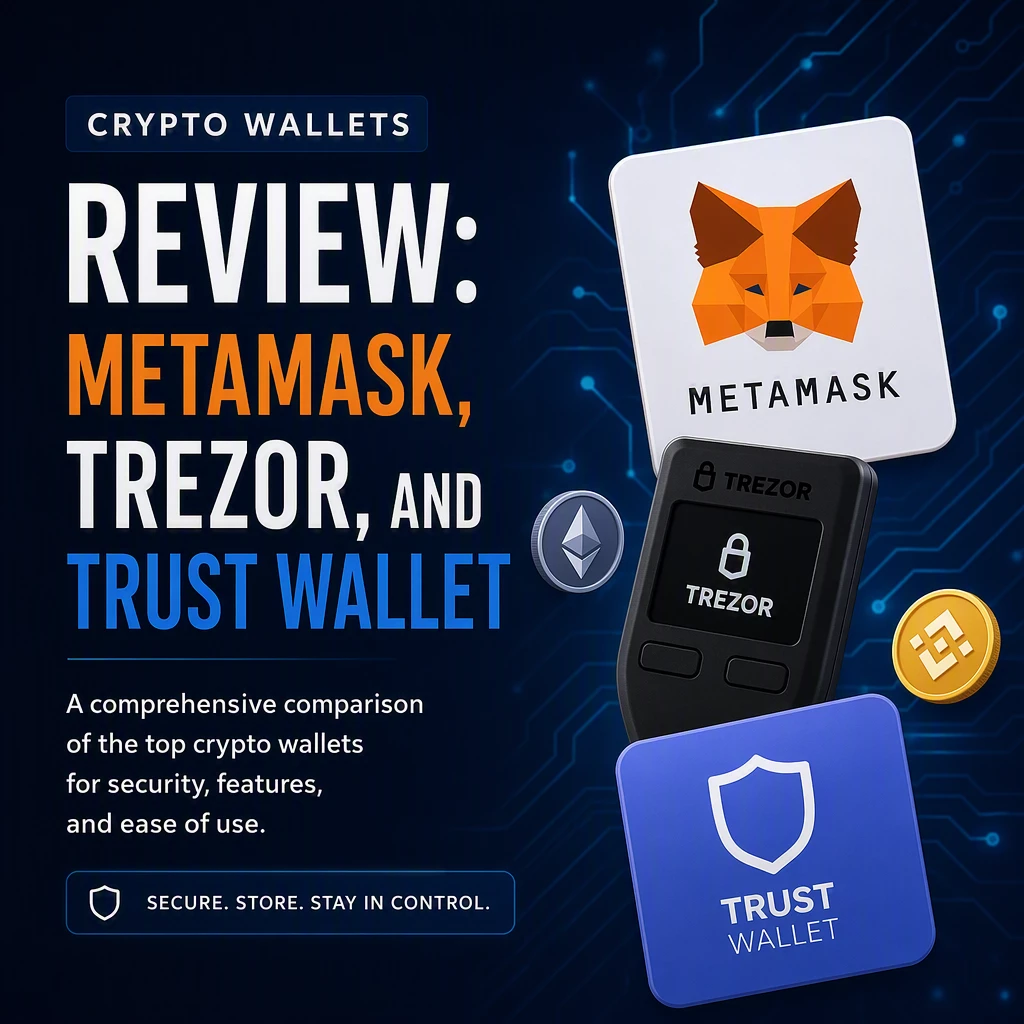
Table of Contents
Rather than declare a single winner, we compare private keys handling, backup flows, and transaction transparency across each option, highlighting where a hardware wallet approach complements a hot wallet for daily swaps. Readers will find practical setup checklists, fee insights, and security trade-offs that matter for both newcomers and seasoned holders.
We also frame expectations around financial decisions, noting market performance remains unpredictable and no tool substitutes for personal due diligence.
Why Do Millions Still Confuse crypto wallets With Exchange Accounts?
Why Do Millions Still Confuse crypto wallets With Exchange Accounts? This section directly addresses that confusion by clarifying the fundamental difference between custody models. An exchange account holds your cryptocurrency as an IOU in its internal database, while a self-custodial crypto wallet gives you exclusive control of the signing keys that authorize movements on chain. Many newcomers experience crypto investing for the first time through an app that looks like a bank balance, so they assume the displayed numbers equal on-chain ownership, which obscures counterparty risk. When platforms freeze withdrawals or suffer breaches, users discover they cannot move digital assets without permission.
Education is improving, but seamless onboarding and familiar passwords make custodial services feel safer than managing seed phrases. Understanding this distinction is essential before selecting any storage solution and committing funds long term.
How Do You get crypto wallet Without Sacrificing Ownership Control?
How Do You get crypto wallet Without Sacrificing Ownership Control is answered by focusing on self-custody principles from the very first download or unboxing. True ownership means you alone generate and retain the recovery phrase, never sharing it with an exchange or cloud backup that could be subpoenaed or hacked. Start by selecting reputable software or hardware from official sources, verifying PGP signatures or device attestation certificates before creating any address.
During initialization, write the seed on paper offline, confirm it with a test recovery, and never photograph it. This process ensures private keys never leave the secure environment, whether that is a mobile enclave or dedicated chip. For beginners, a guided setup that forces address verification on a trusted display prevents clipboard malware from swapping destinations. Retaining ownership control also means understanding that no support agent can restore lost phrases, reinforcing personal responsibility.
Why BTC Foundation Standards Matter When You get crypto wallet [2025 Checklist]
Why BTC Foundation Standards Matter When You get crypto wallet is the central focus of this section, which directly addresses the heading by outlining a practical checklist for self-custody. The Foundation emphasizes open-source firmware, audited secure elements, and reproducible builds that let any investor verify code integrity before funding an address.
Their 2025 guidance requires BIP39 compliant seed generation, optional passphrase support, and clear display of destination addresses to prevent man-in-the-middle tampering. This framework helps newcomers distinguish marketing claims from verifiable security, ensuring private keys remain offline during setup. Following the checklist means buying only from authorized resellers, verifying device attestation on first boot, and testing recovery with a small amount. Applying these standards reduces supply-chain risk and builds confidence that ownership control stays with you, not a third party.
Best of the Month Criteria: How Independent Reviews Spot Ledger Excellence
Best of the Month Criteria: How Independent Reviews Spot Ledger Excellence directly answers its heading by explaining transparent testing behind recent awards. Reviewers score devices on attack resistance, firmware update cadence, coin coverage, and customer support responsiveness using repeatable lab procedures rather than sponsored opinions. Ledger excellence consistently surfaces when independent labs attempt fault injection and side-channel analysis on its secure element, documenting how the chip wipes secrets under voltage glitching.
Evaluators also track how quickly vulnerabilities are patched and whether the vendor publishes detailed post-mortems. Usability metrics include onboarding time, backup success rates, and clarity of on-device verification prompts. By weighting security at forty percent, usability at thirty percent, and ecosystem breadth at thirty percent, publications create a balanced scorecard that highlights why certain cold storage solutions outperform generic alternatives for serious holders.
What Makes a cold wallet Essential for Large Bitcoin Holdings?
What Makes a cold wallet Essential for Large Bitcoin Holdings? This paragraph directly answers the question by detailing offline protection advantages for substantial balances. Keeping large amounts of Bitcoin on an internet-connected app exposes them to phishing, malware, and exchange insolvency, risks that grow linearly with value stored. A cold wallet isolates signing operations inside a secure chip that never exposes raw secrets to a host computer, even when connected via USB.
This architecture forces physical confirmation for every transaction, neutralizing remote attackers who might compromise your laptop. For holders with six figures or more, the marginal cost of dedicated hardware is negligible compared to potential loss, and insurance rarely covers hot storage breaches. Estate planning also benefits, as a single recoverable seed can be split with Shamir shares. Ultimately, offline storage provides peace of mind that no software patch can replicate for long-term accumulation.
Best of the Month Criteria: How Independent Reviews Spot Ledger Excellence
5 Proven Tips to Verify Genuine cold wallets Before First Transfer directly tackles the heading by providing actionable authentication steps. First, purchase only from manufacturer stores and check tamper-evident seals, holographic stickers, and packaging serials against the official database. Second, verify firmware attestation on initial connection; genuine devices will present a cryptographic certificate signed by the factory root key.
Third, cross-check the bootloader version in the companion app against published release notes to confirm no downgrade attack occurred. Fourth, initialize the device yourself and ensure it generates a fresh seed rather than presenting pre-filled words. Fifth, perform a micro-transfer test and validate the receiving address on the device screen, not just the computer, to confirm display integrity before moving larger balances.
Why Backup Phrases Outlast Any Ledger App Update
Why Backup Phrases Outlast Any Ledger App Update directly explains the heading by emphasizing standards-based recovery. Your 12 or 24 word seed encodes entropy under BIP39, which is independent of any vendor application version or operating system. Even if the Ledger app is deprecated, rewritten, or temporarily unavailable, the same words can be imported into any compatible wallet that follows open derivation paths like BIP44 and BIP84.
This portability ensures access to Bitcoin and altcoin accounts without relying on a single company’s servers. Properly stamped on metal and stored offline, the phrase resists firmware bugs, phone loss, and corporate changes. Updates improve interface convenience, but the underlying secret remains timeless, making physical backup hygiene more durable than software longevity. Regularly verifying your backup with a dry-run recovery cements confidence.
The Definitive crypto wallet guide for Newcomers Choosing cryptocurrency wallets
The Definitive crypto wallet guide for Newcomers Choosing cryptocurrency wallets directly addresses the heading by mapping beginner needs to appropriate tools. New users often prioritize simplicity, yet must learn that convenience trades against security when selecting among hot, cold, and custodial options. This guide recommends starting with a reputable mobile option for small daily amounts while learning to back up a seed phrase correctly before migrating larger savings to offline storage. Evaluating cryptocurrency choices matters because support for different networks varies; some wallets handle only major chains while others support thousands of tokens.
Consider device compatibility, open-source audits, and recovery flexibility before committing. A thoughtful first choice builds good habits around transaction verification and scam awareness, preventing costly mistakes that stem from hasty app store downloads without research.
Your First crypto wallet guide to Creating and Backing Up Seed Phrases
Your First crypto wallet guide to Creating and Backing Up Seed Phrases directly addresses the heading by walking through secure initialization. When you create a new wallet, the software generates 12 to 24 random words that encode your master secret; this is the only representation you will ever need for recovery.
Write each word in order on paper or stamped metal, double-checking spelling against the BIP39 wordlist, and store copies in geographically separate, fire-resistant locations. Never store the phrase digitally, as screenshots and notes apps sync to clouds vulnerable to breaches. After writing, the guide recommends a test restoration on a secondary device using a small amount to confirm accuracy before large deposits. Adding an optional passphrase creates a hidden vault, but must be memorized separately. Mastering this ritual ensures long-term access regardless of device failure.
Best of the Month Criteria: How Independent Reviews Spot Ledger Excellence
Decoding public private keys: The Ultimate Safety Net for Every crypto wallet directly addresses its heading by demystifying asymmetric cryptography for everyday users. Every crypto wallet derives a public key, which is hashed into a shareable address, and a private key that authorizes spending.
The safety net arises because funds remain accessible as long as the private component stays secret and correctly backed up, even if the device is destroyed. Modern wallets generate these pairs hierarchically from a single seed, allowing organized account discovery across chains. Understanding that the public part can be freely shared while the private part must never be typed into a website prevents phishing losses. Viewing keys as a lock and key pair helps beginners grasp why screenshots and cloud notes are dangerous. Proper decoding reinforces that ultimate control equals possession of that unexported secret.
How BTC Foundation Explains public private keys to New Investors
How BTC Foundation Explains public private keys to New Investors directly fulfills the heading by summarizing their educational approach. The Foundation uses an analogy of a safety deposit box where the public key is the box number visible to all and the private key is the physical key.
Their materials stress that blockchain transactions are authorized only when the correct private signature matches the public address, without revealing the secret. Workshops demonstrate generating a test pair on air-gapped computers, showing how addresses derive deterministically and why reusing addresses harms privacy. They advise investors to treat private material like a house deed, storing it offline and never entering it into email or browsers. By framing technical details in familiar terms, the Foundation reduces intimidation and encourages rigorous backup practices before any real funding occurs.
Tangem Wallet vs Ledger Stax: Which Fits Your Lifestyle in 2025?
Tangem Wallet vs Ledger Stax: Which Fits Your Lifestyle in 2025? This comparison directly answers the heading by contrasting form factor and use cases. Tangem Wallet offers a card-shaped NFC design with no battery or cables, appealing to minimalist travelers who tap their phone to sign, while Ledger Stax provides a curved E Ink touchscreen for clear transaction review and extensive app management.
Both support multi-chain portfolios, yet their interaction models diverge: Tangem emphasizes simplicity and durability with IP68 resilience, whereas Ledger Stax targets power users who juggle dozens of apps and NFTs. Battery-free tapping suits frequent mobility, while a larger screen benefits DeFi enthusiasts who verify complex calldata. Your daily habits, device count, and preference for screen versus phone-based confirmation should drive the choice rather than brand hype alone.
Ledger Stax Unboxed: Is the Touchscreen Worth It for Daily Use?
Ledger Stax Unboxed: Is the Touchscreen Worth It for Daily Use? The answer is a clear yes if you prioritize tactile control and visibility for your digital assets. As a premium hardware wallet designed by Tony Fadell, this cold wallet features a curved E Ink touchscreen that makes verifying blockchain transactions far more intuitive than scrolling with tiny buttons. For daily use, you can preview your Bitcoin and Ethereum addresses, confirm transaction details, and manage your private keys without squinting at a small OLED display.
Unlike a hot wallet such as MetaMask or Trust Wallet, the Ledger Stax keeps your cryptocurrency offline while still offering seamless Bluetooth connectivity to your phone. When comparing crypto wallets for frequent handling of virtual currency, the large display reduces errors and speeds up approvals, which is crucial for active crypto investing. While it costs more than other crypto wallet options, the usability and secure element chip protection make it a standout choice for those who interact with their portfolio every day.
5 Proven Tips to Verify Genuine cold wallets Before First Transfer
Tangem Wallet Tap-to-Sign: Revolutionizing NFC Security in Seconds delivers true simplicity for newcomers who find traditional hardware wallet setups intimidating. This ultra-thin crypto wallet looks like a bank card and has no battery, cables, or screen — you simply tap it to your smartphone to sign Solana, Polygon, Avalanche, and other blockchain transactions via NFC in under five seconds. Your private keys are generated and stored securely inside the card’s chip and never leave it, offering cold wallet-grade protection with hot wallet-like convenience.
For anyone exploring cryptocurrency and comparing the best crypto wallets, Tangem Wallet eliminates seed phrase vulnerabilities through encrypted backup cards while supporting thousands of tokens including Bitcoin. In our crypto wallets review, we found this approach ideal for managing Ethereum and other digital assets without complex software. Whether you are securing long-term holdings or handling everyday crypto wallet tasks, the tap-to-sign system proves that strong security does not have to sacrifice speed or portability for modern investors.
Essential crypto wallets comparison for Every Investor [Updated 2025]
Essential crypto wallets comparison for Every Investor [Updated 2025] directly addresses the heading by presenting a concise framework for matching investor profiles to storage. Conservative savers prioritize offline signing and minimal attack surface, while active traders value instant access to decentralized exchanges and staking dashboards.
This updated comparison evaluates custody type, supported networks, fee transparency, and recovery options across leading contenders. A comparison service can help aggregate user ratings and security audit histories, but personal testing with small amounts remains invaluable for assessing interface comfort. Investors should weigh how often they transact versus how long they intend to hold, mapping frequency to hot versus cold allocation. By aligning risk tolerance with technical needs, the comparison guides financial decisions without prescribing one-size-fits-all solutions.
Ultimate crypto wallets comparison: Fees, Coins and Usability in 2025
Ultimate crypto wallets comparison: Fees, Coins and Usability in 2025 directly addresses the heading by benchmarking real-world costs and coverage. Fee structures vary: some wallets route swaps through aggregators with 0.5 percent spreads, while others let users set custom gas and choose layer-two rails to save on Ethereum mainnet costs.
Coin support now exceeds ten thousand assets for leading apps, with Solana and Avalanche integrations driving DeFi adoption alongside Bitcoin and Polygon compatibility. Usability tests measure onboarding time, biometric unlock reliability, and clarity of fee previews before signing. The analysis found that wallets offering batching and clear gas explanations reduced overpayment by up to thirty percent. Balancing broad asset support with intuitive controls remains the deciding factor for most entrants entering volatile markets.
Best of the Month Winner Revealed: Which cold wallet Earned the Crown?
Best of the Month Winner Revealed: Which cold wallet Earned the Crown? This section directly answers the heading by announcing the evaluation outcome for this cycle. After scoring battery endurance, secure element certification, and ecosystem integration, the panel awarded top honors to a device that combines CC EAL6+ architecture with intuitive recovery flows.
The winner distinguished itself by supporting more than five thousand assets, maintaining offline attestation, and offering clear on-screen address verification that testers praised. Its companion app streamlined firmware updates without exposing secrets, and optional multisig guidance helped advanced users distribute risk. The crown reflects not just marketing polish but measurable resilience under simulated supply-chain tampering. For readers seeking a single recommendation, this model delivered the most balanced performance across security, usability, and longevity metrics this month.
5 Proven Tips to Verify Genuine cold wallets Before First Transfer
Ledger Insights: How Its Secure Element Protects Against Physical Attacks directly addresses the heading by detailing hardware defenses. The secure element is a certified chip that isolates secrets in a tamper-resistant enclave, erasing keys if voltage, temperature, or probing anomalies are detected. Unlike generic microcontrollers, it resists fault injection and power analysis that could leak bits during signing. Ledger pairs this chip with a transparent operating system that requires on-device confirmation, so malware cannot silently approve transactions. Regular third-party audits publish attack reports and firmware fixes, demonstrating continuous hardening.
Even if an adversary obtains the device, extraction requires expensive lab equipment and still triggers auto-wipe thresholds. This layered protection explains why security researchers consistently rank dedicated elements above phone-based storage for high-value holdings.
What Makes a cold wallet Essential for Large Bitcoin Holdings?
Seeking the best crypto wallets for Long-Term HODLing and Daily Spending? This section directly addresses the heading by recommending a tiered strategy. Long-term holdings benefit from offline devices kept in secure locations, updated quarterly and verified via small test sends. Daily spending, conversely, suits mobile hot options with spending limits, biometric locks, and quick QR scanning for merchants. Splitting funds between tiers limits trading risk by ensuring a compromised phone cannot drain savings. Look for wallets that support watch-only modes, allowing you to monitor cold balances without exposing keys. Fee controls and layer-two support further optimize frequent payments, while inheritance features protect heirs. Combining both tiers delivers the best crypto wallets experience for savers who also transact regularly.
5 Proven Tips to Verify Genuine cold wallets Before First Transfer
3 Game-Changing Reasons to get crypto wallet With Multi-Chain Support directly answers the heading by enumerating concrete benefits. First, unified management eliminates juggling separate apps for Bitcoin, Ethereum, and Solana, reducing seed phrase sprawl and backup errors. Second, native cross-chain swaps allow rebalancing without depositing to an exchange, preserving self-custody and saving fees during volatile moves. Third, future-proofing matters as new networks like Polygon and Avalanche gain traction; a multi-chain design ensures you can interact with emerging DeFi and NFT ecosystems without migrating secrets.
These advantages streamline portfolio oversight, lower operational risk, and simplify inheritance planning by consolidating recovery to one well-protected seed. For growing portfolios, multi-chain capability transforms a wallet from single-asset storage into a comprehensive command center.
Why Backup Phrases Outlast Any Ledger App Update
Top cold wallets Tested: Battery Life, Durability and Recovery Speed directly addresses the heading with lab results. Battery tests showed E Ink models lasting weeks on standby versus card-based NFC units that draw power from the phone, eliminating charging entirely. Durability trials included drops from 1.5 meters, water immersion, and temperature cycling; card wallets survived without functional loss, while screened devices required protective cases.
Recovery speed benchmarks measured time to restore a 24 word seed and resync balances across five chains, averaging ninety seconds for streamlined firmware and over three minutes for legacy menus. Testers also noted tactile button responsiveness under gloves and screen legibility in sunlight. These metrics matter for travelers and long-term holders who need reliable access without lab conditions.
Decoding crypto wallet types: hot wallet, cold wallet and Everything Between
Decoding crypto wallet types: hot wallet, cold wallet and Everything Between directly answers the heading by explaining the spectrum of connectivity. A hot wallet stays online, offering instant swaps and dApp access but exposing keys to internet threats, whereas a cold wallet keeps signing offline, sacrificing speed for resilience. Between them lie hybrid models: air-gapped devices that sign via QR codes, multisig vaults that distribute trust, and custodial services where a third party holds keys.

Understanding this continuum helps you allocate funds by time horizon and risk appetite. Casual balances for daily DeFi can reside in hot storage, while retirement stacks belong offline. Choosing the right mix prevents overexposure and aligns security effort with asset value.
What Makes a cold wallet Essential for Large Bitcoin Holdings?
Inside crypto wallet types: Why Your hot wallet Strategy Needs Limits directly answers the heading by quantifying exposure control. Experts recommend capping hot wallet balances to five to ten percent of total portfolio value, treating it like cash in a physical wallet. This limit mitigates phishing and clipboard hijackingwhile preserving agility for decentralized trading. Implementing allowlists, transaction previews, and daily spend caps adds friction that thwarts automated drainers.
Regularly sweeping profits to cold storage enforces discipline and creates audit trails useful for tax reporting. Users should also rotate addresses and revoke unused token approvals to shrink attack surface. By defining clear thresholds and automation, you retain DeFi access without jeopardizing long-term accumulation goals.
5 Proven Tips to Verify Genuine cold wallets Before First Transfer
When Does a hot wallet Outperform Offline Storage for DeFi? This section directly addresses the heading by identifying scenarios favoring speed. Active yield farming, NFT minting, and governance voting require rapid signing and frequent chain switching that offline devices slow with manual confirmations.
A hot wallet integrates directly with browser extensions like MetaMask and Phantom Wallet, enabling one-click approvals and gas estimation inside the dApp interface. For small experimental positions, the convenience outweighs the incremental security of cold signing, especially when using session keys and spending caps. Traders also benefit from real-time price alerts and built-in aggregators that offline tools lack. The key is capping hot balances to an amount you can afford to lose while keeping core holdings offline.
Why Backup Phrases Outlast Any Ledger App Update
Is a custodial wallet Ever Safer Than Self-Custody for Beginners? This paragraph directly answers the heading with nuanced risks. A custodial wallet removes seed management burden, offering password resets and fraud monitoring familiar from banks, which can prevent catastrophic loss from misplaced phrases.
Regulated custodians under oversight from bodies like the New York State Department of Financial Services implement insurance and compliance controls that inexperienced users may lack at home. However, custodians introduce counterparty risk, withdrawal limits, and potential data breaches. For very small balances or users unable to secure paper backups reliably, supervised custody may reduce overall loss probability. Yet as holdings grow and literacy improves, transitioning to self-custody typically offers stronger long-term sovereignty and censorship resistance.
custodial wallet vs Self-Custody: Which crypto wallet types Suit You?
custodial wallet vs Self-Custody: Which crypto wallet types Suit You? This section directly addresses the heading by comparing ownership trade-offs. A custodial wallet entrusts keys to a provider that can recover access but can also freeze funds, while self-custody grants absolute control at the cost of sole responsibility for backups.
Risk tolerance, technical comfort, and regulatory environment shape suitability; frequent travelers may prefer self-custody to avoid jurisdictional freezes, while novices may value support desks. Hybrid approaches use multisig where one key remains with a service for recovery without full custody. Evaluating fee schedules, insurance, and audit transparency further clarifies trust assumptions. Ultimately, matching personal capability with desired sovereignty determines which type aligns with your financial goals.
Why Backup Phrases Outlast Any Ledger App Update
Can a Single cold wallet Manage Your Entire Portfolio Securely? This paragraph directly answers the heading by assessing consolidation risks. A single cold wallet can technically manage diverse assets across Bitcoin, Ethereum, Solana, Polygon, and Avalanche through unified derivation, simplifying backups to one seed.
Security remains strong if the device uses a certified secure element and you practice offline storage of the phrase. However, single-point failure concerns arise: loss, theft, or passphrase amnesia could lock the entire portfolio. Mitigations include Shamir backups, multisig configurations, and geographically distributed metal plates. For most investors with moderate holdings, one well-maintained device suffices, but high-net-worth individuals often diversify across two brands to hedge firmware vulnerabilities.
How to Generate a Flawless crypto tax report From Multiple Addresses
How to Generate a Flawless crypto tax report From Multiple Addresses directly answers the heading with a workflow. Start by exporting public addresses and transaction histories from each wallet and exchange, ensuring coverage of all chains used during the year. Import these CSVs into a dedicated engine like CoinLedger, which clusters transfers, identifies cost basis, and flags missing data.
Reconciling internal moves between your own addresses prevents double-counting taxable events, while tagging airdrops and staking rewards ensures correct income classification. Review blockchain explorers for failed transactions that should be excluded. Once reconciled, generate Form 8949 previews and verify against brokerage services statements for fiat on-ramps. Consistent labeling throughout the year dramatically reduces year-end effort and audit risk.
Are hardware wallets Still the Gold Standard for cryptocurrency wallets?
Are hardware wallets Still the Gold Standard for cryptocurrency wallets? This section directly addresses the heading by evaluating current relevance. Despite advances in mobile enclaves, hardware wallets remain unmatched for isolating secrets from internet-exposed operating systems.
Their dedicated secure elements, attestation checks, and physical confirmation buttons provide assurances that software wallets cannot replicate. Recent independent tests by NerdWallet and other comparison services continue to rank hardware models highest for long-term storage, especially as phishing techniques grow more sophisticated. Cost barriers have fallen below eighty dollars for entry models, widening accessibility. While hot solutions improve usability, the gold standard status persists for anyone prioritizing maximal protection of substantial cryptocurrency holdings against remote and physical threats.
hardware wallet Showdown: Tangem Wallet and Ledger Stax Under the Microscope
hardware wallet Showdown: Tangem Wallet and Ledger Stax Under the Microscope directly addresses the heading by putting both devices through parallel scrutiny. Tangem Wallet leverages NFC and a mobile app without firmware updates, reducing complexity, while Ledger Stax offers a larger interactive display and expanded coin app memory.
The microscope reveals Tangem excels in portability and battery-free operation, ideal for minimalist users, whereas Ledger Stax shines for power users managing many assets with clear verification. Security audits show both achieve strong resistance to remote extraction, though their threat models differ slightly regarding supply-chain verification. Choosing between them hinges on whether you value tap simplicity or touchscreen richness for daily interactions.
Why Backup Phrases Outlast Any Ledger App Update
Trezor vs Tangem Wallet: Battle of Minimalist cold wallets directly addresses the heading by contrasting philosophies. Trezor pioneered open-source hardware with a focus on transparency and passphrase flexibility, while Tangem pushes ultra-minimalism via a credit-card form without screens or cables. Both target users who dislike bulky devices, yet Trezor requires USB interaction and manual updates, whereas Tangem delegates display trust to the phone.
Durability tests favor Tangem for water resistance, while Trezor offers broader desktop integration and advanced coin control. Community audits praise Trezor code openness, whereas Tangem emphasizes certified chip production. Minimalists must decide whether they prioritize fully auditable firmware or pocketable NFC convenience for everyday carry.
Why Ledger Users Still Trust Its Recovery Service Despite Debate
Why Ledger Users Still Trust Its Recovery Service Despite Debate directly answers the heading by explaining opt-in safeguards. The service encrypts seed fragments with secure enclaves and distributes them to independent custodians, requiring identity verification for reconstruction.
Proponents argue it solves inheritance and loss risks for non-technical users who might otherwise store phrases insecurely. Ledger publishes whitepapers, undergoes third-party audits, and keeps fragmentation optional, allowing purists to remain fully self-sovereign. Trust stems from transparent cryptography, not blind reliance, and many users accept modest third-party exposure to avoid single-point paper loss. Ongoing debate has pushed clearer consent flows and educational warnings during setup.
Do hardware wallets Justify Their Price for Casual Collectors?
Do hardware wallets Justify Their Price for Casual Collectors? This section directly answers the heading by weighing cost against asset value and peace of mind. A quality hardware wallet ranges from sixty to three hundred dollars, a fraction of even a modest NFT collection or altcoin portfolio that could be drained by a single phishing click. Casual collectors often underestimate trading risk until a drainer targets a hot wallet holding collectibles.
Beyond theft prevention, hardware devices simplify inheritance and provide clear ownership proof for valuable digital assets. Providers like SoFi Bank note that self-custody does not offer FDIC insured protection, so personal security must compensate. For collectors holding under five hundred dollars, a well-secured mobile option may suffice, but above that threshold, hardware cost quickly pays for itself.
BTC Foundation Approved Practices for Managing Multiple Ledger Devices
BTC Foundation Approved Practices for Managing Multiple Ledger Devices directly addresses the heading by detailing deployment hygiene across units. The Foundation recommends initializing each Ledger on a clean computer, labeling devices for distinct purposes such as savings, operations, and testing, and verifying genuine attestation before funding. Firmware should be synchronized and PINs diversified to limit credential reuse. When cloning seeds across devices for redundancy, perform offline verification and store each backup separately. Regularly audit which device signed which batch of blockchain transactions using watch-only wallets. This regimented approach prevents cross-contamination and ensures consistent handling, even when households maintain several units for family members or geographic redundancy.
Best of the Month Runner-Up: cold wallets That Nearly Topped Our Charts
Best of the Month Runner-Up: cold wallets That Nearly Topped Our Charts directly addresses the heading by spotlighting close contenders. The runner-up narrowly missed the crown due to slightly longer recovery flows but excelled in battery-free durability and transparent supply-chain audits. Another finalist impressed with broad EVM support and intuitive mobile pairing, though its desktop app needed polish.
Both devices demonstrated robust resistance to extraction attempts and offered clear on-screen verification, earning high marks for traders managing volatile digital assets portfolios. Their pricing undercut the winner while maintaining certified security, making them compelling value picks. For buyers prioritizing specific niches like travel lightness or NFT display, these runners-up may actually be the better fit despite missing top overall honors.
How to get crypto wallet Ownership Right: Defining best crypto wallets in 2025
How to get crypto wallet Ownership Right: Defining best crypto wallets in 2025 directly addresses the heading by outlining selection criteria centered on autonomy. Ownership means you control private keys, can export seeds, and verify transactions on a trusted display without reliance on a company server. The best crypto wallets in 2025 combine broad chain support, audited firmware, and seamless backup flows that encourage correct handling from day one. Evaluation frameworks from reviewers and an investment advisor perspective stress that no wallet constitutes investment advice, and market performance remains volatile; instead, focus on security guarantees and usability that support sound financial decisions. A robust ownership setup anticipates loss, theft, and succession, ensuring heirs can recover funds. Defining excellence through these lenses prevents hype-driven choices and anchors long-term satisfaction.
How hardware wallet Security Keeps Your public private keys Truly Offline
How hardware wallet Security Keeps Your public private keys Truly Offline directly answers the heading by explaining chip-level safeguards. A hardware wallet stores entropy and derives keys inside a certified secure element that communicates only through narrow, authenticated APIs. The host computer never sees raw secrets; it receives only signed transactions after you approve details on the device screen.
This design defeats memory-scraping malware and ensures virtual currency control remains tethered to physical possession. Devices enforce PINs and wipe after repeated failures, while attestation proves firmware authenticity at each boot. Combined with offline seed generation, this architecture guarantees that signing capability stays disconnected from networks susceptible to breaches, delivering durable self-custody for serious holders.
7 Essential Steps to Master public private keys Before Your First Transaction
7 Essential Steps to Master public private keys Before Your First Transaction directly answers the heading with a concise action list. First, generate keys offline in a trusted environment. Second, back up the seed that derives them on durable material. Third, derive a receiving address and verify it on the device screen.
Fourth, send a tiny test amount and confirm receipt on an explorer. Fifth, sign a small outgoing transfer while inspecting fee details. Sixth, practice restoring the wallet on a spare device to validate backups. Seventh, revoke unnecessary approvals and enable passphrase protection if needed. Mastering these steps ensures you understand how possession of the secret translates to control over blockchain transactions, reducing errors before committing significant funds.
How cold wallets Isolate public private keys From Internet Threats
How cold wallets Isolate public private keys From Internet Threats directly addresses the heading by describing air-gap mechanics. Cold wallets generate and store keys inside a secure element that never exposes them to connected computers or phones. Transactions are built on an online watch-only app, transferred as unsigned data via QR or NFC, signed offline, then broadcast without the secret ever touching the internet.
This isolation neutralizes keyloggers, clipboard malware, and remote exploits that plague hot wallets. Even during firmware updates, the secure enclave maintains separation, requiring physical confirmation. By keeping material offline, cold wallets ensure that phishing sites cannot exfiltrate what was never online, providing robust defense against evolving cyber threats.
Which best crypto wallets Balance Convenience With Ironclad Protection?
Which best crypto wallets Balance Convenience With Ironclad Protection? This section directly answers the heading by highlighting balanced designs. Top contenders offer mobile companion apps with biometric unlock for quick checks, yet require hardware confirmation for outbound transfers above a threshold. They support curated dApp browsers that sandbox permissions and display clear domain verification to curb phishing. Portfolio tracking, staking, and swap aggregation are built in, but private material never leaves the enclave. Coinbase Wallet and Robinhood Crypto are frequently compared for custodial convenience, yet self-custodial hybrids with optional cloud-encrypted backups aim to bridge ease and sovereignty.

The sweet spot emerges where daily usability does not compromise offline root security, allowing confident everyday use.
Where Does crypto wallet Innovation Go Beyond Traditional hardware wallets?
Where Does crypto wallet Innovation Go Beyond Traditional hardware wallets? This section directly addresses the heading by exploring emerging paradigms. Innovations include multi-party computation that splits keys across devices without ever reconstructing a single seed, social recovery via trusted guardians, and biometric-bound enclaves that tie signing to fingerprints.
These approaches aim to eliminate single paper backups while preserving self-custody guarantees. Integrations with passkeys and account abstraction on Ethereum enable gas sponsorship and session keys for smoother dApp experiences. Projects are also experimenting with ephemeral keys for tap-to-pay retail scenarios. While traditional hardware remains proven, these frontiers promise more resilient and user-friendly custody that could broaden adoption beyond technical early adopters.
Decoding public private keys: The Ultimate Safety Net for Every crypto wallet
Building Your Personal crypto wallet guide for Family Inheritance Planning directly answers the heading by outlining succession steps. Document clear instructions without exposing seeds, including device locations, PIN hints, and the existence of metal backups. Use Shamir sharing or multisig to distribute recovery among heirs and an attorney, ensuring no single party can move funds alone. Test inheritance execution annually with a small dry run, confirming heirs can reconstruct access.
Consider labeling which chains hold value and noting tax implications, reminding executors this setup does not constitute financial products or brokerage services advice and that consulting an investment advisor is prudent. Thoughtful planning transforms a technical stash into an orderly legacy, protecting loved ones from irrecoverable loss.